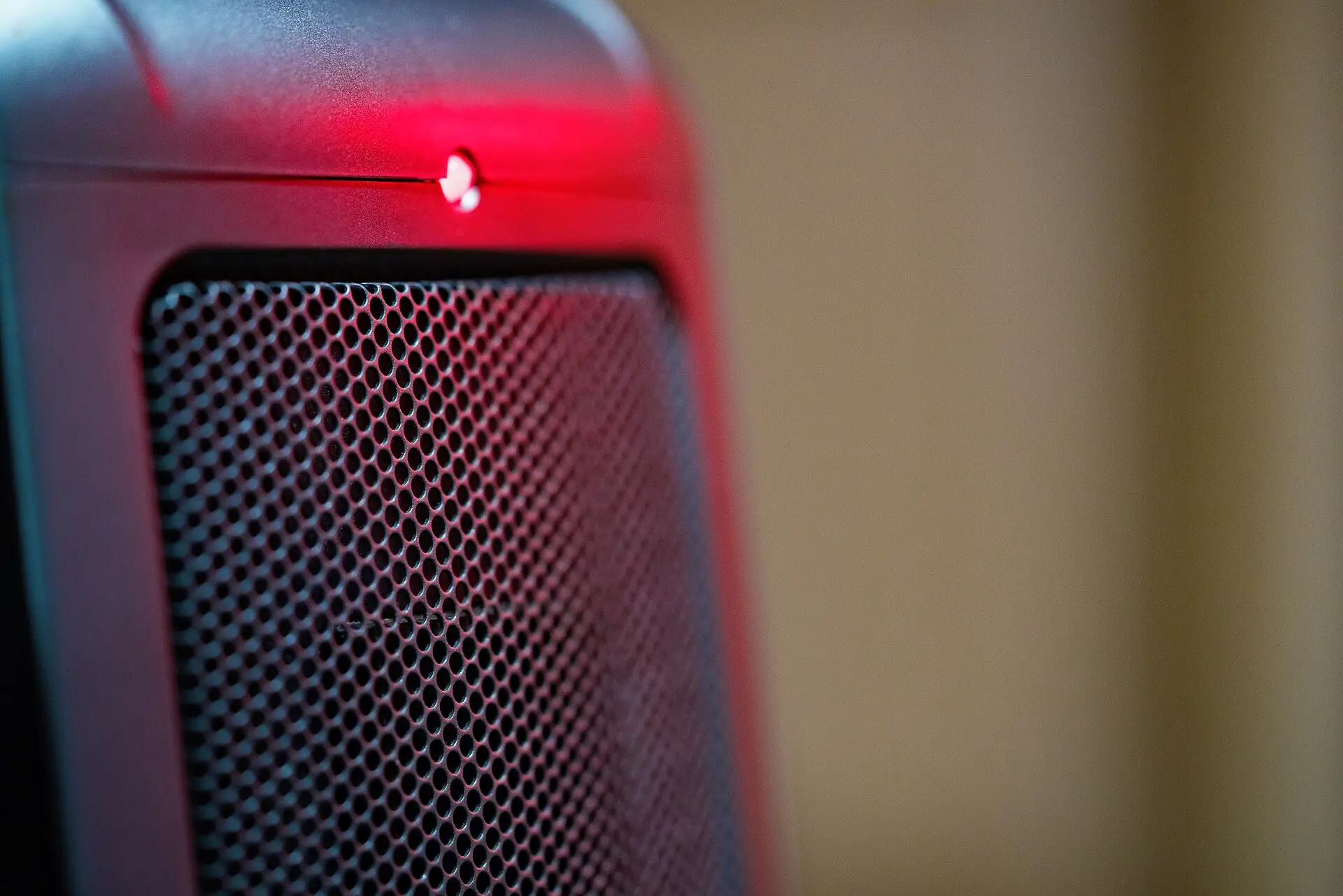
Every winter, the same question shows up: which space heater is cheapest to run? The honest answer is a little disappointing and very useful: at the same wattage, they all cost the same. A 1,500 W ceramic fan heater, a 1,500 W quartz infrared heater, and a 1,500 W oil-filled radiator each turn about 1.5 kWh of electricity into about 1.5 kWh of heat for every hour they run at full power. What you’re really choosing is how the heat reaches you — moving warm air, radiant warmth, or slow, steady heat — plus noise, safety, and cycling. Do the cost math at your rate and check it with a plug-in meter. Find out whether a space heater saves or costs money in your house before you pick a type.
Shopping for the cozy version? See electric fireplace cost to run (heat vs flame-only).
The one fact the ads leave out: ~100% efficient, all of them
Plug-in electric space heaters are resistance heaters. Electricity runs through a heating element (a ceramic PTC stone, a quartz tube, a coiled wire, or a wire inside sealed oil) and becomes heat. Practically all of the energy ends up as heat in your room — even the bit that runs the fan and display. That’s why resistance heat is called “~100% efficient” at the point of use — and why it’s still often expensive next to a heat pump.
That means:
- Watts decide the cost. A 1,500 W heater uses 1.5 kWh per hour at full power no matter what’s inside it. A 750 W setting uses 0.75 kWh per hour.
- Heat output is fixed by watts too. 1 W ≈ 3.412 Btu/h, so a 1,500 W heater makes about 5,100 Btu per hour. A listing that promises “60% more heat” from 1,500 W is describing distribution, not more energy.
- Thermal mass doesn’t create free heat. An oil-filled radiator keeps radiating after it clicks off because it stored heat while it was on. You paid for that heat already. It smooths the temperature swing; it doesn’t cut kWh.
- “ECO mode” isn’t magic either. ECO, ComfortTemp, and similar modes lower the wattage or cycle the element once the room reaches the setpoint. That can reduce overshoot — a real, small benefit — but a kWh is still a kWh.
What does change between types? How fast you feel warm, whether it heats the air or you, cycling, noise, surface heat, and tip risk. Those can change how many hours you run it and at what setting — the only way type affects your bill.
Cost math: watts × hours × your rate
The formula is the same for every heater:
Cost = (watts ÷ 1,000) × hours × your rate per kWh
Find your rate first. Take the total electric charges on a recent bill (energy, delivery, and riders — not just the “energy charge” line) and divide by the kWh used that month. That all-in number is what an extra kWh actually costs you. For context, the U.S. Energy Information Administration’s preliminary figure for the average U.S. residential price was 18.31¢ per kWh in July 2026 (EIA Electric Power Monthly, Table 5.3) — but state averages range from the low teens to well over 30¢, and your utility’s winter or tiered rates may be different again.
Worked examples (example rates — swap in your bill’s rate)
All numbers below use an example rate of $0.18/kWh (rounded from the EIA national average above) unless labeled otherwise. They’re arithmetic illustrations, not predictions of your bill.
| Scenario | kWh | Cost at $0.18/kWh |
|---|---|---|
| 1,500 W on High, 1 hour, element on the whole time | 1.5 | $0.27 |
| 750 W on Low, 1 hour | 0.75 | ~$0.14 |
| 1,500 W, 8-hour night, never cycles off (drafty room or no thermostat) | 12.0 | $2.16 |
| 1,500 W, 8-hour night, thermostat holds the room so the element is on ~50% of the time | 6.0 | $1.08 |
| 750 W, 4-hour evening, element on the whole time | 3.0 | $0.54 |
| 1,500 W ceramic at a desk, 2 hours/day on High, 22 workdays | 66.0 | $11.88/month |
| 1,500 W, 8 h/night at ~50% duty, 30 nights | 180 | $32.40/month |
Other example rates: at $0.12/kWh, 1,500 W costs $0.18 an hour; at $0.30/kWh, $0.45 an hour. Scale any row above by your rate ÷ 0.18.
The 50% duty cycle is invented to show a thermostat’s effect; real on-time depends on room size, insulation, drafts, weather, and setpoint. That’s why you measure.
Measure it with a Kill A Watt (10 minutes of setup, one real night)
- Read the label on the heater (bottom or back). Most US portable heaters max out at 1,500 W (~12.5 A at 120 V); many have a 600–900 W Low.
- Plug a Kill A Watt directly into the wall and the heater directly into the meter. No power strip or extension cord in the chain. If the meter or plug gets hot, stop.
- Run a normal evening or night the way you’d actually use it — same setting, same door open or closed.
- Read kWh and elapsed time in the morning. kWh ÷ hours = your real average draw. Multiply kWh by your all-in rate for the night’s cost.
- Repeat on a similar-weather night after you change something (lower setting, door closed, draft sealed, a plug-in thermostat, or a different heater) and compare kWh per hour.
A whole-home monitor or your utility’s hourly smart-meter data also shows whether the furnace or heat pump actually ran less that night.
When a space heater saves money — and when it costs more
The heater’s own cost is only half the story. The other half is what your central heat stops doing while the space heater runs.
It can save when you really zone-heat
A space heater lowers the bill only if you turn the whole-house thermostat down and heat just the room you’re in, with the door closed. The DOE says turning your thermostat back 7–10°F for 8 hours a day can save as much as 10% a year on heating (DOE) — that’s the central-heat savings a space heater can make livable. It works best when:
- Your central heat is expensive per unit of heat: an electric furnace or baseboard (same cost per kWh as a space heater, so heating one room instead of the whole house is a straightforward win), propane, or heating oil.
- You live in one or two rooms for long stretches — a home office, a bedroom at night, a den in the evening.
- The room holds heat: the door closes and obvious drafts are sealed (weatherstripping, window kits, outlet gaskets).
It often costs more in a heat-pump home
A heat pump moves heat instead of making it. DOE says heat pumps can provide up to three times more heat than the energy they use, and can reduce electricity use for heating by about 50% compared with electric furnaces or baseboard heaters (DOE Energy Saver guide, PDF). A space heater makes one unit of heat per unit of electricity.
Example math only: if your heat pump is running at an efficiency of about 2.5 units of heat per unit of electricity on a mild day, the 1.5 kWh of heat a space heater makes in an hour would take the heat pump about 0.6 kWh to deliver. At $0.18/kWh, that’s roughly $0.11 of heat-pump electricity vs $0.27 of space-heater electricity for the same warmth. One small closed room can still beat warming a big house, but it’s a close call, and in mild weather the heat pump usually wins.
Two caveats: on very cold days many heat pumps lean on backup resistance strips (AUX or EM heat), which cost about the same per kWh as a space heater; and DOE advises not setting a heat pump back manually if recovery triggers that backup heat. Check your thermostat’s recovery behavior before counting on a setback.
Gas furnace: it depends on your two rates
Compare cost per unit of delivered heat. One therm of natural gas is 100,000 Btu, about 29.3 kWh of heat. Divide your gas price per therm by (29.3 × the furnace’s efficiency):
- Example: $1.50/therm in a 95% efficient furnace → $1.50 ÷ (29.3 × 0.95) ≈ $0.054 per kWh of heat. In an older 80% furnace → about $0.064.
- At $0.18/kWh electricity, the space heater’s heat costs about 3× as much per unit as the gas furnace’s in this example.
Zone heating can still win in a gas home if one small room replaces a deep whole-house setback, but the margin is thin. Use your own gas and electric rates and the furnace’s AFUE from its label.
It always costs more when you stack heat
Leave the whole-house thermostat alone, add a 1,500 W heater, and you pay for both — the most common reason bills rise after buying one.
Ceramic vs infrared/quartz vs oil-filled: what actually differs
| Ceramic / fan-forced (PTC) | Infrared / quartz radiant | Oil-filled radiator | |
|---|---|---|---|
| How you feel it | Warm air blown at you, then the room | Radiant heat on skin and objects in its line of sight, almost instantly | Gentle, even warmth after a slow start; heats room air by convection plus some radiant |
| Warm-up | Fast (seconds to a minute) | Instant at close range | Slow (often 15–30+ minutes to feel the room change) |
| Cycling | Short on/off cycles, sometimes noticeable temperature swings | Short cycles; warmth stops quickly when it cycles off | Smooth; keeps radiating after it switches off |
| Noise | Fan noise (varies widely by model) | Quiet without a fan; many towers and cabinet models add one | Silent except light ticking as metal expands |
| Surface heat | Often cool-touch housing; hot air at the grille | Very hot, glowing elements behind a grille | Fins and body get hot to the touch |
| Best fit | Quick spot heat you’ll turn off when you leave: desk, bathroom (only if rated), mornings | Spot heat in drafty rooms, workshops, standing at a counter or desk | Long sessions in one closed room: bedroom, office, den |
| Watch-outs | Tip-over risk, dust smell, dry-feeling air for some people | Combustibles in front of it; poor match for bedding, curtains, toddlers | Slow to react; can’t be moved quickly; hot fins |
A note on “infrared cabinet” heaters. Many heavy wood-cabinet heaters sold as “infrared” (some with “copper heat exchangers”) blow air over quartz or PTC elements — effectively a quiet fan heater in a furniture box, still ~5,100 Btu/h at 1,500 W.
Can the type lower your bill indirectly?
Sometimes — through use, not efficiency:
- Radiant at a desk or drafty spot: a 750 W quartz heater aimed at your legs can replace a 1,500 W fan heater fighting a draft for the whole room.
- Fast heat you switch off: 20 minutes of ceramic while you dress can beat a slow oil heater left on all morning.
- Smooth cycling: oil-filled can overshoot less than a crude fan-heater dial — though a digital thermostat or plug-in thermostat narrows the gap.
- Fewer watts when enough: a heated mattress pad or under-desk heater uses a fraction of a room heater’s draw.
Measure with the Kill A Watt to know whether a change actually used fewer kWh.
Which type for which situation (buyer decision table)
| Your situation | Best-fit type | Why | Watch-out |
|---|---|---|---|
| Quick spot heat at a desk for an hour or two | Small ceramic, or a 750 W quartz infrared aimed at you | Fast; you feel it right away; easy to turn off | Keep paper and bags 3 ft away; consider a 90–235 W foot warmer first |
| Bedroom, evening and overnight | Oil-filled with thermostat/ECO and timer | Silent, steady, no glowing element | Hot fins; 3 ft from bedding and curtains; for sleep-only warmth a heated mattress pad uses far fewer watts |
| Drafty room you can’t fully seal yet | Infrared/quartz aimed at where you sit | Warms you, not the escaping air | Seal drafts anyway — any heater runs nonstop in a leaky room |
| Garage workbench or basement corner | Infrared/quartz | Spot heat without warming a huge, leaky space | Sawdust, solvents, and gas cans don’t belong near any heater; follow the manual on garage use |
| Kids or pets in the room | Ceramic with cool-touch housing, tip-over and overheat protection, and child lock; or an oil-filled unit placed out of reach | Fewer exposed hot surfaces | Supervision still required; no glowing quartz element at toddler height; secure cords |
| Heat-pump home in mild weather | Usually none — let the heat pump work | Heat pump heat is often cheaper per unit | Watch for AUX heat on cold-day recovery |
| The whole house is cold (failed furnace) | Call for repair; use heaters only as a short, supervised stopgap | A 1,500 W heater won’t heat a house | Never use gas ovens or grills indoors for heat |
Safety rules
Space heaters start home fires every winter when clearance and cord rules slip. Before you plug one in:
- Do not use an extension cord or power strip. Plug the heater directly into a wall outlet. ESFI’s guidance is the same: plug space heaters directly into the wall; extension cords and power strips can overheat (ESFI).
- Do not put anything within 3 feet of the heater — curtains, bedding, sofas, clothes, papers, boxes, or pet beds. Never dry clothes or towels on a heater. If the heater is there to keep a pet warm, a low-watt heated pet bed is safer and costs a small fraction as much to run.
- Do not buy a heater without tip-over shutoff and overheat protection.
- Do not buy an unlisted heater. Look for a mark from a nationally recognized testing lab — UL, ETL (Intertek), or CSA — on the product label, not just the listing.
- Do not leave a heater running unattended, or in a room where you’re sleeping, unless its manual explicitly allows it and you’ve accepted the risk. In particular, keep ceramic and quartz heaters well away from beds and bedding.
- Do not share the circuit with other big loads. A 15 A, 120 V circuit tops out at 1,800 W, and electricians size long-running loads at about 80% of that (~1,440 W). A 1,500 W heater on High should essentially have the circuit to itself — add a hair dryer, kettle, or second heater and the breaker trips, or a weak connection overheats.
- Do not keep using a heater whose plug, cord, or the outlet feels hot, discolors, or smells — unplug and have the outlet checked; replace a damaged heater.
- Do not run a cord under a rug, or set the heater on furniture or thick carpet unless the manual allows it.
- Do not use a heater in a bathroom, garage, or near water unless the manufacturer rates it for that location.
- Do not disable or bypass a tip-over switch because it trips on carpet — move the heater to a hard, level floor.
- Do keep working smoke alarms, and CO alarms if you have any fuel-burning appliances. Electric heaters don’t make CO, but they can start fires.
“Miracle heater” red flags (and what’s really going on)
Every fall brings ads for heaters that “cut your bill in half.” Physics sets hard limits on a plug-in heater: on a standard US outlet it’s capped near 1,500 W ≈ 5,100 Btu/h, and it can’t make more heat than the electricity it uses. Red flags:
| Claim | Reality |
|---|---|
| “Cuts your heating bill 50%” | Any savings come from turning the central heat down and heating one room — any inexpensive heater does that too. Added on top, it raises the bill. |
| “Uses less electricity than other heaters” | At the same watts and hours, every resistance heater uses the same kWh. Check the wattage on the label. |
| “Heats 1,000 sq ft” | 5,100 Btu/h warms one small-to-medium, reasonably sealed room in most climates — not a whole floor. |
| “Doesn’t burn oxygen / dry the air” | No electric heater burns oxygen. Warmer air holds the same moisture at lower relative humidity — that’s true for every heater. |
| “Patented copper / nano-ceramic / Amish-built heat exchanger” | Materials change looks, noise, and surface temperature, not how much heat a watt makes. |
| Tiny plug-in “outlet heaters” that “heat a whole room” | Low-watt plug-in cubes make a few hundred watts at most. Fine for a cold corner; not room heat. |
This isn’t hypothetical: in 2012 an advertising self-regulation program recommended that the marketer of one widely advertised portable heater discontinue claims about monthly savings it couldn’t support (Consumer Reports). Buy on safety features, controls, noise, and fit for the room, and let a Kill A Watt tell you what it costs.
Our picks
We earn a commission if you buy through these Amazon links, at no extra cost to you. Check size and fit on the listing before you order.
Measure firstP3 Kill A Watt P4400
Why: Turns “this heater feels cheaper” into kWh per night. Meter a normal night before and after any change.
- P3 P4400 Kill A Watt Electricity Usage Monitor Check price on Amazon
Ceramic, simplest desk/small-room pickLasko 754201 9” tabletop
Why: Compact 1,500 W ceramic with manual controls (two heat settings plus fan-only), listed tip-over switch, overheat protection, cool-touch housing, and ETL certification. Fast heat you turn off when you leave.
Watch-outs: “Tabletop” still needs 3 ft of clear space — a desk full of papers isn’t. For feet-and-legs only, a foot warmer uses far fewer watts.
- Lasko 9” Tabletop Ceramic Space Heater with Thermostat (754201) Check price on Amazon
Ceramic, best controlsDREO Atom One with digital thermostat
Why: Digital thermostat in 1°F steps (41–95°F), ECO mode, 70° oscillation, listed 37.5 dB, ETL-listed tip-over and overheat protection. A real numbered setpoint is what cuts fan-heater overshoot.
Watch-outs: “Save more on energy bills” means ECO modulates at the setpoint — useful, but still 1,500 W at full power. Digital units may wake in standby after a power cut, so skip an external plug-in thermostat.
- DREO Atom One Space Heater with Thermostat Check price on Amazon
Ceramic tower for a living roomLasko 751320 23” with remote
Why: Long-running, widely reviewed 1,500 W tower with wide oscillation, remote, 7-hour timer, self-regulating ceramic element, overheat protection, cool-touch housing, and ETL listing — moves warm air around a room instead of one spot.
Watch-outs: Fan noise; tall towers are easier to bump — hard, level floor, out of walkways. Use the timer.
- Lasko 23” Ceramic Tower Space Heater with Remote (751320) Check price on Amazon
Infrared/quartz budget spot heatBLACK+DECKER BHTI06
Why: Dual quartz tubes with a small fan, a true 750 W Low / 1,500 W High, adjustable manual thermostat, cool-touch housing, overheat and tip-over shutoff, about 5 lb. Aim it at a desk chair or drafty corner at half the watts.
Watch-outs: Glowing, very hot elements behind the grille — keep away from bedding, curtains, and small hands. Not an overnight bedroom heater.
- BLACK+DECKER Infrared Radiant Quartz Tower Heater (BHTI06) Check price on Amazon
Infrared, floor or wall-mountHeat Storm Phoenix HS-1500-PHX
Why: Highly rated, with 750 W and 1,500 W modes, a thermostat with ambient-temperature display, remote, and removable feet or wall mounting for tight rooms. Its listing states 5,200 Btu at 1,500 W — exactly what physics predicts.
Watch-outs: Ignore the “doesn’t reduce oxygen or humidity” framing — true of every electric heater. Follow the manual’s clearance and mounting rules; still wall-outlet power, no extension cord.
- Heat Storm Phoenix Infrared Space Heater, 750–1500 W Check price on Amazon
Infrared cabinet, quiet room heatDr Infrared DR-968
Why: Quartz tubes plus PTC elements with a blower, electronic thermostat (50–85°F), 12-hour auto shut-off, remote, casters, listed 39 dB, tip-over and overheat protection. Behaves like a quiet fan heater in a cabinet — good for a living room or office.
Watch-outs: The listing claims “60% more heat than others” while also listing about 5,200 Btu at 12.5 A / 1,500 W — the same heat as any 1,500 W heater. Buy it for quiet and controls. About 19 lb.
- Dr Infrared Heater DR-968 Portable Space Heater, 1500 W Check price on Amazon
Oil-filled, bedroom or officeDe’Longhi EW7707CM with ComfortTemp
Why: Widely reviewed, fanless, quiet oil radiator with simple controls and a ComfortTemp mode — De’Longhi’s own fine print compares it with the same unit at max thermostat, not with other heaters. Even heat for long sessions in one closed room.
Watch-outs: Slow to warm; pre-heat 30–60 minutes. Hot fins. Deep dive: oil-filled space heaters.
- De’Longhi EW7707CM Oil-Filled Radiator Heater, 1500 W Check price on Amazon
Oil-filled, mechanical controls + timerDe’Longhi TRD40615T Dragon
Why: Mechanical temperature and power controls, a 24-hour timer, and ECO Plus. Mechanical controls usually resume after a power cut, so it pairs well with an external plug-in thermostat — still run the unplug-and-replug restart test on arrival.
Watch-outs: Heavy; no remote; one room, not an open plan.
- De’Longhi TRD40615T Oil-Filled Radiant Heater, Mechanical Controls Check price on Amazon
Add-on for knob heatersEconoHome plug-in thermostat (15 A / 1,875 W)
Why: Cuts power at a real setpoint when your heater’s unnumbered dial overshoots. Listed 15 A / 1,875 W, heat/cool modes, ETL listed. Only with heaters that pass the restart test, plugged directly into the wall. Details: plug-in thermostats.
- EconoHome Adjustable Plug-In Heating & Cooling Thermostat Check price on Amazon
What we left out
- “Miracle” heaters with bill-cut percentages, square-footage promises far beyond 1,500 W, or no clear wattage on the listing.
- Heaters without tip-over and overheat protection or without a visible UL/ETL/CSA listing.
- Indoor use of propane or kerosene heaters — outside the scope of this electric-bill guide and a carbon-monoxide risk if misused.
Troubleshooting: “my space heater bill is too high”
| Symptom | Likely cause | Fix |
|---|---|---|
| Bill went up after buying a heater | Central thermostat never moved (stacked heat) | Lower the whole-house setpoint on a schedule while you zone-heat; meter the heater |
| Heater runs nonstop and the room never warms | Drafts, open door, room too big for 1,500 W | Close the door; seal drafts; switch to radiant aimed at you; accept that one heater can’t heat an open plan |
| Room overshoots, then you turn it down, then it’s cold | Crude dial thermostat | Use a numbered digital thermostat or a plug-in thermostat at seated height |
| Oil-filled heater “takes forever” | Normal thermal mass | Pre-heat with a timer; close the door; don’t crank it to High and forget it |
| Breaker trips | Other loads on the same 15 A circuit | Move to a less-loaded circuit; never add a strip; repeated trips with the heater alone → electrician |
| Plug or outlet feels hot | Worn receptacle, loose plug, or a strip/cord in the chain | Unplug; remove the cord/strip; have the outlet replaced |
| Heat-pump home bill rose | Resistance heat replacing cheaper heat-pump heat, or AUX heat on recovery | Let the heat pump carry the house in mild weather; check thermostat recovery settings |
What this won’t fix
- No type is more efficient than another at the same watts. Anyone claiming otherwise is selling something.
- A space heater is a zone tool. It saves money only when the central heat runs less — and in heat-pump and many gas homes, the math is tight or negative.
- A 1,500 W heater heats one room, not a house, and can’t keep up with a very drafty room.
- Duty cycles in our examples are invented to show the arithmetic. Your Kill A Watt reading replaces them.
- Safety beats savings. No bill trim is worth a fire; follow the safety rules and your manual.
- No universal number. Rates, climate, insulation, and habits vary too much for honest “you’ll save $X” claims.
Checklist before you buy (or before you plug in)
- All-in electric rate from your bill written down (and gas rate per therm if you have gas heat)
- Know your central heat type: electric resistance, heat pump (with AUX?), gas, propane, or oil
- One room picked, door closes, obvious drafts sealed
- Plan to lower the whole-house thermostat while the heater runs
- Heater has tip-over + overheat protection and a UL/ETL/CSA mark
- Wall outlet on a lightly loaded circuit, 3 ft clearance, no cords or strips
- Kill A Watt reading for one normal night, then again after any change
FAQ
Which type of space heater is cheapest to run — ceramic, infrared, or oil-filled?
At the same wattage and the same hours, none of them. Every plug-in resistance heater turns essentially all of the electricity it draws into heat, so a 1,500 W ceramic, a 1,500 W quartz infrared, and a 1,500 W oil-filled radiator each use 1.5 kWh per hour of full-power running. Type changes how the heat reaches you, noise, warm-up speed, and cycling — not efficiency. The cheapest heater is the one that keeps you comfortable at the lowest setting for the fewest hours.
How much does it cost to run a 1,500 W space heater?
Multiply kilowatts by hours by your rate. A 1,500 W heater running flat out uses 1.5 kWh per hour, so at an example rate of $0.18 per kWh it costs about $0.27 an hour, or $2.16 for eight hours. On Low (often 750 W) it’s about half that. Thermostats cycle the element off once the room warms, so real use is usually lower. Use your bill’s all-in rate (total electric charges ÷ kWh) and measure a real night with a plug-in meter like a Kill A Watt.
Does a space heater save money compared to central heat?
Only when it lets you turn the central heat down. Heating one closed room while the whole-house thermostat drops can cost less than heating every room, especially if your central heat is electric resistance, propane, or oil. Added on top of an unchanged thermostat, it’s extra load. In heat-pump homes, resistance heat often costs more per unit of warmth than the heat pump, which the U.S. Department of Energy says can deliver up to three times more heat than the electricity it uses. With a gas furnace, it depends on your gas and electric rates.
Are infrared heaters more energy efficient?
Not in the sense the ads imply. An infrared or quartz heater still turns 1,500 W into about 5,100 Btu per hour, the same as any other 1,500 W heater. It heats people and objects in its line of sight, so you feel warm quickly in a drafty room or at a desk. That can let you run it fewer hours or on Low — a usage change, not a more efficient heater. Big wooden-cabinet “infrared” heaters usually push fan-forced air over quartz or PTC elements, so they behave more like a fan heater.
Which space heater type is safest for a bedroom or a home with kids and pets?
No type is safe without clearance and supervision, but the risks differ. Oil-filled radiators have no glowing element and are quiet for bedrooms, but their fins get hot and they’re heavy to knock over. Ceramic heaters often have cool-touch housings but blow hot air and can tip. Quartz infrared heaters have very hot, visible elements behind a grille and are a poor match for bedding, curtains, and curious toddlers. Whatever you pick: tip-over and overheat protection, a UL, ETL, or CSA listing mark, plugged directly into a wall outlet, 3 feet of clearance, and never left running unattended or near bedding while you sleep.
Do “cut your heating bill 50%” heaters really work?
Be skeptical. A plug-in heater can’t produce more heat than the electricity it uses, and on a standard 120 V outlet it’s limited to about 1,500 W, roughly 5,100 Btu per hour, no matter what the heat exchanger is made of. Real savings come from heating fewer rooms while you lower the central thermostat — any inexpensive heater does that. In 2012, an advertising self-regulation program recommended that one heavily advertised heater’s marketer discontinue unsupported monthly-savings claims. Treat “heats 1,000 sq ft,” “uses less electricity than other heaters,” and “doesn’t burn oxygen” as marketing, not math.
Sources
- U.S. Energy Information Administration, Electric Power Monthly, Table 5.3 — average U.S. residential price 18.31¢/kWh, July 2026 (preliminary)
- U.S. DOE, Energy Saver guide (PDF) — heat pumps provide up to three times more heat than the energy they use and can cut heating electricity about 50% vs electric furnaces/baseboard; avoid setbacks that trigger backup resistance heat
- U.S. DOE, Six Simple Steps To Save Energy and Money This Winter — 7–10°F setback for 8 hours a day, up to 10% a year on heating
- Electrical Safety Foundation International (ESFI), Space Heater Safety Tips — wall outlet only, no extension cords or power strips, three-foot clearance, never leave unattended
- Consumer Reports, Ad watchdog tells EdenPure to tone down space heater claims (2012)
- Unit conversions: 1 W ≈ 3.412 Btu/h; 1 therm = 100,000 Btu ≈ 29.3 kWh
- Product features (watts, settings, safety features, listings) are from each Amazon listing at the time of writing; confirm on the label and manual before use
Related reading
- Heat pump aux heat settings — in a heat-pump home, fix eager backup strips before adding plug-in resistance heat
- Oil-filled space heaters / zone heating — deep dive on the quiet, all-evening option and the setback plan
- Plug-in thermostats for space heaters — hold a real setpoint on a knob-control heater
- Kill A Watt & plug-in energy meters — measure kWh per night before and after any change
- Under-desk heaters & heated foot warmers — 90–235 W personal heat instead of a 1,500 W room heater
- Heated mattress pads for zone heating — warm the bed, not the bedroom air
- Best smart thermostats (2026) — schedule the whole-house setback that creates the savings
- Best weatherstripping and door draft stoppers — stop the draft that keeps any heater running
- Lower your electric bill: priority checklist — this-month order of operations
- Start Here — full suggested reading order
Bottom line
Ceramic, infrared/quartz, and oil-filled space heaters all cost the same per hour at the same wattage — watts × hours × your rate. Pick the type for the room: ceramic for quick spot heat you’ll switch off, infrared/quartz for warming yourself in a drafty spot, oil-filled for quiet, steady heat in one closed room. The bill only goes down when the central heat goes down with it, and in heat-pump homes (and often gas homes) resistance heat is the pricier heat. Find your all-in rate → meter a real night with a Kill A Watt → lower the whole-house setpoint → wall outlet, 3 ft clearance, tip-over protection, never unattended. Amazon links may earn a commission as an Associate (disclosure). Return to Start Here or the priority checklist for order of operations.
Some links on this page go to Amazon, and we earn a commission if you buy, at no extra cost to you. Prices and savings vary by home and utility rate. More in our disclosure.