Heating a garage is one of those jobs where the heater gets all the attention and the building does most of the deciding. The same 5,000-watt heater can cost a few dollars for a Saturday project in an insulated attached garage, or a few hundred dollars a month keeping an uninsulated detached one warm. Before buying anything, it helps to know what an hour of heat costs with each fuel, and how much of that heat your garage is going to leak out the door.
The short version
- Heat when you use the space, not around the clock. Keeping an uninsulated garage warm all winter is where bills get ugly.
- Fix the door before you size the heater. A foam panel kit and a new bottom seal are cheap and make every heater work less.
- For a 2-car garage, plan on a 240-volt electric heater on its own circuit, or an indoor-safe propane heater on a 20-pound tank with ventilation and a CO alarm.
- Skip 1-pound propane bottles for regular use. Per unit of heat, they cost several times more than a refilled tank.
- If you use the garage most days, price out a mini-split heat pump. It costs more up front and far less to run.
What a garage heater costs per hour
Electric heaters are simple: every watt in becomes heat. Find your real rate by dividing your bill’s total charge by the kWh used. We use $0.17/kWh as an illustrative US average.
Cost per hour at full power:
| Heater | $0.12/kWh | $0.17/kWh | $0.25/kWh |
|---|---|---|---|
| 1,500 W (120-volt plug-in or wall heater) | $0.18 | $0.26 | $0.38 |
| 4,000 W | $0.48 | $0.68 | $1.00 |
| 5,000 W (typical 240-volt garage heater) | $0.60 | $0.85 | $1.25 |
| 5,600 W | $0.67 | $0.95 | $1.40 |
| 7,500 W | $0.90 | $1.28 | $1.88 |
That’s the most an hour can cost. Once the garage reaches the thermostat setting, the heater cycles, so a warm, insulated garage might only run half the time. A cold, leaky one may never shut off.
Electric vs propane vs heat pump
Comparing fuels is easier per 100,000 BTU of heat delivered. A kilowatt-hour is 3,412 BTU, and a gallon of propane holds about 91,500 BTU.
| Heat source | Price assumption | Cost per 100,000 BTU |
|---|---|---|
| Electric heater (any kind) | $0.12 / $0.17 / $0.25 per kWh | $3.52 / $4.98 / $7.33 |
| Mini-split heat pump, average COP 2.5 | $0.12 / $0.17 / $0.25 per kWh | $1.41 / $1.99 / $2.93 |
| Indoor-safe propane heater, 20-lb tank | $2.50 / $3.00 / $3.50 per gallon | $2.73 / $3.28 / $3.83 |
| Indoor-safe propane heater, 1-lb bottles | $5 per bottle | about $23 |
| Vented natural gas unit heater, 80% efficient | $1.00 / $1.50 / $2.00 per therm | $1.25 / $1.88 / $2.50 |
A few things that table doesn’t show:
- Unvented propane heaters put all their heat into the room, but they also put combustion gases and water vapor there. Burning a gallon of propane releases most of a gallon of water, which condenses on cold tools, cars and windows. That’s why they need ventilation, and the ventilation lets some heat out.
- Infrared electric heaters don’t use less electricity per BTU. They warm you and the surfaces in front of them instead of the air, which can feel better in a drafty garage when you’re standing in one spot.
- Gas unit heaters and mini-splits are permanent installs that need a licensed pro. They’re the cheapest to run, so they make sense for spaces you heat often.
Why the garage matters more than the heater
A typical attached garage has a thin steel door, uninsulated walls on two or three sides, a concrete slab, and a gap under the door you could slide a hand through. The heat you need depends on that gap between inside and outside temperature, multiplied by how leaky the building is.
A common rule of thumb for sizing electric heat in an insulated garage with an 8-foot ceiling is about 10 watts per square foot. That puts a 2-car garage of 400 to 500 square feet around 4,000 to 5,000 watts, which is why so many garage heaters are 5,000 watts. Uninsulated walls, high ceilings, very cold weather and a drafty door can push the real need much higher. A heater that’s too small will run constantly and never get the space warm, which costs more than a properly sized one that cycles off.
What to do first
- Decide how you’ll use the space. A few hours on weekends calls for a heater that warms up fast. A daily home gym or office calls for something cheap to run, plus insulation.
- Seal the bottom of the door. A worn bottom seal lets cold air pour in at floor level. Our garage door seal guide covers which type fits your door.
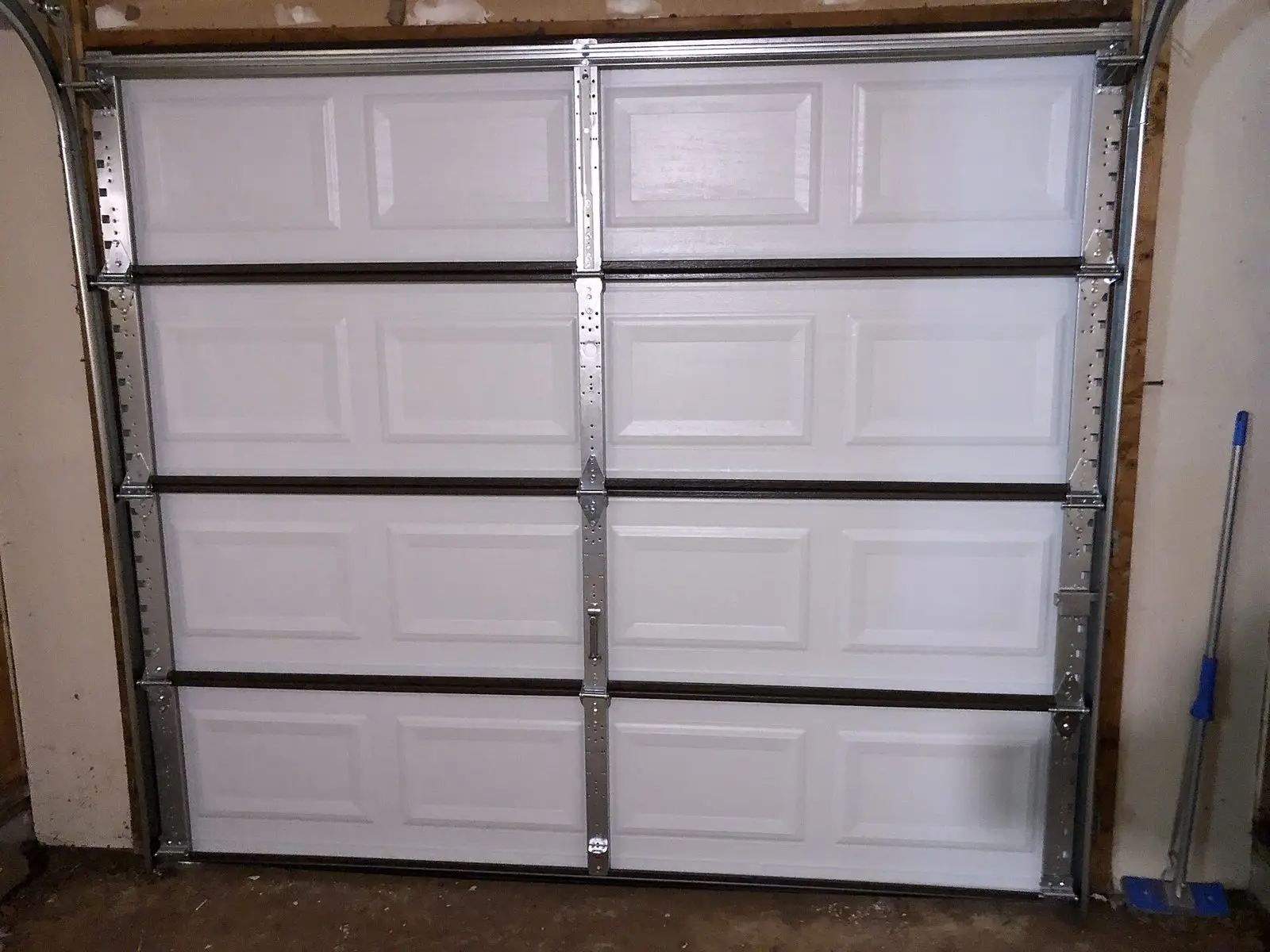
- Insulate the door if it’s bare steel. Foam panel kits fit standard pan-style doors and take an afternoon.
- Weatherstrip the door between the garage and the house. In an attached garage, that door leaks heated house air out, and lets car exhaust and fumes in. See our weatherstripping guide.
- Check your circuits. Most 5,000-watt heaters need a dedicated 240-volt, 30-amp circuit. If your panel has no room, that changes the plan.
- Then pick the heater.
What not to do
- Don’t use outdoor-only heaters indoors. Torpedo heaters, patio heaters and charcoal or kerosene heaters aren’t for a closed garage.
- Don’t bring a refillable propane tank indoors. Mr. Heater’s own manual says this can cause a fire or explosion. Use the approved hose so the tank stays outside.
- Don’t run a 240-volt heater on an extension cord or adapter, and don’t run a plug-in heater on a power strip.
- Don’t store gas cans, solvents or paint thinner near any heater. Gasoline vapor is heavier than air and settles near the floor.
- Don’t leave the heater running in an empty garage just to keep it warm, unless something in there truly can’t freeze.
- Don’t cut corners on wiring. Have an electrician install the circuit and the heater if you’re not certain it meets code.
Which one should you buy?
If you have a 240-volt circuit or can add one, a 5,000-watt hardwired ceiling heater is the most common fit for a 2-car garage. It stays out of the way, aims down at your work area, and has a built-in thermostat.
If you want electric heat without hardwiring, a 240-volt portable with a 30-amp plug works the same way once an electrician installs the matching outlet.
If you need more output for a big or poorly insulated space and you have a 40-amp circuit available, step up to a 7,500-watt unit.
If you only have a regular 120-volt outlet, a 1,500-watt wall or floor heater will warm a corner or a small insulated garage. Don’t expect it to heat a cold 2-car garage.
If you have no 240-volt option and heat for a few hours at a time, an indoor-safe propane heater on a 20-pound tank is often the cheapest per hour. Ventilate as the manual says and put a CO alarm in the garage.
Our picks
These are good starting points. Check the manual for wiring, clearances and approved locations before buying, and match the heater to your circuit.
Best hardwired garage heaterComfort Zone CZ220
A 5,000-watt, 240-volt ceiling-mount heater with 3,000, 4,000 and 5,000-watt settings, a tilting bracket and a built-in thermostat. The manual calls for hardwiring to a 30-amp breaker with 10-gauge copper wire, so plan on an electrician unless you’ve done this before. It’s a good size for a typical insulated 2-car garage.
- Comfort Zone CZ220 5,000 W ceiling-mount garage heater Check price on Amazon
Best 240-volt plug-inDr. Infrared DR-988
A 5,600-watt heater with a thermostat that goes as low as 37°F, handy for keeping a garage just above freezing. It uses a NEMA 6-30 plug, so you need a matching 30-amp, 240-volt outlet. The listing mentions wall and ceiling mounting, but the manual we read says floor use only, so follow the manual that comes in your box.
- Dr. Infrared DR-988 5,600 W 240-volt garage heater Check price on Amazon
For larger or colder garagesDr. Infrared DR-975
A 7,500-watt hardwired wall or ceiling heater with a remote, a 4,700-watt low setting and a timer. It needs a dedicated 40-amp, 240-volt circuit with 8-gauge copper wire, so it’s a bigger electrical job. The timer helps you avoid heating an empty garage.
- Dr. Infrared DR-975 7,500 W hardwired garage heater Check price on Amazon
Best 120-volt optionHeat Storm Phoenix wall heater
A 750 or 1,500-watt infrared heater that mounts on a wall or stands on feet. Heat Storm says it can go in a finished garage with drywall, and recommends a dedicated 15-amp circuit. Good for a workbench corner, a small insulated garage or a home gym. The Wi-Fi version lets you warm it up before you head out.
- Heat Storm HS-1500-PHX-WIFI infrared wall heater Check price on Amazon
Best propane heaterMr. Heater Big Buddy
An indoor-safe 4,000, 9,000 or 18,000 BTU radiant heater with a low-oxygen sensor and tip-over shutoff. It runs on two 1-pound bottles or, with an approved hose and filter, a 20-pound tank that stays outside. Use the tank for regular use, because the bottles cost far more per hour. Mr. Heater lists a 7,000-foot elevation limit.
- Mr. Heater Big Buddy 18,000 BTU indoor-safe propane heater Check price on Amazon
- Mr. Heater Buddy 9,000 BTU (smaller spaces) Check price on Amazon
Don’t skip thisa carbon monoxide alarm
If you use any fuel-burning heater, or park a car in an attached garage, put a CO alarm in the garage and one in the room next to it. A plug-in model with battery backup keeps working if the power goes out.
- First Alert CO605 plug-in carbon monoxide alarm with battery backup Check price on Amazon
Garage door insulation kits
The Matador kit uses 1.25-inch foam panels that press into the frames of standard pan-style 8 and 9-foot doors, with no glue or tape, and the listing puts them at R-4.8. The Reach Barrier kit is a thinner reflective bubble panel that sticks on with adhesive pads. It’s easier to fit on odd doors, but it adds less insulation. Buy two kits for a double door.
- Matador garage door insulation kit, 8 foam panels Check price on Amazon
- Reach Barrier 3009 reflective garage door insulation kit Check price on Amazon
To see what it actually costsa circuit monitor
A plug-in meter can’t read a 240-volt heater. A home energy monitor with a sensor on the heater’s breaker shows exactly what each cold weekend costs. Have someone qualified install it in the panel.
- Emporia Vue 3 home energy monitor Check price on Amazon
Four example garages
These are worked examples with round numbers, not measurements. Your climate, insulation and habits will change the results.
The weekend project garage. An insulated attached 2-car garage, a 5,000-watt ceiling heater, 4 hours on Saturday and Sunday. After the first half hour the heater averages about 3,000 watts. That’s about 24 kWh a weekend, roughly $4 at $0.17/kWh, or about $70 over a 17-week winter.
The morning home gym. A 1,500-watt wall heater aimed at a workout corner, 1 hour a day, running the whole time. That’s 45 kWh a month, about $7.65 at $0.17/kWh. A small heater pointed at you is a much better deal here than warming the whole garage.
The detached shop held at 50°F all winter. An uninsulated detached garage in a cold climate with a 5,000-watt heater that averages half power around the clock. That’s about 1,825 kWh a month, roughly $310 at $0.17/kWh and $219 at $0.12. This is where insulation, a lower setpoint, or a heat pump pay off fastest.
The propane Saturday. A Big Buddy on high for 3 hours, fed from a 20-pound tank outside. 54,000 BTU is about 0.6 gallons, roughly $1.80 at $3 a gallon. Running the same 3 hours on 1-pound bottles uses 2.5 bottles, about $12.50 at $5 each.
Settings and habits that cut the bill
Warm it up, then turn it down
Most garages don’t need to be heated when nobody is in them. Turn the heater on 30 to 60 minutes before you start, and turn it off or way down when you’re done. A heater with a timer or Wi-Fi control makes that easy.
If the main reason you heat the garage is so the car starts on cold mornings, a block heater on an outdoor timer does that for pennies a day. Our block heater guide has the cost per morning and the timer setup.
Pick a setpoint you’ll actually work at
The difference between 55°F and 65°F in a garage is big, because the gap to the outdoors is already large and the walls leak heat quickly. Dress for the work and keep the garage cooler than your house. Our setback math guide explains why every degree of gap counts.
Aim the heat where you are
Point a ceiling heater’s louvers at your bench, not the middle of the floor. A radiant heater facing you feels warmer at a lower air temperature, which is the whole point in a space you can’t fully seal.
Freeze protection only
If something in the garage can’t freeze, like a laundry sink, a water heater or latex paint, set the thermostat to the lowest setting that protects it, often around 40°F, instead of a comfortable temperature. Pipe heat tape on just the exposed lines may be cheaper than heating the room. See our pipe heat tape guide.
If the heater is only running overnight because a dog or cat sleeps out there, heat the bed instead of the room. A 40-watt heated pad costs about 16¢ a day at $0.17/kWh even if it never shuts off. Our heated pet bed guide has the numbers and picks.
Wiring and safety basics
- Most 5,000 to 5,600-watt heaters need a dedicated 240-volt, 30-amp circuit. 7,500-watt units usually need 40 amps.
- A 1,500-watt plug-in draws about 12.5 amps on a 120-volt circuit. On a 15-amp garage circuit shared with a freezer or tools, it may trip the breaker.
- Mount ceiling heaters with the clearances the manual lists, and keep anything that burns away from the front of any heater.
- Never block a propane heater’s air intake or use it while sleeping. Follow the ventilation requirement in the manual.
- Keep a CO alarm in the garage if you burn fuel there or start a car in it.
Troubleshooting
| Symptom | Likely cause | Fix |
|---|---|---|
| Heater runs nonstop and the garage never warms up | Heater too small for the space, or the door and walls leak too much heat | Seal and insulate the door, warm a smaller work area, or size up |
| Breaker trips when the heater starts | Shared or undersized circuit | Move it to a dedicated circuit; have an electrician check the wiring |
| Windows and tools drip with condensation | Unvented propane heater adding water vapor | Increase ventilation, run a fan, or switch to electric heat |
| Propane heater keeps shutting off | Low-oxygen sensor tripping, high altitude, or a cold, low tank | Open more ventilation, check the elevation limit, use a 20-pound tank |
| Garage feels warm near the ceiling but cold at the floor | Hot air stratifying, draft under the door | Angle the louvers down, run the fan, replace the bottom seal |
| Electric bill jumped after adding a heater | Heater left on when nobody is out there, or set too high | Add a timer, lower the setpoint, and check usage on your utility’s hourly data |
Bottom line
The cheapest garage heat is the heat you don’t need. Seal and insulate the door, heat only while you’re out there, and keep the setpoint modest. For a 2-car garage, a 5,000-watt 240-volt heater is the usual answer; a propane heater on a 20-pound tank can cost less per hour if you ventilate properly and use a CO alarm. If you heat the space most days, a heat pump is worth pricing out. For heating in the rest of the house, compare options in our space heater cost guide, or start with the priority checklist.
Some links on this page go to Amazon, and we earn a commission if you buy, at no extra cost to you. Prices and savings vary by home and utility rate. More in our disclosure.