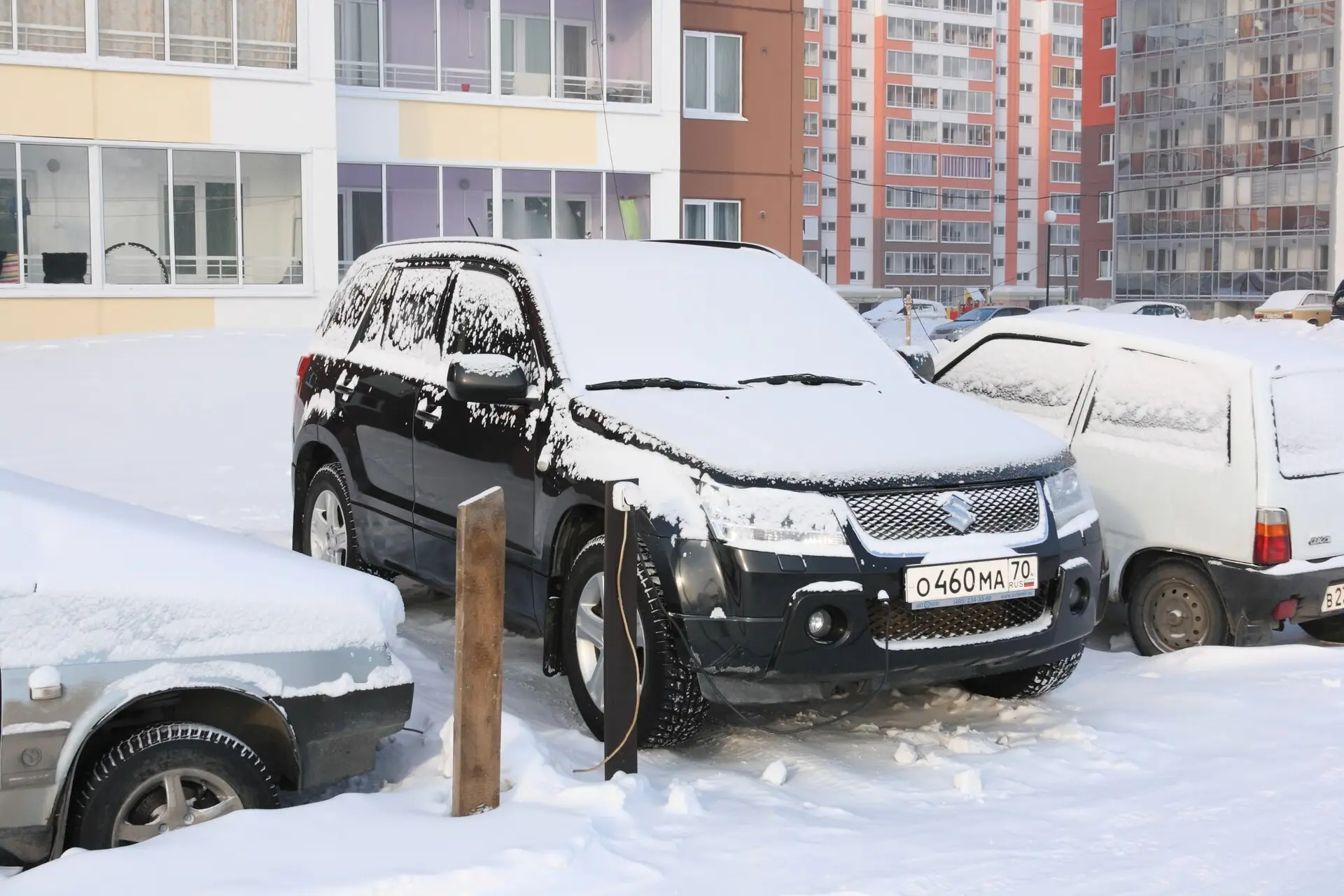
If you live where winter mornings start below zero, the block heater is one of the most useful things on your car. It keeps the coolant warm so the engine turns over easily, the oil flows right away and the defroster blows warm air before you reach the end of the street. It’s also an easy way to waste electricity, because most people plug in when they get home and unplug when they leave, and the heater draws full power the whole time.
A block heater only needs a couple of hours to do its job. Here’s what it costs to run per morning and per winter, how much a timer saves, and the timers and cords that hold up in hard cold.
The short version
- Car block heaters are usually 400 to 600 watts. V8 trucks often use 600 to 1,000 watts, and diesel pickups can be 1,000 to 1,500 watts.
- Two hours of plugging in is enough on most cold mornings. Overnight is five to six times the electricity for almost the same result.
- A 1,000-watt heater plugged in overnight for 100 winter nights costs about $204 at $0.17/kWh. On a two-hour timer it’s about $34.
- A $15 to $25 outdoor timer usually pays for itself in the first few weeks of real cold.
- Use an outdoor-rated timer and a cold-weather extension cord, and plug into a GFCI-protected outlet.
What a block heater costs per morning
Find your real electric rate by dividing your bill’s total by the kWh you used. We use $0.17/kWh as a rough US average. Most block heaters have no thermostat of their own, so they draw their full rating for as long as they’re plugged in. The wattage is usually stamped on the heater or printed in the owner’s manual.
These are costs for one morning at $0.17/kWh. “Overnight” means plugged in from 6 p.m. to 6 a.m.
| Heater | 2 hours | 3 hours | Overnight, 12 hours |
|---|---|---|---|
| 400 W, small car | 0.8 kWh, $0.14 | 1.2 kWh, $0.20 | 4.8 kWh, $0.82 |
| 600 W, larger car or SUV | 1.2 kWh, $0.20 | 1.8 kWh, $0.31 | 7.2 kWh, $1.22 |
| 750 W, V8 truck | 1.5 kWh, $0.26 | 2.25 kWh, $0.38 | 9 kWh, $1.53 |
| 1,000 W, truck | 2 kWh, $0.34 | 3 kWh, $0.51 | 12 kWh, $2.04 |
| 1,500 W, diesel pickup | 3 kWh, $0.51 | 4.5 kWh, $0.77 | 18 kWh, $3.06 |
On any one morning these numbers look trivial. The problem is that they repeat every cold night of the winter.
What it costs over a winter
How many nights you plug in depends on where you live. Someone in Minneapolis or Edmonton might plug in 100 to 120 nights a year. Someone in Denver might only need it for 20 or 30 of the coldest mornings. Here’s a 100-night winter at $0.17/kWh:
| Heater | 2-hour timer | 3-hour timer | Overnight | Timer saves (2 hours vs overnight) |
|---|---|---|---|---|
| 400 W | $13.60 | $20.40 | $81.60 | $68 |
| 600 W | $20.40 | $30.60 | $122.40 | $102 |
| 750 W | $25.50 | $38.25 | $153.00 | $127.50 |
| 1,000 W | $34.00 | $51.00 | $204.00 | $170 |
| 1,500 W | $51.00 | $76.50 | $306.00 | $255 |
And here’s the same 1,000-watt truck heater at cheaper and pricier rates, still 100 nights:
| How you plug in | kWh for the winter | $0.12/kWh | $0.17/kWh | $0.25/kWh |
|---|---|---|---|---|
| 2-hour timer | 200 | $24 | $34 | $50 |
| 3-hour timer | 300 | $36 | $51 | $75 |
| Overnight, 12 hours | 1,200 | $144 | $204 | $300 |
Utilities have been making this point for years. Wisconsin Public Service and We Energies both tell farm customers that a block heater takes only one to two hours to warm a tractor engine, and that a simple timer usually pays for itself in one to three months.
Why two hours is enough
A block heater warms the coolant, and the coolant warms the block and the oil. In the first hour or two, the engine absorbs most of that heat and its temperature climbs. After that, the engine is losing heat to the cold air about as fast as the heater adds it, so the temperature levels off. Every hour after that point is mostly paying to replace heat that drifts away into the night.
Natural Resources Canada puts it plainly: get an automatic timer that switches the heater on two hours before you drive instead of leaving it plugged in all night, because that’s usually all the time needed to warm the coolant and the engine. Woods, which makes one of the common block heater timers, tells buyers to set theirs for two to three hours before departure.
The one time to give it longer is in serious cold. At -20°F and below, or with a big diesel, three or four hours is reasonable. That’s still a third of what overnight costs.
Is it worth plugging in at all?
For most cold-climate drivers, yes. Natural Resources Canada says that at -20°C (-4°F) a block heater can improve overall fuel economy by as much as 10 percent, and that for a single short trip at -25°C (-13°F) the savings can be around 25 percent. Cold starts are also hard on an engine, because thick oil takes longer to reach the parts that need it.
There’s a clean-air case too. Anchorage, which deals with winter carbon monoxide build-up, runs a campaign called Plug at 20 that asks drivers to plug in when it’s 20°F or colder. The city cites local testing showing that preheating an engine for two to three hours before starting cuts carbon monoxide from the cold start by nearly 60 percent.
Compare it with idling. The U.S. Department of Energy says idling uses about a quarter to a half gallon of fuel an hour, depending on the engine. Fifteen minutes of idling in the driveway costs roughly 20¢ to 40¢ at $3.10 a gallon, and the engine still isn’t fully warm. A 400-watt heater on a two-hour timer costs about 14¢ at $0.17/kWh.
What to do first
- Find out whether your vehicle already has a block heater. Look for a plug tucked behind the grille or bumper, or a cold-weather package on the window sticker. Many trucks and cars sold in cold states have one from the factory.
- Find the wattage. It’s often on the heater, in the owner’s manual, or on the parts listing for your engine.
- Check the outlet. Outdoor outlets should be GFCI-protected and have an in-use cover that closes over a plugged-in cord. If you don’t have an outlet near where you park, have one added rather than running a cord out a window.
- Get an outdoor timer rated for at least 15 amps and set it to come on two hours before you usually leave, or three to four hours on the coldest days.
- Use a cold-weather extension cord sized for the heater, and keep the connection off the ground.
- Test the setup before the first deep freeze. Plug a lamp into the timer to check it switches, and make sure the heater actually warms the engine.
What not to do
- Don’t leave the heater plugged in from evening to morning by default. That’s where almost all the wasted money goes.
- Don’t use an indoor timer or a light-duty indoor extension cord outdoors.
- Don’t use a photocell timer. It turns on at dusk, which is the opposite of what you want.
- Don’t load one timer past its rating. Most outdoor plug-in timers are rated 15 amps, or 1,875 watts. Two 1,000-watt heaters on one timer is too much.
- Don’t drive off with the cord plugged in. Hang the plug end on the mirror or door handle as a reminder.
- Don’t tape over a cracked cord or a melted plug. Replace it.
- Don’t cut into coolant hoses or pull a frost plug yourself unless you know what you’re doing. Installed block heaters are a mechanic job on most engines.
Timers: which kind to get
| Timer type | How it works | Good for | Watch-outs |
|---|---|---|---|
| Outdoor 24-hour mechanical dial | Push pins down for each 30-minute block you want on | Cheap, simple, no batteries or Wi-Fi | Drifts after a power outage until you reset the clock |
| Outdoor digital block heater timer | One on and one off time a day, set with two buttons | Same schedule every morning | Some lose their settings when unplugged |
| Outdoor 7-day digital | Several programs, different days | Weekday commute, no heater on weekends | More buttons to learn |
| Outdoor Wi-Fi smart plug | App schedules, remote on and off | Changing plans, turning it on early from bed | Needs Wi-Fi outside; check its cold rating |
One detail worth knowing: Woods’ manual for its digital block heater timer says it isn’t for permanent installation and shouldn’t be installed for more than 90 days a year. For a setup you want to leave in place year-round, an electrician can install a hardwired outdoor timer or a switched outlet.
Which one should you buy?
If your vehicle already has a block heater and you have an outdoor outlet, buy a timer. Nothing else on this page saves as much.
For one car with the same morning schedule every day, a basic outdoor mechanical timer or the Woods digital block heater timer is all you need. If your schedule changes or you’d like to start the heater from bed when it turns out colder than forecast, the Kasa outdoor smart plug does that from your phone, as long as your Wi-Fi reaches the driveway and it doesn’t routinely get colder than its -4°F rating where you live. In colder places than that, stick with a mechanical timer.
If you’re using a short, light extension cord now, replace it with a 12-gauge cold-weather cord. It stays flexible well below zero and has headroom for a big truck heater.
If your car has no block heater, the first thing to price is a heater made for your engine, installed by a mechanic. Battery warmers and oil pan heaters are cheap add-ons that help, especially on diesels and older batteries.
And if your car mostly sits, a battery maintainer is the better buy. A weak battery is behind a lot of cold no-starts.
Our picks
Check the amp and watt ratings on the listing, and make sure anything you put outside is rated for outdoor use.
Best simple timerWoods outdoor 24-hour mechanical timer
A heavy-duty outdoor dial timer with two grounded outlets on a 12-inch cord, a weatherproof housing and settings in 30-minute steps that repeat daily. It’s rated 15 amps and 1,875 watts for resistive loads like a block heater, and handles up to 24 on and off settings a day.
- Woods outdoor 24-hour heavy-duty mechanical timer, 15 A Check price on Amazon
Made for block heatersWoods outdoor digital block heater timer
A two-button digital timer built for this job, with one on and one off time a day that repeats daily, two grounded outlets and a weatherproof housing. It’s rated 15 amps and 1,875 watts, so it can run two small car heaters. Woods says the settings reset if it’s unplugged.
- Woods 50016 outdoor digital block heater timer, 15 A Check price on Amazon
Budget pickBN-LINK outdoor timers
BN-LINK’s outdoor dial timer uses 48 pins for 30-minute blocks and keeps its pin settings through a power cut. The 7-day digital version holds up to eight on and off programs and has a backup battery to keep settings, which is handy if you don’t drive on weekends. Both are rated 15 amps.
- BN-LINK outdoor 24-hour mechanical timer, 15 A Check price on Amazon
- BN-LINK outdoor 7-day digital timer, 15 A Check price on Amazon
Control it from your phoneKasa outdoor smart plug
Two outlets you can schedule separately in the Kasa app, rated 15 amps and 1,875 watts in total, with an IP64 weather rating. TP-Link rates it for -4°F to 122°F, so it suits places where the coldest mornings stay around zero. In colder climates, a mechanical timer is the safer choice.
- Kasa EP40 outdoor smart plug Check price on Amazon
Best cold-weather cordsIron Forge and Southwire Polar/Solar
Both of these are 12-gauge, three-conductor cords with SJEOW jackets that stay flexible in hard cold, and both are rated 15 amps. The Iron Forge cord is 25 feet with a lighted end and is rated from -58°F. The Southwire Polar/Solar Supreme is 50 feet for longer runs to the street or a far stall.
- Iron Forge 12-gauge cold-weather extension cord, 25 ft Check price on Amazon
- Southwire Polar/Solar Supreme 12/3 extension cord, 50 ft Check price on Amazon
For a cold batteryKat’s battery warmers
A warm battery delivers more cranking power. The Kat’s battery pad is a 5½ x 8½-inch silicone pad that sits under the battery and fits most car and truck batteries. The thermal wrap goes around the battery instead. Both are 60 watts, so three hours a morning costs about 3 cents. Plug them into the same timer as the block heater.
- Kat’s 22400 battery pad heater, 60 W Check price on Amazon
- Kat’s 22100 battery thermal wrap, 60 W Check price on Amazon
Warm the oilKat’s oil pan heaters
Silicone pad heaters that bond to the outside of an oil pan or transmission pan and warm the fluid so it flows sooner. The 100-watt and 150-watt pads are 4 x 5 inches. They’re a common add-on for diesels and for engines without a block heater. Follow the surface prep and adhesive instructions closely, and keep the pad and cord away from the exhaust.
- Kat’s 24100 hot pad heater, 100 W Check price on Amazon
- Kat’s 24150 oil pan heater, 150 W Check price on Amazon
For snowblowers and small enginesKat’s magnetic heater
A 200-watt thermostatically controlled heater that sticks on with a magnet, with no installation. Kat’s lists snowblowers, snowmobiles and other small engines as typical uses. It needs a flat steel surface, so it won’t hold on an aluminum oil pan.
- Kat’s 1155 magnetic heater, 200 W Check price on Amazon
If the car sitsa battery maintainer
A smart maintainer keeps a parked car’s battery topped up through the winter without overcharging it. The NOCO GENIUS1 and Battery Tender Junior are small, low-current units for cars that sit for weeks. The GENIUS2 charges a little faster for larger batteries.
- NOCO GENIUS1 battery maintainer, 1 A Check price on Amazon
- NOCO GENIUS2 battery maintainer, 2 A Check price on Amazon
- Battery Tender Junior 12 V maintainer, 800 mA Check price on Amazon
To check your heatera plug-in meter
Plug the block heater’s cord into a Kill A Watt for a minute in a dry garage and it shows the real watts. That tells you whether the element is working and gives you the number for the cost tables above. The meter is for indoor use, so take it off before you plug the car in outside.
- P3 P4400 Kill A Watt Check price on Amazon
Four example drivers
These are worked examples with round numbers, not measurements, all at $0.17/kWh.
The commuter in Minnesota. A 500-watt heater in a compact SUV, plugged in on 110 nights from 6 p.m. to 7 a.m. That’s 13 hours, 6.5 kWh a night, about 715 kWh and $122 a winter. Switched to a timer that comes on at 5 a.m. for a 7 a.m. departure, it uses 1 kWh a night, 110 kWh and about $19 for the winter. The $20 timer saves about $100.
The diesel truck. A 1,000-watt block heater plus a 150-watt oil pan pad and a 60-watt battery pad, 1,210 watts in all, on 100 nights. Plugged in for 12 hours, that’s 1,452 kWh, about $247. On a three-hour timer, 363 kWh, about $62. The setup is under the 1,875-watt limit of a 15-amp timer.
The two-car driveway. Two 400-watt car heaters share one outdoor timer, 800 watts total, for 90 nights. Overnight for 12 hours that’s 864 kWh, about $147. On a two-hour timer, 144 kWh, about $24.50.
The occasional cold snap. A 600-watt heater in Denver, used on 25 of the coldest mornings. Overnight it costs about $31 for the winter. On a two-hour timer, about $5. The timer still pays for itself the first year, just not by as much.
Setting it up so it works
- Mount the timer above snow level. Anchorage suggests about 3 feet up on a post or the garage wall.
- Set the clock to the real time and check it now and then. Power blips and deep cold can make timer clocks drift.
- Test the timer indoors with a lamp before you rely on it.
- Plug into a GFCI-protected outlet with an in-use cover that closes over the plug.
- Keep the cord connection off the ground, out of puddles and snowbanks, and away from the snowplow’s path.
- Route the cord where it won’t get pinched in a door or run over.
- Look at the heater cord at the grille every fall. Mice, road salt and slammed hoods damage them.
- Put battery and oil pan heaters on the same timer as the block heater, as long as the total stays under the timer’s rating.
Troubleshooting
| Symptom | Likely cause | Fix |
|---|---|---|
| Engine still cold after two hours | Timer clock wrong, heater not getting power, or a failed element | Check the timer with a lamp, then test the heater with a plug-in meter |
| GFCI trips when you plug in | Moisture in the plug or connection, or a failing heater element | Dry and cover the connection; if it keeps tripping, have the heater checked |
| Timer turned on at the wrong time | Clock drifted after a power outage | Reset the clock, and check it after every outage |
| Smart plug offline on cold mornings | Weak Wi-Fi outside, or below its temperature rating | Move the router or add an extender, or switch to a mechanical timer |
| Cord is stiff and cracking | Vinyl cord in hard cold | Replace it with an SJEOW or SJOOW cold-weather cord |
| Electric bill jumped in winter | Heater left plugged in overnight every night | Put it on a timer for two to three hours |
| Breaker trips with two vehicles | Two big heaters on one circuit with other loads | Split them across circuits, or stagger the timer start times |
Is it worth the money?
If your vehicle has a block heater and you’ve been plugging in overnight, a timer is one of the best $20 purchases you can make for your electric bill. For a 400-watt car heater it saves about $68 over a 100-night winter. For a big truck heater it can save $150 or more.
If you only plug in a handful of times a year, the savings are smaller, but the timer still means you don’t have to go out in the cold at 5 a.m. to plug in.
Bottom line
Plug in when it’s cold enough to matter, put the heater on an outdoor timer set for two to three hours before you leave, and use a cord that stays flexible below zero. If the car or truck lives in a garage you’re heating just so it starts, a block heater on a timer is far cheaper; our garage heater guide has the numbers. For the rest of the house, start with the priority checklist.
Some links on this page go to Amazon, and we earn a commission if you buy, at no extra cost to you. Prices and savings vary by home and utility rate. More in our disclosure.