A dirty or wrong-sized HVAC filter is one of the cheapest reasons your furnace or air handler runs longer than it should. Check your filter size and slot first. Then pick a MERV rating your system can breathe through and set a change schedule you’ll actually keep.
When filters help your bill (and when they don’t)
They can help when:
- The current filter is clogged (gray/black media, crushed pleats, or a cardboard frame that bows inward under suction).
- You run a heat pump, electric furnace, or central A/C so longer blower / compressor runtime shows up in kWh.
- You have been using a too-restrictive high-MERV 1″ filter on a system that was never designed for that static pressure.
- Pets, renovation dust, or wildfire smoke force monthly changes and you’ve been skipping them.
- Multiple return grilles each take a filter and one (or more) has been missing for months.
They usually won’t help much when:
- Your filter is already clean, correctly sized, and within the manufacturer’s MERV guidance.
- The real drivers are leaky ducts, low refrigerant, failed staging, or electric strip heat thrashing.
- Door daylight gaps, attic bypasses, or wide-open returns dwarf filter resistance (fix envelope first — see weatherstripping and attic insulation).
- You swap brands every month expecting a magic MERV number to “cut 20%.”
The reality: Filters protect equipment and indoor air by capturing particles. Bill impact comes from restored airflow and sensible MERV, not from the marketing stripe on the box. Manufacturer “up to X% energy” claims are lab/best-case — we do not guarantee a dollar cut. Savings scale with climate, rates, runtime, and whether the old filter was actually the bottleneck.
Check your home before you buy
Ordering a whole-year carton of “hospital MERV 13” before a 10-minute walk is how you end up with the wrong size, the wrong thickness, or a filter that starves the blower. Do this once:
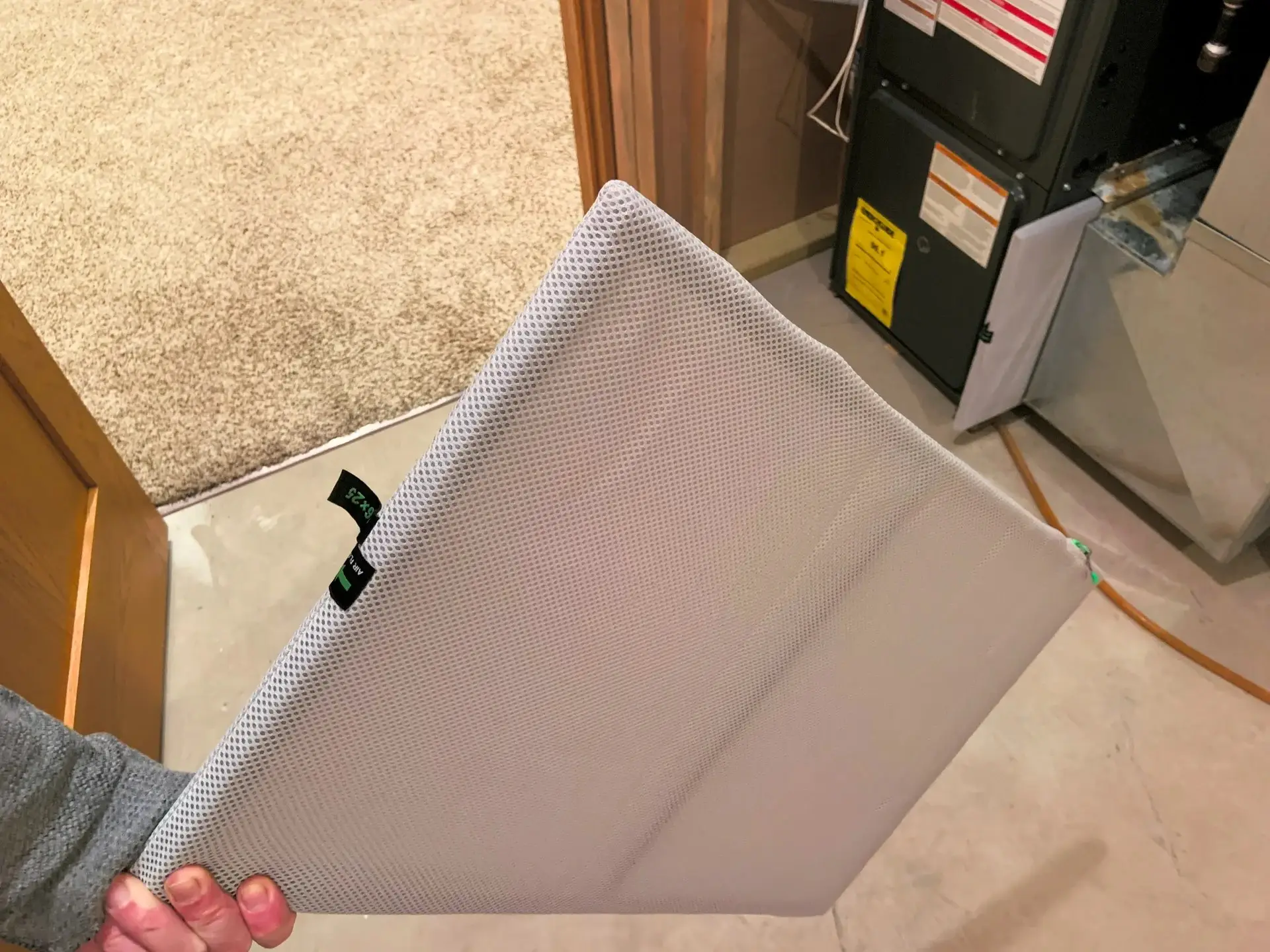
- Find every return — wall/ceiling grilles, floor returns, and the filter slot at the furnace or air handler. Some homes have one filter at the unit; others put a filter behind each return grille. Missed returns = dusty ducts + one clogged grille doing all the work.
- Pull the old filter (power off if you’re opening a furnace panel) — note printed nominal size, brand MERV/MPR if shown, and how dirty/crushed it is. Photograph the label.
- Nominal vs actual size — almost every residential 1″ filter uses a nominal size (what’s printed on the slot) that is slightly larger than the actual cardboard. Example: a “16×25×1” often measures about 15.5–15.7″ × 24.5–24.7″ × ~0.75–0.8″. Measure length, width, and thickness with a tape — don’t trust last year’s memory.
- Thickness: 1″ slot vs deep media cabinet — look at the rack depth. A standard 1″ return grille or furnace slot is not a 4–5″ media cabinet. Don’t force deep media into a skinny rack; upgrading cabinet depth is a hardware project (often pro).
- Airflow arrow — arrow (or “air flow”) points toward the blower / furnace, away from the room on grille-mounted filters. Backward filters load funny and can collapse.
- Pets / smoke / dust load — dogs, cats, renovation drywall dust, candles, and wildfire seasons shorten life. If the old filter is black at 30 days, plan monthly checks — not a 90-day marketing calendar.
- Furnace MERV sticker / manual — look for an installer sticker inside the blower door or a line in the owner’s manual (“use MERV X or lower,” “1″ pleated only,” etc.). That ceiling beats influencer charts.
Renters: photograph the size label and ask the landlord before changing thickness or installing a sealed media cabinet. If you still can’t tell whether a clogged filter or a door gap is the villain, seal the obvious daylight under the exterior door with a sweep from the weatherstripping guide and re-check airflow after a fresh, correctly sized filter.
MERV tradeoffs (when “more filtration” hurts)
MERV (Minimum Efficiency Reporting Value) rates how well a filter captures particles. Higher MERV generally means finer capture and more resistance to airflow when media area is limited — common on skinny 1″ filters. (Filtrete’s MPR scale roughly maps: MPR ~600–800 ≈ MERV 8; MPR 1000–1200 ≈ MERV 11; MPR 1500–1900 ≈ MERV 13 — brands differ slightly.)
Practical bill-side ranges for many US forced-air homes with a 1″ return filter:
| Goal | Typical MERV ballpark | Notes |
|---|---|---|
| Dust / lint / basic equipment protection | MERV 8 (≈ MPR 600–800) | Often the safest default if the manual is silent |
| Pets / pollen compromise | MERV 11 (≈ MPR 1000–1200) | Watch for pressure drop on older blowers |
| Aggressive allergen / smoke marketing | MERV 13 (≈ MPR 1500–1900) | Fine if the system allows it; not automatically “more efficient” |
Too-high MERV on a 1″ filter can:
- Raise static pressure so the blower works harder and longer.
- Contribute to frozen evaporator coils in cooling season (low airflow).
- Cause short cycling, whistling returns, weak supply air, or heat-exchanger stress on marginal systems.
- Collapse a cheap cardboard frame into the rack so air bypasses around the edges (dirty coils, dirty filter “that still looks white” because dust went around it).
Always prefer the equipment manual / installer sticker over social-media charts. If the furnace says “MERV 8 max” (or similar), treat that as a hard ceiling. Deep (4–5″) media cabinets can often run higher MERV with less pressure drop because there is more surface area — that is a hardware change, not a cart trick.
System / room priorities + do-not / safety list
Do these first
- The clogged primary return or furnace-slot filter — if one filter is black and bowed, change it today before shopping for “better MERV.”
- Every grille-mounted return that takes a filter — multi-return homes often neglect hallway or basement returns.
- Heat pump / electric furnace / central A/C homes — airflow problems show up as longer compressor or strip-heat runtime on the bill.
- Pet + allergy households already at MERV 8 — step to MERV 11 only if the sticker allows and supply air stays strong after a week.
- Wildfire / renovation seasons — stock multipacks and check monthly; don’t stretch a gray filter through smoke weeks.
These can wait
- Chasing MERV 13 on a 1″ slot when the manual is silent and airflow already feels weak.
- Replacing a clean, correctly sized MERV 8 every two weeks “because Amazon suggested it.”
- Deep media cabinet upgrades when the real bill drivers are setpoints, door gaps, or attic bypasses.
- Washable foam “forever” pads that don’t match furnace guidance.
What not to do
- Don’t run with no filter “just for a few days” — coils and blowers load with dust fast.
- Don’t block return grilles with furniture, rugs, or plastic — starved returns mimic a clogged filter.
- Don’t close most supply registers to “force” air elsewhere — raises static pressure and can damage equipment.
- Kill power at the air-handler / furnace breaker before opening panels you aren’t familiar with. Don’t bypass limit switches.
- Gas smell = leave the area and call the utility / emergency line. HomeBillCuts is not your HVAC contractor.
- Combustion appliances — never block furnace, water-heater, or dryer vents while “improving” airflow paths.
- Renters — don’t cut new return openings or modify cabinets without written approval.
Fix the worst filter first, live through a hot or cold week, then decide whether MERV or multipack size is the next lever.
Which one should you buy?
Use this before you cart six boxes of “hospital grade”:
- Is the current filter dirty, crushed, or missing? → Buy the correct size at a safe MERV (often MERV 8) today. Airflow first; marketing later.
- Manual / sticker says MERV 8 max (or is silent and the blower is older)? → Stay MERV 8 on 1″ media. Pets/pollen: vacuum returns and change more often before jumping MERV.
- Pets / pollen and the system already ran MERV 11 without icing or weak airflow? → MERV 11 multipack is a reasonable compromise.
- Allergens / smoke priority and the sticker allows MERV 13 or you have a deep media cabinet? → MERV 13 only if supply air stays strong and the coil doesn’t ice. On skinny 1″ slots, treat MERV 13 as a monitored experiment — not a free efficiency upgrade.
- 1″ slot vs deep media? → Match thickness. Deep media is a cabinet upgrade; don’t jam 4″ filters into 1″ racks.
- Multipack vs Subscribe & Save? → Multipack once size is locked. Subscribe & Save only after you’ve confirmed actual dimensions and MERV fit — wrong auto-ships waste money.
- Filters vs weatherstripping / air sealing / thermostat habits? → Filters = maintenance. Daylight under doors and sash leaks → weatherstripping. Outlet gaps and penetrations → air sealing. Runtime from setpoints → smart thermostats. Cold glass at night → thermal curtains or window film kits — none of those replace a clogged filter, and a filter doesn’t replace them.
| Job | Better tool |
|---|---|
| Restore airflow / protect equipment | Correct-size HVAC filter (this page) |
| Door bottoms, sash stops, daylight gaps | Weatherstripping & sweeps |
| Outlets, baseboards, penetrations | Caulk, foam & outlet gaskets |
| Schedules and setbacks | Smart thermostats |
| Cold/hot glass comfort | Thermal curtains / window film |
| Prove whether HVAC kWh moved | Kill A Watt / Emporia vs Sense |
| Attic bypass / insulation gaps | Attic approaches |
You can stack tools: clean filter + door sweep + thermostat schedule is normal. Don’t buy MERV 13 to compensate for an open attic hatch.
Change cadence that actually sticks
Manufacturer “up to 90 days” assumes clean suburban air and low pet load. Tighten the schedule when:
- You have dogs/cats that shed.
- Someone cooks often or burns candles/incense.
- You’re near construction, agriculture, or wildfire smoke.
- The filter looks gray before day 60.
- You run the system hard in peak heating or cooling.
Practical pattern many homes use:
- Check monthly (pull or flashlight through the grille) — change when gray, crushed, or bowed.
- 30–60 days with pets, smoke, or renovation dust.
- 60–90 days only if media still looks reasonably clean and airflow is strong.
Write the install date on the cardboard frame with a marker. Keep one spare on the shelf so “I’ll order later” doesn’t become three dirty months. A calendar reminder or Subscribe & Save cadence beats guessing — over-extending a clogged filter is worse for bills than buying one extra multipack per year.
Troubleshooting
| Symptom | Likely cause | What to try |
|---|---|---|
| Whistling / roaring at the return | Restrictive MERV, crushed filter, or undersized return | Drop MERV; reseat filter flat; open blocked grilles; confirm size |
| Weak airflow at supplies after “upgrade” | High MERV 1″ or filter installed backward | Flip arrow toward blower; try MERV 8; check for collapsed frame |
| A/C coil ices up / water under air handler | Low airflow (dirty or too-dense filter) | Replace with cleaner/lower MERV; thaw fully before restart; call tech if repeats |
| Short cycles / limit trips on heat | Overheating from poor airflow | New correct filter; clear returns; don’t close most supplies |
| Dust still coats furniture | Bypass around filter, missing secondary returns, or leaky returns | Ensure snug fit; filter every return that takes one; seal obvious return leaks |
| Filter bows into the rack in weeks | Cheap frame + high suction / high MERV | Sturdier pleated brand; lower MERV; don’t stretch change interval |
| Wrong size won’t seat / huge side gaps | Ordered nominal without checking actual inches | Remeasure; match actual L×W×T on the product page |
| “Smart” filter app nagging every 30 days | Marketing calendar, not your dust load | Trust visual check + date on frame; disable useless alerts |
If bills stay high after a clean, correctly rated filter, move to envelope fixes and measurement — don’t stack gadgets first.
Our picks
Links use our Associates tag (homebillcuts-20). Confirm the size dropdown matches your slot before checkout — many listings share a title across dozens of dimensions. Examples below use the common 16×25×1 nominal size as a template; change the size on Amazon if yours differs. Always compare actual inches on the detail page.
Best default for many systemsMERV 8 multipack
Pleated MERV 8 packs are the usual bill-safe starting point when the manual is vague and you mainly want dust control plus airflow.
- Nordic Pure 16×25×1 MERV 8 (6-pack) Check price on Amazon
- Filterbuy 16×25×1 MERV 8 (4-pack) Check price on Amazon
Best mid upgrade when pets/pollen matterMERV 11
Step up only if airflow stays strong and the equipment allows it.
- Aerostar 16×25×1 MERV 11 (6-pack) Check price on Amazon
- Filtrete 16×25×1 MPR 1000 / MERV 11 (6-pack) Check price on Amazon
Best when you need finer capture and the system tolerates itMERV 13
Useful for smoke/allergen priorities on systems that already ran high MERV without icing or short cycling. Not a free efficiency boost.
- Filtrete 16×25×1 MPR 1900 / MERV 13 (2-pack) Check price on Amazon
If your size isn’t 16×25×1, search the same brand + MERV with your nominal size and compare actual inches on the detail page before Subscribe & Save.
Habits that help
- Write the install date on the cardboard frame with a marker.
- Keep one spare on the shelf so ordering delays don’t stretch dirty months.
- After a change, listen for happier airflow and watch whether cooling still reaches setpoint without long, weak runs.
- Pair with free checklist items: setpoints, outdoor coil clearance, and dryer lint discipline (dryer vent kits when the dryer is slow).
- If bills stay high after a clean, correctly rated filter, move to measurement (Kill A Watt, Emporia Vue vs Sense) or envelope fixes — don’t stack gadgets first.
What we intentionally left out
- Deep dives on hospital-grade HEPA whole-house conversions (pro design territory).
- Exact static-pressure targets without a manometer and manufacturer curves.
- Brand loyalty wars; buy for size + MERV fit, then price per filter-month.
- Invented ASINs or “guaranteed $X/month” savings claims.
Related reading
- Heat pump aux heat raising your bill? — a clogged filter is a classic trigger for expensive backup strips
- Priority checklist — filters are maintenance; setpoints and sealing come first
- Start Here — reading order for the whole site
- Best weatherstripping & draft stoppers — door and sash leaks filters can’t fix
- Air sealing: caulk, foam & outlet gaskets — small holes that add runtime
- Best smart thermostats 2026 — schedules that cut runtime after airflow is healthy
- Smart thermostat install cost vs DIY — when a pro install is worth it
- Thermal & blackout curtains — cold-glass comfort after HVAC airflow is sorted
- Window insulation kits — seasonal film for leaky single-pane glass
- Furnace humidifier water panels for winter comfort — measure RH; #10 vs #35 fit; portable path when you have no whole-house unit
- Register booster fans for cold rooms — after the filter is healthy, boost a weak far supply (doesn’t create heat)
- Kill A Watt plug-in energy meter — spot-check plug loads while you watch HVAC habits
- Emporia Vue vs Sense — prove whether filter cadence changed HVAC kWh
- DIY HVAC duct sealing (mastic + UL 181 foil tape) — seal leaky accessible ducts after airflow basics
Bottom line
For most US homes, the revenue-smart filter move is boring: correct size, MERV your equipment can breathe through, changed on a real schedule. Walk the returns, read the sticker, and treat high MERV on skinny 1″ media as a monitored choice — not a magic bill cut. Amazon multipacks make the cadence easy — just double-check actual dimensions before you click.
Amazon product links may earn us a commission as an Associate (disclosure). We don’t invent ASINs or guaranteed savings.
Some links on this page go to Amazon, and we earn a commission if you buy, at no extra cost to you. Prices and savings vary by home and utility rate. More in our disclosure.