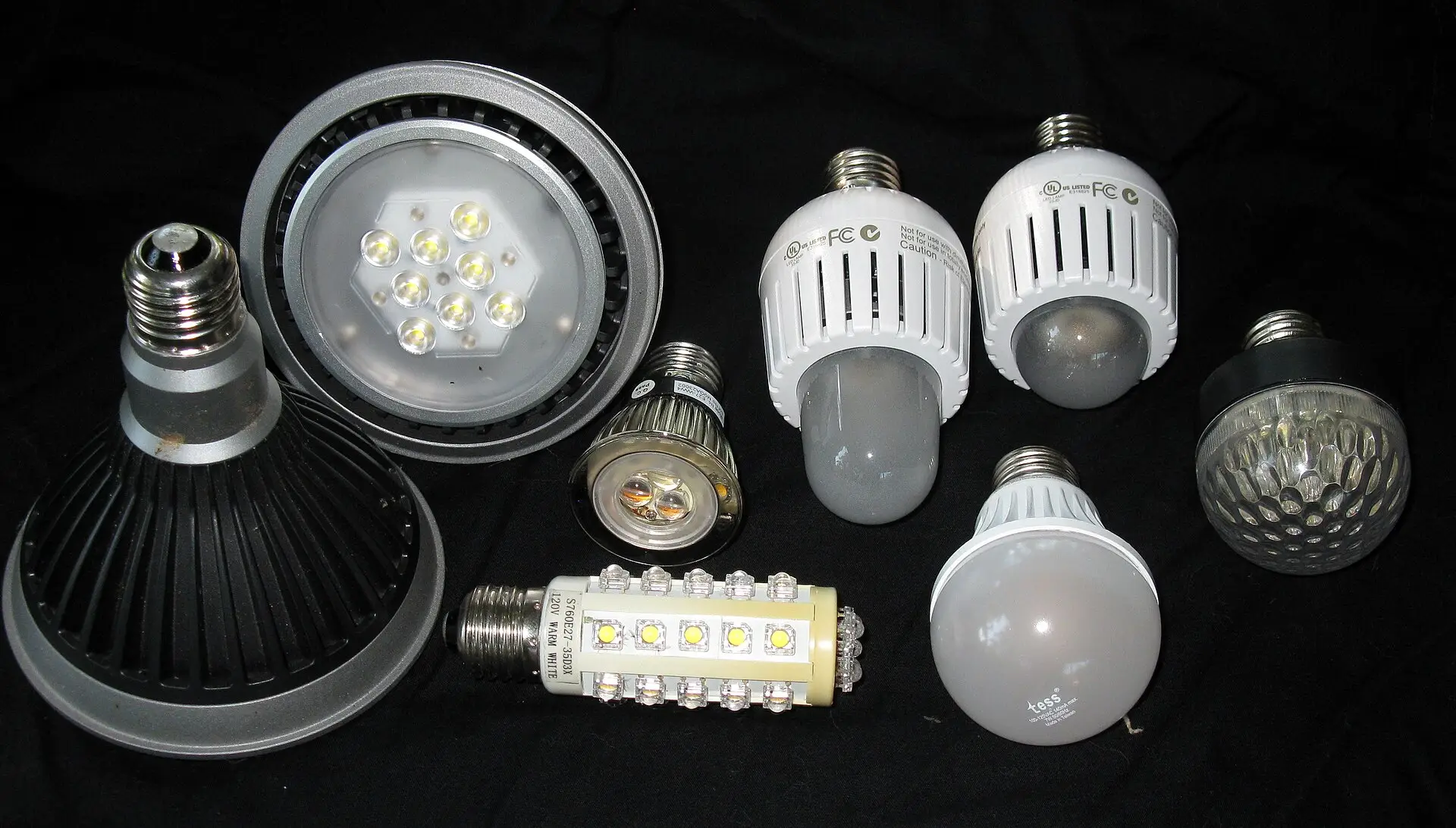
LED bulbs are one of the easiest efficiency upgrades left in many US homes — but easy is not the same as will transform your electric bill. Lighting is often a smaller slice of household kWh than HVAC or water heating. Not every socket is worth switching. We’ll show which ones are, how lumens map to old wattages, and which bulb shape you need: A19, BR30, candelabra, outdoor or smart.
If you’re prioritizing actions for this billing cycle, keep the priority checklist above any shopping cart. New visitors: Start Here. Envelope leaks and HVAC habits still usually outrank lighting — see weatherstripping and HVAC filters if the house fights every setpoint. Prove lighting (or anything else) with a Kill A Watt, smart plugs, or a whole-home monitor when you want numbers instead of guesses.
When LED swaps move the bill (and when they don’t)
Think of lighting energy as watts × hours. An LED cuts the watts for the same light; it does nothing for a socket you almost never flip on. Bill leverage appears when you retire high-hour inefficient lamps — not when you fill a cart with 5000K daylight multipacks for bedrooms you already LED’d years ago.
LEDs help most when:
- You still have incandescent, halogen torchieres, or old CFLs in rooms that run hours every day (kitchen, living, office, porch left on for safety, garage shop).
- You can match lumens and form factor so the new lamp is actually used (not returned because it looks harsh or won’t dim).
- You’re replacing failing / flickering early LEDs that drive people to leave brighter inefficient lamps on longer.
- A porch light sits on all night — a few watts of outdoor-rated LED (or dusk-to-dawn where that fits) beats leaving a 60W incandescent on until dawn.
They help less — or barely move the bill — when:
- Most sockets are already decent LEDs that match color and don’t flicker.
- Remaining inefficient bulbs live in guest closets, decorative fixtures you almost never switch on, or rooms you visit twice a week.
- HVAC dominates your kWh (hot summers, cold winters, electric resistance heat) — setpoints, filters, and air sealing still outrank lighting multipacks.
- You’re tempted to replace working LEDs with “ultra-efficient” packs for a few watts — keep the good lamps; spend the Saturday on the checklist.
The reality: We do not claim a fixed annual dollar savings. Your rate ($/kWh), hours of use, and how many inefficient bulbs remain decide the math. A perfect LED house still loses to a stuck heat-pump aux strip or a drafty attic hatch on whole-bill impact.
Quick payback math (fill in your numbers)
Use this once for a high-hour socket so expectations stay honest:
- Note old watts and new watts from the packages (or meter a fixture cluster if you have a plug-in meter).
- Estimate hours per day the light is actually on.
- Rough yearly kWh saved:
(old W − new W) × hours/day × 365 ÷ 1000. - Multiply by your $/kWh from the bill — not a national average graphic.
Example shape only: a 60W lamp replaced by a 9W LED at 4 hours/day is about 51 × 4 × 365 ÷ 1000 ≈ 74 kWh/year. At $0.16/kWh that’s roughly ~$12/year for that one socket — fine, but not a reason to ignore a stuck heat-pump aux strip or a drafty attic hatch. Scale by how many high-hour sockets remain; don’t invent a whole-house graphic from one kitchen can.
Check your home before you buy
Gadgets before a 10-minute walk is how you end up with a closet full of 5000K garage bulbs for the bedrooms. Spend ten minutes with a notepad before you click “Buy.”
- Existing bulb watts / type — Read the stamp on remaining lamps: incandescent, halogen, CFL, or LED. Note watts where printed. A socket already at ~8–12W LED is usually done for bill math.
- Lumens (or honest brightness feel) — If the package is gone, note whether the room feels dim, OK, or harsh. Target roughly 800 lm for classic “60W” feel, ~450 lm for “40W,” ~1100 lm for “75W,” ~1600 lm for “100W” — then confirm on the new package.
- Hours-on — Which fixtures run every evening or all day? Kitchen, living, office, porch, garage shop first. Closets and guest rooms last.
- Fixture / form factor — A19 medium base, BR30 / BR40 cans, candelabra (E12), GU10/MR16, globe, outdoor wet-rated. Don’t buy one multipack shape for every hole.
- Dimmer compatibility — Wall dimmers? Need bulbs labeled dimmable, and often an LED-rated dimmer if a whole room flickers. Non-dimmable bulk packs on a dimmer circuit = regret.
- Color temperature needs — Soft white (~2700–3000K) for living/bedrooms; neutral (~3000–3500K) for kitchens/baths; daylight (~4000–5000K) for garage/utility only unless you truly want that look.
- Enclosure / location rating — Enclosed globes, damp/wet outdoor fixtures, IC-rated cans. Indoor-only A19s die early outdoors or in sealed globes not rated for enclosed use.
- Specialty gotchas — 3-way lamps, photocells, motion sensors, low-voltage transformers, pin bases. Measure before you assume an A19 multipack fits.
Write “room / old type+W / hours / base / dimmer? / CCT / enclosed or outdoor?” on a sticky before Amazon. If you want proof lighting is (or isn’t) a big slice of kWh, a whole-home monitor or a cheap plug-in meter on a lamp cluster beats guessing. After high-hour lamps are done, hunt always-on electronics with smart plugs for vampire power.
What to do first
Do these first
- Kitchen ceilings, under-cabinet, and main living lamps still on incandescent/halogen — longest daily runtime in many homes.
- Home office / schoolwork spaces with daytime hours — task lamps beat blasting every can if the goal is usable light, not a glowing ceiling.
- Porch and entry lights left on for safety — outdoor-rated (and dusk-to-dawn where it fits) so you’re not paying for a forgotten 60W globe until morning.
- Garage shop / basement work lights — long DIY sessions; daylight multipacks belong here, not in bedrooms.
- Failing LEDs that flicker or buzz — swap so people stop “solving” it by leaving brighter inefficient lamps on.
These can wait
- Guest-room closets opened twice a year.
- Decorative fixtures you almost never switch on.
- Sockets already filled with decent LEDs that match color and don’t flicker.
- Specialty bases you haven’t measured (pin bases, low-voltage transformers) until you confirm voltage and form factor.
- Replacing working soft-white LEDs with “newer” packs for marketing watts.
What not to do
- Do not put indoor-only bulbs in wet/outdoor fixtures — use damp/wet-rated lamps; water + wrong rating = early death or worse.
- Do not ignore enclosed-fixture ratings — bulbs not rated for enclosed globes overheat and fail early.
- Do not put non-dimmable bulbs on dimmer circuits — flicker, buzz, and early failure are common; buy dimmable or change the dimmer.
- Do not jam an A19 into a recessed can that needs a BR30/BR40 — wrong beam and often wrong heat path.
- Do not force 5000K daylight into living rooms and then blame LEDs for “feeling cold.”
- Do not exceed fixture wattage/current guidance — LEDs draw less, but still follow the fixture label and enclosure rules.
- Do not invent bill ROI from a multipack listing — use your hours and your $/kWh.
- Do not crush working LEDs into the trash for a few watts of “ultra-efficient” upgrade while high-hour halogens remain elsewhere.
- CFL disposal (brief): If you’re retiring CFLs, don’t toss them in regular trash where local rules require recycling — they contain a small amount of mercury. Check local household hazardous waste / retailer take-back. LEDs are mercury-free; still recycle e-waste when your area offers it.
If any do-not item matches your plan, pause the cart — the wrong bulb in the wrong fixture is comfort spend with no bill story.
Which one should you buy?
Use this after you’ve checked your home, not instead of it.
- Socket already has a decent LED (right color, no flicker, roughly enough lumens)?
- Yes → Skip / keep. Move to the next high-hour inefficient socket.
- No → continue.
- Standard A19 / E26, soft-white preferred, no dimmer?
- → Everyday ENERGY STAR soft-white multipack (~800 lm). Ultra-efficient packs (~5W near 800–850 lm) help when many high-hour sockets remain.
- Fixtures on wall dimmers?
- → Explicitly dimmable A19 (warm-glow styles often behave better). Budget for an LED-rated dimmer if a whole room flickers after a quality dimmable bulb.
- Recessed cans / flood-style fixtures?
- → Correct BR30 (or BR40) form factor; outdoor/enclosed rating when the fixture needs it — not an indoor A19 jammed in a can. Soft white for living spaces; daylight high-output for tall ceilings / task cans.
- Chandelier, sconce, or ceiling-fan candelabra (E12)?
- → Candelabra / A15 E12 pack matched to shape and dimmable needs — don’t force an A19 into a chandelier arm.
- Outdoor porch / entry left on for safety?
- → Outdoor-rated lamp; consider dusk-to-dawn A19 if you want auto on/off without a separate photocell. Keep indoor-only bulbs indoors.
- Garage, laundry, unfinished basement only?
- → Bulk daylight multipack can be fine; keep it off dimmer circuits and out of living rooms unless you truly want 5000K.
- Tempted by smart bulbs for “savings”?
- → Buy dumb LEDs first for bill math. Smart bulbs are for schedules, scenes, and remote control. A schedule can help if humans leave lights on — it does not beat a 5–9W dumb LED already in the socket. If the problem is standby AV gear, that’s smart plugs, not Hue.
- Specialty (3-way, GU10/MR16, low-voltage)?
- → Confirm voltage and base before buying; when unsure, measure twice or hire — wrong low-voltage LED on a magnetic transformer is a common failure mode.
Still unsure? Photograph the fixture and the old bulb base, note dimmer/enclosed/outdoor, and choose the shortest path that matches hours + form factor, not the biggest multipack on the page.
Form factor quick picks (before the cart)
| Need | Typical form | Notes |
|---|---|---|
| Table / ceiling everyday | A19 E26 | Soft white ~800 lm for classic 60W feel |
| Recessed 5” cans | BR30 | Soft white living; daylight for tall/task cans |
| Larger cans / floods | BR40 | Measure aperture — don’t assume BR30 |
| Chandelier / fan kit | E12 candelabra / A15 | Shape matters when the bulb shows |
| Porch left on overnight | Outdoor-rated A19 (± dusk-to-dawn) | Indoor-only bulbs fail early outdoors |
| Garage / laundry bulk | Daylight A19 multipack | Keep off dimmers and out of bedrooms |
If the fixture shows the bulb (clear glass chandelier, vintage cage), match shape and CCT so you don’t hate the room and leave brighter lights on longer.
Wattage / lumen cheat table (shop lumens)
Incandescent wattage was a rough proxy for brightness. With LEDs, shop lumens (light output) and CCT / CRI (color), then confirm wattage is low. These are standard equivalences, not dollar forecasts.
| Old incandescent (approx.) | Target LED lumens | Typical LED wattage range |
|---|---|---|
| 40W | ~450 lm | ~5–7W |
| 60W | ~800 lm | ~5–12W (ultra-efficient packs can land near ~5W) |
| 75W | ~1100 lm | ~11–15W |
| 100W | ~1600 lm | ~15–20W |
Always read the package: a “60W replacement” should land near 800 lumens, not merely say “60W” in big type while delivering a dim 450 lm lamp. Ultra-efficient listings that claim ~5W near ~850 lm are real products from major brands — still verify your package before you buy a closet full.
Color temperature quick picks
- 2700K–3000K: Warm, residential living rooms / bedrooms.
- 3000K–3500K: Neutral warm for kitchens and baths.
- 4000K+: Cooler task / garage / utility — fine if you like it; jarring if you don’t.
Prefer CRI 80+ (90+ nicer for kitchens and makeup lighting). Skip mystery no-name bulbs that omit lumens and CRI.
Troubleshooting
| Symptom | Likely cause | What to try |
|---|---|---|
| Flicker or buzz on dimmer | Non-dimmable bulb; old leading-edge dimmer; too few LED watts on the dimmer | Use dimmable LEDs; try an LED-rated dimmer; add load or choose bulbs known to work at low dimmer loads |
| Early burnout in enclosed globe | Bulb not rated for enclosed fixtures; heat buildup | Replace with enclosed-rated LED; confirm fixture rating |
| Outdoor fixture fails fast | Indoor-only bulb in damp/wet location | Use damp/wet-rated outdoor LEDs; check gasket/hood |
| Looks harsh / “cold” | Wrong CCT (often 5000K in living spaces) | Swap to 2700–3000K soft white; keep daylight for garage/utility |
| Too dim vs old lamp | Package under-delivered lumens; “60W” marketing without ~800 lm | Match lumens from the table; return under-spec bulbs |
| Ghost glow with photocell / sensor | Cheap LED + sensor incompatibility | Buy sensor-compatible or dusk-to-dawn models; try a different brand |
| 3-way lamp stuck on one level | Standard LED in a 3-way socket | Use a 3-way LED design, not a normal dimmable A19 |
| Smart bulb drops off Wi‑Fi / “saves nothing” | Expecting bill magic from connectivity | Use dumb LEDs for watts; use smart only for schedules/scenes |
| Next-bill lighting slice barely moved | Most sockets already LED; remaining bulbs low-hour | Stop shopping multipacks; return to priority checklist |
Fixture and dimmer gotchas (safety)
Safety notes: Kill power at the switch or breaker before opening fixtures. Don’t exceed fixture wattage and follow LED-specific enclosure ratings (IC-rated cans, enclosed globes). Use damp/wet-rated lamps outdoors. For GU10/MR16 and pin bases, confirm voltage (line vs. low-voltage transformer). Mis-matched dimmers cause flicker, buzz, or early failure — use LED-compatible dimmers and check the bulb’s dimmable label. Recessed can retrofits must maintain fire/IC ratings; when unsure, use listed retrofit kits or hire an electrician.
Other practical gotchas:
- Enclosed fixtures: Only use bulbs rated for enclosed use or they overheat and die early.
- 3-way lamps: Need 3-way LED designs, not standard dimmable A19s.
- Photocells / motion sensors: Cheap LEDs sometimes ghost-glow; buy compatible models or dusk-to-dawn bulbs built for that job.
- Candelabra / globe aesthetics: Match shape if the fixture shows the bulb — don’t force an A19 into a chandelier arm.
- Heat and summer bills: Incandescent heat is waste indoors in cooling season; LEDs cut that waste. In heating season, that heat was never an efficient furnace substitute — fix setpoints with a sane thermostat strategy instead of keeping hot lamps on purpose.
Our picks
We earn a commission if you buy through these Amazon links, at no extra cost to you. Check size and fit on the listing before you order.
Match form factor and dimmable/outdoor needs from your walk-through. Keep working LEDs that already fit.
Best everyday swapultra-efficient soft-white A19 multipack (~800–850 lm)
Best for: Classic “60W replacement” use in table lamps and ceiling fixtures when many high-hour sockets still need retiring. Ultra-efficient packs cut watts further while staying near ~800+ lumens.
Watch-outs: Verify dimmable vs. non-dimmable against your switches. Confirm soft white (2700K-ish) if these go in living spaces — don’t accidentally cart daylight for bedrooms.
- Philips Ultra Efficient A19 soft white 12-pack Check price on Amazon
Best for dimmerswarm-glow dimmable A19
Best for: Flicker-prone residential dimmers. Warm-glow lamps (color warms as you dim, like old incandescents) reduce “this feels wrong” returns and often play nicer with wall dimmers.
Watch-outs: Old leading-edge dimmers may still misbehave; budget for a dimmer refresh if a whole room flickers. Not a Hue / smart-bridge bulb.
- Philips Warm Glow dimmable A19 6-pack Check price on Amazon
Best for cansBR30 flood form factor
Best for: Recessed fixtures where an indoor A19 is the wrong shape. BR30 is the common 5-inch can size — match aperture, CCT, and dimmable/outdoor needs.
Watch-outs: Check BR30 vs BR40, IC/enclosure rules, and whether outdoor/damp rating is required. High-output daylight BR30s are great for tall ceilings and task cans; they can feel harsh in a cozy living room if you wanted soft white.
- Four Bros BR30 LED flood (dimmable, indoor/outdoor rated options on listing) Check price on Amazon
- Feit Enhance high-output BR30 daylight (enclosed / outdoor rated on listing) Check price on Amazon
Best for candelabra / ceiling-fan E12soft-white A15
Best for: Chandeliers, sconces, and ceiling-fan light kits that take an E12 candelabra base — not a standard A19.
Watch-outs: Confirm E12 vs E26 before you buy. Check dimmable needs against your switch. Compact A15 shape still has to clear the glass; measure if the fixture is tight.
- Feit A15 E12 soft white dimmable 12-pack Check price on Amazon
Best outdoor dusk-to-dawnA19 with photocell
Best for: Porch/entry fixtures left on for safety where you want auto on at dusk and off at dawn without a separate photocell or timer.
Watch-outs: Non-dimmable on most dusk-to-dawn packs. Photocell needs a view of outdoor light — enclosed opaque globes can confuse sensors. Prefer outdoor-appropriate fixtures; these are high-hour convenience tools, not a reason to leave indoor A19s outside.
- Amazon Basics A19 dusk-to-dawn sensor LED (daylight 5000K 2-pack; soft-white option on listing) Check price on Amazon
Best bulk garage / utilitydaylight A19 multipack (not for bedrooms)
Best for: Unfinished spaces where you want crisp 5000K task light and a low cost-per-bulb. Fine for laundry, garage, workshop.
Watch-outs: Non-dimmable on many bulk daylight packs — keep them off dimmer circuits. Do not force 5000K into living rooms and then blame LEDs for “feeling cold.”
- Feit A19 24-pack 5000K daylight Check price on Amazon
Pair LEDs with behavior (still free)
- Turn off empty rooms — LEDs are efficient, not free.
- Use task lighting instead of blasting every can at night.
- On time-of-use rates, decorative lighting in peak windows is still avoidable waste.
- Hunt remaining halogen torchieres; they’re quiet bill villains.
- After sockets are done, cut standby clusters with smart plugs — a warm AV rack can dwarf a nightlight.
- Prove odd loads with a Kill A Watt or Emporia / Sense before you buy another gadget.
What we can’t promise
- Fake “save $200/year from one 8-pack” graphics without your hours and rates
- That LEDs replace the need for HVAC maintenance or sane thermostat schedules
- That every ultra-cheap bulk import matches its lumen label for five years
- That smart bulbs are required for bill-cutting once a dumb LED is already in the socket
- That replacing working LEDs with newer packs is a high-ROI bill move
Related reading
- Kill A Watt & plug-in energy meters — prove lighting kWh on lamp clusters before you buy more gear
- Best smart plugs for vampire power — cut standby after you’ve swapped high-hour lamps
- Emporia Vue vs Sense — see whether lighting is actually a big slice of your kWh
- Priority checklist — LEDs after setpoints and filters
- HVAC air filters: MERV & size — recurring win that still beats most lighting multipacks on whole-bill impact
- Window AC controllers & ceiling fans — summer comfort without over-cooling
- Best smart thermostats (2026) — runtime and setpoints still dominate lighting
- Start Here — ranked path for new visitors
Bottom line
Yes — LEDs save money versus leaving incandescents and halogens in high-hour sockets, especially when you match lumens, buy the right form factor, and keep daylight bulk packs in utility spaces. No — they rarely outperform fixing setpoints, filters, and air leaks on a percentage-of-bill basis, and they won’t rewrite a bill that’s already mostly LED. Walk the house first, use the lumen table, follow the “Which one should you buy?” section (including skip when the socket is already fine), and keep expectations honest. Continue with Start Here for what to tackle next.
Some links on this page go to Amazon, and we earn a commission if you buy, at no extra cost to you. Prices and savings vary by home and utility rate. More in our disclosure.