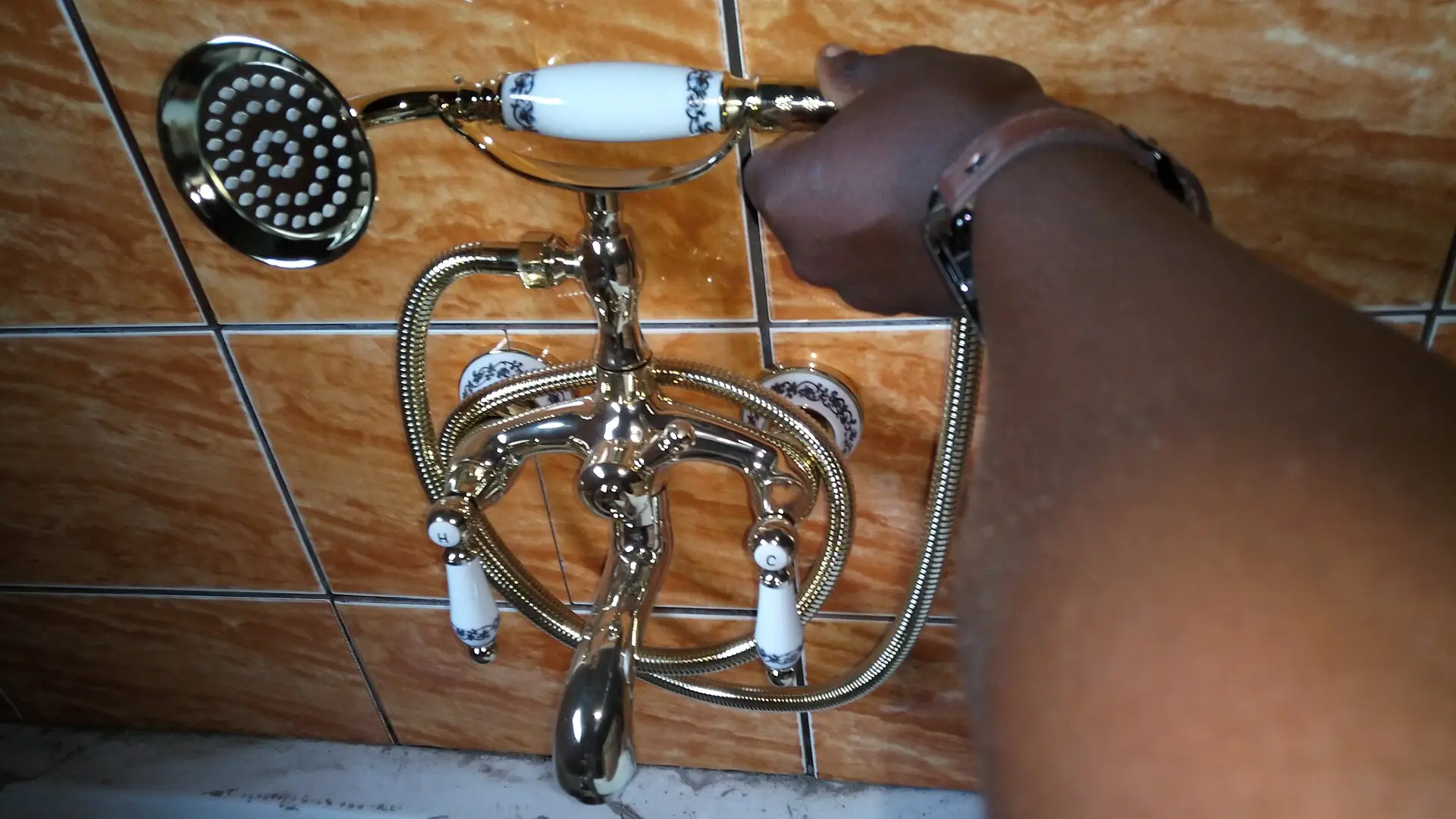
Hot water is often the #2 or #3 electric load in US homes with resistance tanks — and showers are a big slice of that. A WaterSense showerhead and tighter faucet aerators reduce gallons (and the energy to heat them) without replacing the water heater. We’ll cover when new fixtures help, how to measure the flow you have now, and which kind fits: a kit, a fixed or handheld head, an ultra-low model, aerators alone, or nothing at all.
When low-flow fixtures actually move the (electric) bill
Think of hot-water waste as two separate loads: gallons you heat and dump at the fixture, and heat lost from pipes and the tank shell between draws. Low-flow showerheads and aerators attack the first load. Pipe foam and (sometimes) a tank jacket attack the second. Bill leverage appears when you’re still running old high-GPM hardware on long or frequent showers — not when fixtures are already efficient and water heating is a tiny line on the bill.
Fixtures help most when:
- Showers run long or frequent, or teens treat the shower like a spa — more minutes × more GPM = more reheats.
- You heat water with electric resistance (or pay high gas / propane rates) so every hot gallon has a real energy cost.
- Existing heads and aerators are clearly old high-GPM hardware (≈2.2–2.5 GPM tips, or no WaterSense mark and a soft “garden hose” feel).
- You’ve already fixed free wins: drips, a sane tank setpoint (~120°F when appropriate), and dishwasher/washer habits from the priority checklist.
- Branch pressure is decent enough that a 1.5–1.8 GPM WaterSense head still feels usable — so people don’t “compensate” by lengthening showers.
They usually won’t move the needle much when:
- Heating and cooling dominate and water heating is a small line item on your bill (see attic insulation and weatherstripping first).
- You’re already on efficient fixtures (≤2.0 GPM WaterSense) and short showers — skip the cart and spend the afternoon elsewhere.
- The real problem is a dying tank, endless recirculation loop, or leaks in the walls — fixtures won’t fix those (compare a heat pump water heater when replacement is on the table).
- Extremely low municipal / well pressure makes even good 1.5 GPM heads feel weak — fix pressure or try one bathroom before a whole-house rollout.
- Someone will simply leave the shower running longer to “make up” for a spray they dislike — behavior can erase the gallon cut.
The reality: Savings scale with how long you shower, how hot you run the mix, your water-heating fuel and rates, household size, and what GPM you replace. EPA WaterSense materials cite typical household water and energy reductions for labeled products — treat those as illustrative averages, not a promise for your house.
Tankless / instantaneous heaters: Some units need a minimum flow to ignite or modulate. Ultra-low aerators on a far bathroom can cause flaky ignition — check the heater manual’s minimum GPM before going aggressive on every tap.
Check your home before you buy
Wrong GPM target, a head that won’t screw onto a weird arm, or a universal aerator forced onto a cache faucet = wasted shipping and a weak-spray week. Spend ten minutes with a jug, a phone timer, and the old hardware before you click “Buy.”
- Read the stamp on the showerhead — Many list max GPM on the face, collar, or packaging remnant. Photograph it. If it’s already ≤2.0 and you like the spray, you may only need aerators (or nothing).
- Bucket / jug flow check — Time how long it takes to fill a 1-gallon jug or marked flow bag at a full hot+cold mix (or full cold for a pure flow check). GPM ≈ gallons ÷ minutes. A kitchen measuring pitcher works in a pinch. Do this on the shower you’ll replace first.
- Time a real shower once — Note minutes under water (not total bathroom time). Long showers on high-GPM heads are the bill story; a 4-minute rinse on an already-efficient head is not.
- Check shower-arm threads — US homes almost always use ½″ NPT / NPS shower-arm threads. Confirm the old head unscrews cleanly counterclockwise. Note chrome vs plastic arm, and whether the joint weeps — you’ll want plumber’s tape ready.
- Inspect faucet aerators: male / female / dual-thread vs cache — Most tips unscrew from the spout. Common dual-thread sizes: 15/16″ male and 55/64″ female (universal kits often include both). Some Delta / Moen / Kohler faucets use cache (hidden) aerators that need a key / wrench and brand-specific adapters — don’t force a universal tip into a cache spout.
- Pressure feel walk — Run the upstairs shower, the guest bath, and the kitchen. Note “weak upstairs,” “strong main bath,” or “kitchen already soft.” Ultra-low (≈1.25 GPM) belongs only where pressure already feels solid.
- Hard-water clue — White crust on nozzles or aerator screens means clean or soak before blaming flow rate. Mineral clog can fake a “low pressure” problem.
- Renter / HOA reality check — Can you swap fixtures and keep the old ones to reinstall later? Photograph the originals. If you’re not allowed to change showerheads, aerators-only (or landlord approval) is the path.
Write current GPM (stamp or jug), “½″ arm OK? Y/N,” aerator style (dual-thread / cache / unsure), pressure feel (strong / weak upstairs), and “longest shower bathroom = ___” before you open Amazon.
What to do first
Do these first
- Longest-use shower still at ~2.2–2.5 GPM — swap that head first; live with it a week before whole-house rollout.
- Bath aerators on frequently used sinks — cheap, fast, and cut hot gallons for handwashing and shaving.
- Kitchen aerator when the tip is splashy or clearly high-flow — stream/spray toggle helps dish rinsing at lower GPM.
- WaterSense-labeled performance (≤2.0 GPM with spray tests) over vague “eco” marketing — so you’re not stuck with a mist.
- Habits already in motion — drips fixed, sane setpoint, and pipe insulation on accessible hot runs so the gallons you still heat stay hotter longer.
These can wait
- Guest baths used twice a year when the main shower is still dumping gallons.
- Fancy multi-spray towers and spa kits when a simple fixed WaterSense head would cut more gallons for less money.
- Ultra-low 1.25 GPM on every fixture before you’ve proven pressure and spray feel in one bathroom.
- Cosmetic finish matching across every bath before the bill stack (kit → main shower → aerators) is done.
- Replacing a head you already like that’s stamped ≤2.0 WaterSense — spend the afternoon on drafts or filters instead.
What not to do
- Don’t force wrong threads — cross-threading cracks shower arms and faucet spouts. Start every joint by hand; plumber’s tape on male threads if the old joint wept; don’t over-wrench chrome.
- Don’t put ultra-low (~1.25 GPM) on already-weak pressure — upstairs branches and well systems often feel lean; try 1.5 first or fix pressure.
- Renters: don’t toss the landlord’s fixtures — bag and label the originals; restore on move-out unless written approval says otherwise.
- Scald / mixing-valve caution — scald risk rises if someone “compensates” for lower flow by opening the hot valve further on poorly tempered systems. Keep anti-scald / thermostatic valves as the manufacturer intended. Households with mobility or sensory needs may prefer a familiar spray — try one bathroom first.
- Don’t ignore leaks first — a dripping hot tap can waste more than a modest GPM cut saves. Fix drips and runaway toilet fills from the checklist before shopping heads.
- Don’t expect miracles from a dying heater — rusty, leaking, or chronically short-of-hot-water tanks need repair or replacement (HPWH guide), not another showerhead.
- Don’t starve a tankless — respect the heater’s minimum ignition GPM before ultra-low aerators on every far tap.
- Don’t soak electrical parts — vinegar soaks are for removable plastic faces and aerator screens, not wired components or unfinished open junctions.
If any do-not item applies, pause that SKU — aerators-only, a milder 1.5 GPM head, or “fix leaks / insulate pipes first” is still fair game.
WaterSense vs “low flow” marketing
Federal law already capped many showerheads at 2.5 GPM. WaterSense labeled showerheads go further: ≤ 2.0 GPM and pass spray performance tests (coverage and intensity), so you’re not stuck with a weak mist.
| Label / rating | Rough meaning | Bill / feel notes |
|---|---|---|
| ~2.5 GPM (older / max federal) | Common baseline many homes still have | Highest gallons; first upgrade target |
| WaterSense ≤ 2.0 GPM | Efficiency + performance certification | Practical certified floor for most homes |
| 1.5–1.8 GPM | Strong savings; good everyday pick | Sweet spot for many households |
| ~1.25 GPM | Aggressive savings | Great for some; too lean for thick hair or low pressure |
| Unlabeled “eco” / “low flow” | Marketing claim only | Verify GPM and spray; prefer WaterSense mark |
Faucet aerators (bathroom and kitchen) are usually 1.0–1.5 GPM on WaterSense-style parts vs older ~2.2 GPM tips. Kitchen aerators sometimes offer a stream / spray toggle for rinsing dishes.
Look for the WaterSense mark on packaging when you want certified performance — not every “eco” listing is labeled.
Showerheads and aerators: what you’re actually choosing
- Fixed wall mount — simplest swap; match ½″ NPT / NPS shower-arm threads (near-universal in US homes). Hand-tighten plus a wrap of plumber’s tape if the old joint wept; don’t over-wrench chrome finishes.
- Handheld — hose + holder; useful for rinsing kids, pets, and tub walls. Check that the holder and hose are included or sold as a set. Pause/trickle on the handle helps if people use it.
- Pause / trickle valve — reduces flow to a trickle while you lather so hot water isn’t blasting unused. Nice efficiency feature if people actually use it.
- Ultra-low fixed (~1.25 GPM) — maximum gallon cut when pressure is already solid; try one shower before replacing every head.
- Whole-bath kit — showerhead + kitchen + bath aerators in one box; fastest path when several fixtures are still old high-flow tips.
- Aerators-only — when the shower is already efficient (or untouchable) but sinks still splash and dump hot water.
- Hard water — mineral buildup clogs tiny nozzles. Prefer designs that rinse clean or have removable faces; vinegar soaks help many plastic heads. Solid single-nozzle metal designs market clog resistance — still wipe mineral film occasionally.
Which one should you buy?
Use this as a quick filter — then buy only what your own checks support.
- Are drips fixed and is the tank basically healthy (not leaking / chronically failing)?
- Yes → go to step 2.
- No → fix leaks / plan heater repair or HPWH first; fixtures won’t rescue a dying tank.
- Is your main shower still ~2.2–2.5 GPM (or unmarked and clearly high-flow), and is pressure usable?
- Yes, several fixtures old → whole-bath WaterSense kit (showerhead + aerators).
- Yes, only the main shower matters and you want durability → premium fixed ~1.5 GPM WaterSense-oriented head (with pause/trickle if you’ll use it).
- Yes, pressure is strong and you want max gallon cut → try ultra-low ~1.25 GPM on one shower first.
- No (already ≤2.0 and happy) → skip the showerhead; go to step 4.
- Do you need handheld flexibility (kids, pets, tub walls) more than a simple fixed head?
- Yes → choose a handheld / hose kit with a known GPM rating and a holder; prefer WaterSense-class flow.
- No → stay with fixed wall mount.
- Are bathroom or kitchen tips still old high-flow or splashy?
- Yes, standard dual-thread → aerators multipack (and/or the aerators in a kit).
- Cache / brand-specific → buy the brand key kit, not a forced universal tip.
- No → skip aerators for now.
- Is pressure already weak upstairs or on a well?
- Yes → avoid ultra-low; prefer 1.5 GPM, one bathroom trial, or pressure diagnosis before whole-house rollout.
- No → 1.5 or careful 1.25 trials are in play.
- Would pipe insulation, a timer, or envelope sealing beat another fixture this month?
- Accessible hot runs in cold basements still bare → prioritize pipe insulation.
- Healthy electric tank, predictable schedule, drips/fixtures done → consider a water heater timer.
- HVAC/envelope dwarfs water heating → return to the priority checklist.
- Fixtures are still the obvious waste → buy from the shortlist below.
Fixtures vs other water-heating moves: Low-flow cuts gallons at the tap. It does not replace pipe insulation, a sane setpoint, a timer on a healthy electric tank, or a HPWH when the heater itself is the problem. Stack cheap fixture swaps before expensive equipment when the checklist says so.
Install order + troubleshooting table
Install order
- Fix dripping hot taps and set a sane tank temperature (checklist).
- Swap the longest-use shower first; live with it a week.
- Update bath aerators, then kitchen if splash/flow still wasteful.
- Insulate accessible hot pipes in cold basements/garages (pipe guide).
- On a healthy resistance tank with a predictable schedule, consider a pro-installed water heater timer before (or instead of) a premature tank swap.
- Only then shop heater replacements (HPWH guide) if the tank is old, undersized, or expensive to run.
Troubleshooting
| Symptom | Likely cause | What to try |
|---|---|---|
| Drip at shower arm after swap | Missing/old plumber’s tape; under-tightened; damaged washer | Shut water if needed; remove head; wrap male threads 2–3 turns tape; hand-tighten then snug — don’t crush chrome |
| Head won’t thread on / cross-thread feel | Starting crooked; non-½″ oddball arm; debris in threads | Back off; start by hand only; clean threads; confirm ½″ NPT/NPS — don’t force with a wrench |
| Weak spray / mist feel | Ultra-low on low pressure; clogged nozzles; expecting 2.5 feel at 1.25 | Clean nozzles; step up to 1.5 GPM; check house pressure; try one bath before whole-house |
| Good day-one spray, weak a month later | Hard-water mineral clog | Remove face/screen; vinegar soak; rinse; wipe film on metal single-orifice designs |
| Handheld hose weeps or kinks | Loose hose washers; over-bent hose; cheap gasket | Reseat washers; gentle curve to holder; replace hose if cracked |
| Aerator won’t screw in / spout damaged | Wrong male/female size; cache faucet treated as universal | Match dual-thread size or buy brand cache key kit; never cross-thread |
| Kitchen rinse feels useless at low GPM | Stream-only tip; no spray mode | Use stream/spray toggle aerator; rinse in spray mode, wash in stream |
| Tankless flaky ignition after ultra-low tips | Flow below heater minimum GPM | Check manual minimum; raise aerator GPM on far baths; don’t starve the unit |
| Someone “fixes” weak feel by longer showers | Behavior erasing gallon cut | Retrial 1.5 GPM with better spray; pause/trickle valve education; one-bath experiment |
| Scald complaint after flow drop | Compensating with more hot on poorly tempered valve | Restore anti-scald settings; don’t defeat tempering; reconsider ultra-low |
Our picks
We earn a commission if you buy through these Amazon links, at no extra cost to you. Check size and fit on the listing before you order.
Best whole-bath starter kitPF WaterWorks HydroSAVER
Best for: Several fixtures still on old high-flow tips — showerhead plus kitchen and bath aerators in one WaterSense-oriented kit so you stack the bill wins in one order.
Watch-outs: Confirm shower-arm threads (½″) and aerator male/female fit before forcing anything. Live with the shower a week before buying a second premium head.
- PF WaterWorks HydroSAVER WaterSense kit (1.5 GPM showerhead + kitchen + bath aerators) Check price on Amazon
Best premium fixed showerhead (1.5 GPM)High Sierra Classic
Best for: The main everyday shower when you want solid metal, WaterSense-oriented 1.5 GPM, and a pause/trickle valve — durability over disposable plastic.
Watch-outs: 1.5 GPM still needs usable branch pressure. Use plumber’s tape; don’t over-wrench the finish. Pause valve only saves gallons if people actually click it while lathering.
- High Sierra Classic 1.5 GPM chrome with trickle valve Check price on Amazon
- High Sierra All Metal 1.5 GPM with trickle (finish options) Check price on Amazon
Best ultra-low flow (1.25 GPM)High Sierra
Best for: Households that want maximum gallons cut and already know pressure is decent — one-shower trial before replacing every head.
Watch-outs: Can feel lean with thick hair or weak upstairs branches. Not the first pick for renters who must please every guest. Long-nut version helps some arm/trim clearances — check your arm length.
- High Sierra 1.25 GPM ultra low flow Check price on Amazon
- High Sierra 1.25 GPM long-nut chrome with trickle Check price on Amazon
Best cheap aerator multipackdual-thread 1.5 GPM 5-pack
Best for: Stocking spare tips for guest baths and the kitchen once you’ve confirmed standard dual-thread fit — cheap gallon cuts at every sink.
Watch-outs: Cache / hidden aerators need a brand key kit, not this pack. Start by hand to avoid cross-threading. Clean screens when hard water slows the stream.
- WaterSense-style 1.5 GPM dual-thread aerator 5-pack Check price on Amazon
What low-flow fixtures won’t replace
- A leaking, rusty, or code-failing water heater
- Heat lost from bare hot runs in cold basements (pipe insulation & jackets)
- Overnight standby strategy on a healthy electric tank (timers)
- Whole-house envelope leaks that dwarf water-heating waste (attic insulation, weatherstripping)
- Behavior: 20-minute showers on a 1.5 GPM head can still dump more hot water than a short rinse on an older head
- Measurement when whole-home usage is still mysterious — see Kill A Watt meters and smart plugs for plug loads (fixtures won’t show up there, but the rest of the bill might)
FAQ
Will a low-flow showerhead lower my electric bill?
It can when you heat water electrically (or pay for any fuel to heat it) — fewer gallons means less energy to reheat. Savings scale with shower length, mix temperature, rates, and what GPM you replace. WaterSense ≤2.0 GPM with decent spray is a practical target.
What’s the difference between WaterSense and “low flow”?
Federal rules already capped many showerheads at 2.5 GPM. WaterSense goes further (≤2.0 GPM) and requires spray performance tests so you’re not stuck with a weak mist. Not every “eco” listing is WaterSense-labeled — check the mark on the package.
Will a low-flow showerhead feel weak?
It depends on your pressure and the head’s design. Many 1.5–1.8 GPM WaterSense heads feel fine for everyday use; ~1.25 GPM can feel lean with thick hair or already-low branch pressure. Measure your current GPM (stamp or bucket test) and try one bathroom first.
Are faucet aerators worth installing too?
Yes for many homes — bathroom and kitchen tips are cheap, screw-on, and cut hot gallons at the faucet. Match thread style (common universal kits vs brand cache aerators that need a key). Pair with pipe insulation on accessible hot runs for a stronger water-heating stack.
Should I buy a whole-bath kit or one premium showerhead first?
If several fixtures are still old high-GPM tips, a WaterSense kit (showerhead + aerators) is the fastest bill stack. If only the main shower dumps gallons and you’re picky about spray feel, start with one proven 1.5 GPM fixed head, live with it a week, then add aerators.
Related reading
- Electric water heater timers — schedule standby recovery on electric storage tanks
- Heat pump water heater vs standard — when the tank itself is the problem
- Insulate hot water pipes & tank jackets — keep the gallons you still heat hotter longer
- Priority checklist — cheap water-heating tweaks in ranked order
- Kill A Watt plug-in energy meter — measure other loads when the bill is still mysterious
- Smart plugs to cut vampire loads — standby wins outside the water heater
- Start Here — the full HomeBillCuts path
Bottom line
Low-flow showerheads and aerators are high-leverage, low-drama when your current fixtures still dump 2.2–2.5 GPM and hot water is a real slice of the bill. Prefer WaterSense-labeled performance, measure GPM and threads before a whole-house swap, and don’t confuse a fixture upgrade with fixing a failed heater or a leaky envelope. Stack drips → longest shower → aerators → pipe insulation → timer/HPWH only when needed. One good showerhead you’ll keep beats a cart of gadgets you disable in a week. For the broader order of operations, return to Start Here or this month’s priority checklist.
Some links on this page go to Amazon, and we earn a commission if you buy, at no extra cost to you. Prices and savings vary by home and utility rate. More in our disclosure.