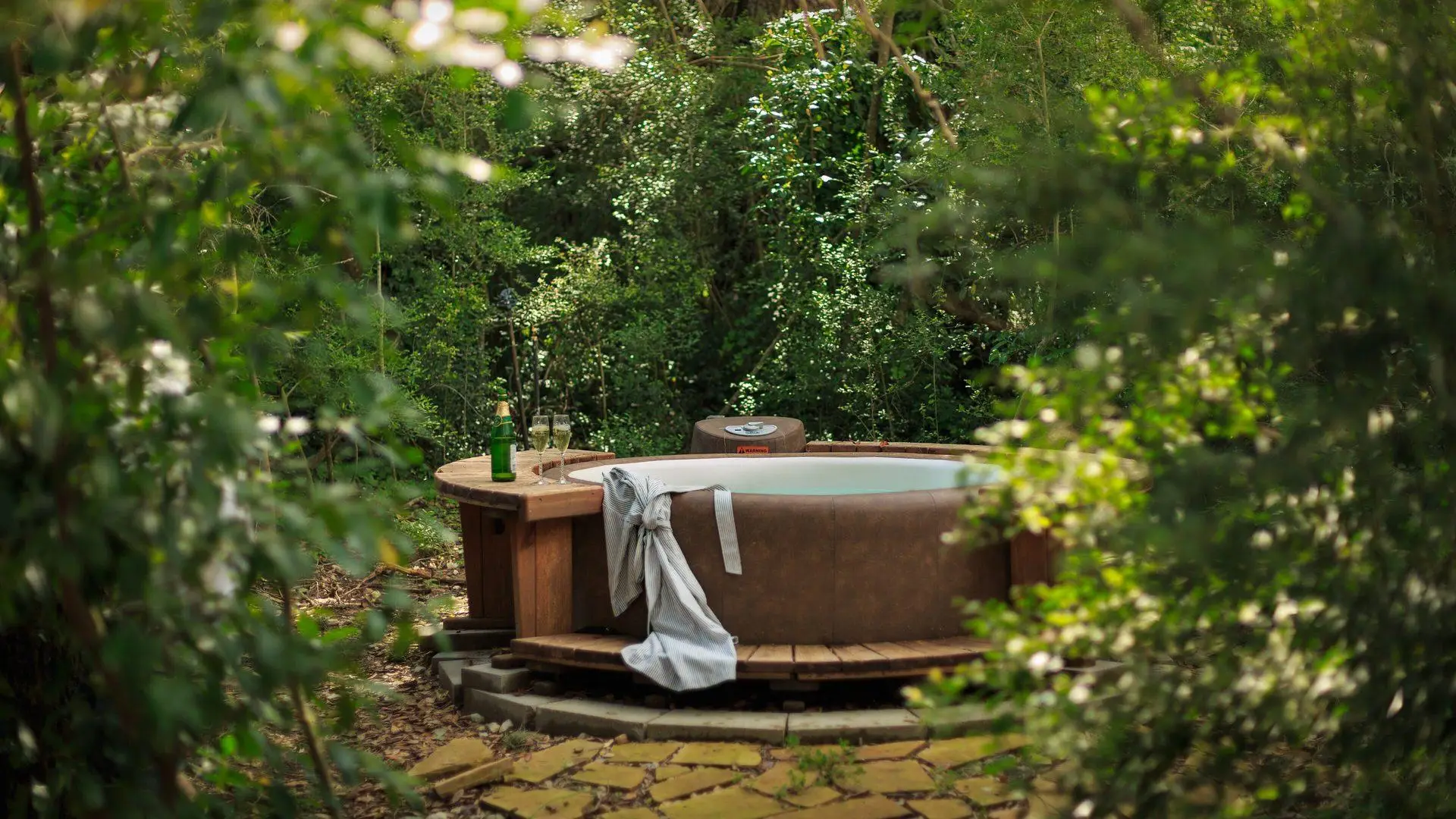
A hot tub is one of the few appliances that runs every hour of every day, and winter is when it shows up on the bill. The heater works against cold air, wind and snow sitting on the cover, and a cover that was fine in May can be soaked through by January. The good news is that most of the cost comes from heat leaking out, and most of that leak is at the top, which is the cheapest part to fix.
The short version
- Measure before you buy anything. Use your utility’s hourly data or a circuit monitor on the spa breaker for a few cold weeks.
- Look at the cover first. A heavy, sagging or steaming cover is the most common reason a winter hot tub bill jumps.
- Add a floating thermal blanket under the cover. It cuts evaporation and keeps steam out of the cover’s foam.
- Lower the setpoint a few degrees, and a lot more when you’re away. Cooler water always loses heat more slowly.
- Leave wiring, GFCI and heater problems to a licensed electrician or spa tech.
What a hot tub costs per month
The math is the same as any appliance: average watts × 730 hours in a month ÷ 1,000 = kWh, then multiply by your rate. Find your real rate on your bill by dividing the total charge by the kWh used. We use $0.17/kWh as an illustrative US average.
The hard part is the average watts. A spa heater might be 5.5 kW, but it cycles. What you pay for is how much heat the tub loses, plus the circulation pump and any jet time. These are example averages, not measurements of any particular model:
| Example setup | Average draw | kWh per month | $0.12/kWh | $0.17/kWh | $0.25/kWh | $0.35/kWh |
|---|---|---|---|---|---|---|
| Well-insulated hard-shell tub, tight cover, mild winter | ~250 W | ~183 | ~$22 | ~$31 | ~$46 | ~$64 |
| Typical hard-shell tub, older cover, cold winter | ~500 W | ~365 | ~$44 | ~$62 | ~$91 | ~$128 |
| Waterlogged cover, cold and windy, frequent soaks | ~900 W | ~657 | ~$79 | ~$112 | ~$164 | ~$230 |
| Inflatable spa run through freezing weather | ~1,000 W | ~730 | ~$88 | ~$124 | ~$183 | ~$256 |
If your number lands in the bottom two rows, the fixes below usually pay back quickly. If you’re already near the top row, there isn’t much left to squeeze.
How much energy it takes to heat the water
Water takes about 1 BTU per pound to warm 1 °F, and a gallon weighs about 8.34 pounds. One kWh is 3,412 BTU. That gives a handy rule: every 100 gallons needs about 0.24 kWh per degree.
| Tub size | kWh per 1 °F | Cost per 1 °F at $0.17 | Fill to soak (50 °F to 102 °F) | Cost of that heat-up at $0.17 |
|---|---|---|---|---|
| 250 gal (small or inflatable) | ~0.61 | ~10¢ | ~32 kWh | ~$5.40 |
| 350 gal | ~0.86 | ~15¢ | ~45 kWh | ~$7.60 |
| 450 gal | ~1.10 | ~19¢ | ~57 kWh | ~$9.70 |
| 600 gal | ~1.47 | ~25¢ | ~76 kWh | ~$13.00 |
Those are the minimums before any heat escapes during the warm-up, so real numbers run higher in cold weather. They also tell you how fast a tub recovers. A 5.5 kW heater adds about 18,800 BTU an hour, so a 400-gallon tub climbs roughly 5 to 6 °F an hour with the cover on. A 1.5 kW inflatable heater on 250 gallons manages about 2 to 3 °F an hour in good conditions and can fall behind entirely in freezing wind.
Where the heat goes
Most of the loss is at the surface. Uncovered warm water evaporates fast, and evaporation carries off a lot of heat. Under the cover, the loss depends on how well the foam insulates and how tightly the cover seals at the edges and along the fold.
The cabinet matters too. Many hard-shell tubs are filled with foam or have insulated walls and a sealed base; some cheaper or older ones have open cabinets with only a little insulation on the shell. You can’t easily change that, but you can check that the access panels close fully and the skirt isn’t broken.
Wind is the other big factor. A tub on an open deck facing the prevailing wind loses noticeably more than one tucked against the house or behind a fence.
What to do first
- Read the last few winter bills or pull hourly data from your utility’s website. Many utilities show usage by hour, and a hot tub has an obvious pattern of heater cycles through the night.
- Check the cover. Lift it. If it’s much heavier than it used to be, sags in the middle, smells musty, or melts snow faster than the deck does, the foam is probably wet.
- Look for steam on a cold morning. Steam at the fold or along one edge shows exactly where the seal is failing.
- Check the cover straps and clips. A cover that lifts in the wind is an open window.
- Look at your setpoint and filter schedule. Note what you have before you change anything so you can compare.
- If you want real numbers, put a monitor on the spa circuit. A whole-home monitor like the ones in our Emporia vs Sense comparison can track the spa breaker by itself, but have it installed by someone qualified to work in a panel.
What not to do
- Don’t push the setpoint above 104 °F. The U.S. Consumer Product Safety Commission says hot tub water should never be hotter than that.
- Don’t leave a floating blanket in while anyone is in the water, and keep kids away from an open tub. Lock the cover straps when you’re done.
- Don’t stand or sit on the cover, and don’t let heavy snow pile up for weeks. Both crush the foam.
- Don’t let a filled tub sit without power in freezing weather. If the power goes out for long, follow the maker’s freeze instructions or call a spa tech.
- Don’t run extension cords to a spa or put inline gadgets on its GFCI cord unless the manual approves them.
- Don’t block the equipment bay vents with extra insulation. Pumps and heaters need airflow.
- Don’t try to fix a tripping GFCI or a heater fault yourself. That’s a job for a licensed electrician or spa tech.
The settings that cut the bill
Setpoint
Heat loss is roughly proportional to the gap between the water and the air. On a 30 °F night, dropping from 104 °F to 100 °F shrinks that gap from 74 to 70 degrees, which is about 5 percent less heat lost. For a tub using 400 kWh a month, that’s around 22 kWh, or about $3.70 at $0.17/kWh. Worth doing, not life-changing.
Away mode
A bigger drop while you’re away saves more, and the reheat doesn’t erase it. Cooler water simply loses less heat while it sits. Many controllers have an economy or vacation mode that holds a much lower temperature. Plan around the reheat time instead: at 5 to 6 °F an hour, coming back up 20 degrees takes three to four hours.
Filter cycles and time-of-use rates
Most spa controllers let you choose when filtration runs, and some heat mainly during those cycles. On a time-of-use plan, setting the cycles overnight or outside the peak window can cut costs without using less energy. Don’t shorten filtration below what the maker recommends to save a few cents; cloudy water costs more in chemicals and draining than you’d save.
Air controls
Many tubs have air valves that pull outside air into the jets. The bubbles feel great, but in winter they cool the water fast. Close the air controls when you don’t need them, and keep jet sessions reasonable.
Which one should you buy?
- Is the cover heavy, sagging, cracked at the fold or steaming? Replace the cover before anything else.
- Is the cover in good shape but you want lower heat loss and longer cover life? Add a floating thermal blanket.
- Is the cover getting damaged because it’s hard to lift? Add a cover lifter.
- Does the cover sit in harsh sun or under heavy snow? Consider a protective outer cap.
- Do you want to know what the tub actually costs? Add a circuit monitor, or at least a wireless thermometer so you can see how fast the water drops overnight.
- Running an inflatable spa in cold weather? An insulated ground mat and an insulated dome cover are the two upgrades that help most.
Our picks
We earn a commission if you buy through these Amazon links, at no extra cost to you. Measure your tub’s shell and cabinet before you order, and check the size chart on the listing.
Best floating blanketclosed-cell foam thermal blanket
Best for: Hard-shell tubs with a decent cover where you want to cut evaporation and keep steam out of the cover foam.
Watch-outs: Comes as a square you trim to your shell’s shape with scissors. Measure the waterline, not the outside of the cabinet. Remove it before anyone gets in.
- Floating thermal hot tub blanket, 6×6 ft, 3/8 in closed-cell foam Check price on Amazon
Cheaper floating blanket16 mil bubble cover
Best for: A low-cost first step, or larger shells where the foam blanket size doesn’t fit.
Watch-outs: Bubble sheets insulate less than closed-cell foam and break down faster in hot, chlorinated water. Put the bubble side down and trim to fit.
- TOPZEA 7×7 ft hot tub bubble blanket Check price on Amazon
- Angooni 6×6 ft hot tub bubble blanket Check price on Amazon
Best replacement covercustom-made hard cover
Best for: Covers that are waterlogged, cracked at the hinge or no longer seal. Custom covers are built to your shell’s measurements and corner radius.
Watch-outs: Measure carefully, including corner radius, skirt length and strap locations, and confirm the foam thickness and taper before you order. In a cold climate, a thicker taper is worth it.
- The Cover Guy custom replacement spa cover Check price on Amazon
- The Cover Guy premium custom spa cover Check price on Amazon
Best cover lifters
Best for: Covers that get dragged off the edge, or tubs where the cover stays half-on because it’s a hassle to lift.
Watch-outs: Check the fit range for your cabinet size, the clearance behind the tub, and whether it mounts under the cabinet or on the side.
- Cover Valet spa cover lifter Check price on Amazon
- The Cover Rock-It cover lifter Check price on Amazon
- The Cover Guy hydraulic cover lifter Check price on Amazon
Protective outer cap
Best for: Covers that sit in strong sun or under snow. A cap protects the vinyl and keeps rain off the seams.
Watch-outs: It doesn’t add much insulation by itself and it won’t fix a waterlogged cover. Match the cap size to your cover, not the shell.
- ULTCOVER waterproof square spa cover cap, 95 in Check price on Amazon
Best way to see what’s happeningwireless thermometer and circuit monitor
Best for: Seeing how fast the water drops overnight with the cover on, and what the spa circuit actually uses.
Watch-outs: A thermometer tells you about heat loss, not kWh. The monitor needs to be installed in your electrical panel by someone qualified.
- GoveeLife P2 wireless pool and spa thermometer Check price on Amazon
- Emporia Vue 3 home energy monitor Check price on Amazon
For inflatable spasground mat and insulated cover
Best for: Inflatable tubs sitting on a cold patio or deck, where a lot of heat goes straight into the ground and out the thin lid.
Watch-outs: Match the mat and cover to your spa’s exact diameter and height. Check the manual for the lowest air temperature your spa is meant to run in.
- tonchean 77 in round foam hot tub mat Check price on Amazon
- NOVWANG 78 in round hot tub mat Check price on Amazon
- 78 in round insulated inflatable hot tub thermal cover Check price on Amazon
Amazon links may earn us a commission as an Amazon Associate at no extra cost to you (disclosure).
Four example households
These are worked examples to show how the numbers move. Your tub, climate and rate will differ.
A tight tub in a mild winter. A 350-gallon hard-shell tub with a three-year-old cover, sheltered from wind, kept at 100 °F. It averages about 250 W, or roughly 183 kWh a month, about $31 at $0.17/kWh. A floating blanket might shave a little off, but the bigger win is protecting the cover so it stays this way.
A typical tub with an aging cover. A 450-gallon tub at 104 °F on an open deck in a cold winter, averaging about 500 W, or 365 kWh and $62 a month. Dropping to 100 °F, adding a foam blanket and closing the air controls could plausibly trim 10 to 15 percent, around $6 to $9 a month.
The waterlogged cover. The same tub with a cover that now takes two people to lift and steams at the fold. If usage climbs to around 650 kWh a month, that’s about $110 at $0.17/kWh and $160 at $0.25/kWh. Getting back to the previous row saves roughly $48 a month at $0.17, or around $240 over a five-month winter. That’s the case where a new custom cover pays for itself.
The inflatable spa in the cold. A 250-gallon inflatable on a concrete patio with a 1.5 kW heater, running through freezing nights. It can end up near 700 kWh a month, around $120 at $0.17/kWh, and still struggle to hold temperature. An insulated mat, an insulated dome cover and a spot out of the wind help, but many owners save the most by draining and storing it until spring, following the maker’s instructions.
Covers: when to replace and what to look for
A good cover is the single biggest piece of a winter hot tub bill, and covers wear out. Steam slowly works its way through the vapor barrier into the foam, and wet foam insulates poorly and gets heavy. Many owners replace covers every few years, sooner in harsh climates.
When you shop for a replacement:
- Measure the shell, not the old cover. Note corner radius, skirt length, and where the straps attach.
- Pick a tapered foam core so water runs off. Thicker tapers hold more heat in cold climates.
- Look for a sealed vapor barrier around each foam panel and a gasket or heat seal along the fold.
- Plan to keep it dry. A floating blanket underneath and a lifter on the side both extend its life.
Troubleshooting
| Symptom | Likely cause | Fix |
|---|---|---|
| Bill jumped this winter with no change in use | Waterlogged or damaged cover; cold snap | Check cover weight and look for steam at the fold; compare with last winter’s hourly data |
| Water drops several degrees overnight | Cover not sealing, straps loose, wind lifting cover | Tighten straps, check the fold seal, add a floating blanket |
| Heater runs constantly and can’t keep up | Air controls open, cover off too long, inflatable heater too small for the cold | Close air valves, keep sessions shorter, insulate the base, check the manual’s minimum air temperature |
| Cover is heavy and smells musty | Foam has absorbed water | Replace the cover; add a floating blanket under the new one |
| Snow melts on the cover but not the deck | Heat escaping through the cover | Same as above; check the fold and edges first |
| Filter cycles run during your peak rate hours | Default controller schedule | Move filtration to off-peak in the controller settings |
| GFCI trips or heater error codes | Electrical or heater fault | Call a licensed electrician or spa tech; don’t reset repeatedly |
| Ice forming around the equipment bay | Possible leak or heat loss from the cabinet | Find the leak quickly; freezing water can crack fittings, so call a spa tech |
Bottom line
A hot tub’s winter bill is mostly about heat escaping through the top. Measure what yours uses, check the cover before anything else, add a floating blanket, and lower the setpoint a few degrees and a lot more when you’re away. Replace the cover when it’s waterlogged, because that’s where the big savings are. If you’re also protecting outdoor plumbing for the winter, see our guides to outdoor faucet covers and pipe heat tape, and for everything else in the house, start with the priority checklist.
Some links on this page go to Amazon, and we earn a commission if you buy, at no extra cost to you. Prices and savings vary by home and utility rate. More in our disclosure.