Holiday lights are one of the few seasonal loads you control completely: you pick the bulbs, the count, and the hours. The bill is just watts × hours × your rate, so the two levers are lower-watt lights and fewer hours on. Work out what your own display costs first. A timer fixes the lights-on-all-night problem for free, and you only need to replace strings where the math says it pays.
The short version
- One LED mini string is pocket change — about a quarter a season on a timer at $0.17/kWh.
- The money is in three places: incandescent C7/C9 strings, blower inflatables, and hours (all night or 24/7).
- Cheapest wins, in order: read the watts → put everything on an outdoor timer with a fixed off time → unplug inflatables early → replace incandescent C9s and big incandescent runs first → leave working LED alone.
- Watch out for dusk-to-dawn sensors without a countdown. They run your lights all night, roughly 14–15 hours in December.
The formula
kWh = watts × hours on ÷ 1,000. Cost = kWh × your all-in rate. Total watts is on the string’s tag or box; add every string, inflatable, projector, and animated figure.
Find your real rate: total electric bill ÷ total kWh used, including delivery and fees — not just the supply price. Many US households land somewhere around $0.12–$0.30/kWh. If you’re on time-of-use, write down your evening peak price separately; holiday lights run right in that window (see below).
Typical watts by light type
These are common label ranges, not promises. Your tag wins. Watts ≈ amps × 120 when only amps are printed.
| Light type | Typical incandescent | Typical LED |
|---|---|---|
| Mini string, 100 bulbs | ~40 W (about 0.4 W per bulb) | ~5–7 W |
| C7 string, 25 bulbs | ~125 W (about 5 W per bulb) | ~10–20 W |
| C9 string, 25 bulbs | ~175 W (about 7 W per bulb) | ~15–25 W |
| Icicle or net light, ~150 bulbs | ~60 W | ~7–12 W |
| Window candle, 1 bulb | ~4–7 W | ~0.5–1 W |
| Light projector (laser/LED) | — | ~5–20 W |
| Blower inflatable, small to large | — | ~50–200 W (fan plus lights) |
| Lighted animated figure | Varies widely; meter it | Varies widely; meter it |
Two things jump out. An incandescent C9 string can draw as much as 25–35 LED mini strings. And inflatables are mostly a fan — LED bulbs inside don’t make the fan cheaper.
Hours matter as much as watts
| Schedule | Hours per night | Hours over a 40-night season |
|---|---|---|
| Dusk to 10 pm (December) | ~5 | ~200 |
| Dusk to 11 pm | ~6 | ~240 |
| Dusk to dawn (plain photocell) | ~14–15 | ~560–600 |
| Left on 24/7 | 24 | 960 |
Dusk comes around 4:30–5:00 pm in much of the continental US in December, so “dusk to 11” is about 6 hours. A plain dusk-to-dawn sensor more than doubles that, and 24/7 quadruples it. Same lights, 2–4× the bill.
Cost per 100 watts per season (40 nights)
Use this as a lookup: find your total watts, divide by 100, and multiply by the number in your column.
| Schedule | at $0.12/kWh | at $0.17/kWh | at $0.30/kWh |
|---|---|---|---|
| 5 hr/night (200 hr, 20 kWh) | ~$2.40 | ~$3.40 | ~$6.00 |
| 6 hr/night (240 hr, 24 kWh) | ~$2.88 | ~$4.08 | ~$7.20 |
| Dusk to dawn (560 hr, 56 kWh) | ~$6.72 | ~$9.52 | ~$16.80 |
| 24/7 (960 hr, 96 kWh) | ~$11.52 | ~$16.32 | ~$28.80 |
Example: a 600 W display left dusk-to-dawn at $0.17 is 6 × $9.52 ≈ $57 a season. On a 6-hour timer it’s 6 × $4.08 ≈ $24.50.
Example season math by item (illustrative, $0.17/kWh, 40 nights)
| Item (typical label watts) | 6 hr/night (timer) | Dusk to dawn (~14 hr) | 24 hr/day (left on) |
|---|---|---|---|
| LED mini string, 100 bulbs (~6 W) | ~1.4 kWh, ~25¢ | ~3.4 kWh, ~57¢ | ~5.8 kWh, ~$1 |
| Incandescent mini string, 100 bulbs (~40 W) | ~9.6 kWh, ~$1.65 | ~22.4 kWh, ~$3.80 | ~38 kWh, ~$6.50 |
| Incandescent C9 string, 25 bulbs (~175 W) | ~42 kWh, ~$7 | ~98 kWh, ~$16.65 | ~168 kWh, ~$28.55 |
| LED C9 string, 25 bulbs (~20 W) | ~4.8 kWh, ~80¢ | ~11.2 kWh, ~$1.90 | ~19 kWh, ~$3.25 |
| Blower inflatable (~150 W) | ~36 kWh, ~$6 | ~84 kWh, ~$14.30 | ~144 kWh, ~$24.50 |
Read the table honestly: one LED mini string is pocket change either way. The money is in incandescent C7/C9 strings, inflatables, and long hours. A big mixed display left on all night can reach tens of dollars a season; the same display on a timer is often a third to a quarter of that.
Four worked displays (example numbers)
These are illustrative households using the typical watts above. Swap in your own tags and rate.
A. Apartment balcony: three LED mini strings
- Load: 3 × ~6 W = 18 W.
- On a 6-hour timer for 40 nights: 18 W × 240 hr = 4.3 kWh ≈ $0.73 at $0.17.
- Left on 24/7: 17.3 kWh ≈ $2.94.
- Verdict: a timer saves about $2 a season. Buy one for convenience if you like; it’s not a money project. Spend energy on drafts and heating instead.
B. Classic incandescent roofline: four C9 strings plus six incandescent minis
- Load: 4 × ~175 W + 6 × ~40 W = 940 W (about 7.8 amps — fine on a 15 A circuit, but check each string’s max-connect).
- Dusk to dawn (~14 hr × 40 nights = 560 hr): 526 kWh ≈ $89 at $0.17.
- Same lights on a 6-hour timer (240 hr): 226 kWh ≈ $38. The timer alone saves about $51 this season.
- Same display in LED (4 × ~20 W C9 + 6 × ~6 W mini = ~116 W) on the timer: 27.8 kWh ≈ $4.73 — about $34 more saved per season.
- Verdict: timer first (it pays back in days), then replace the C9s first because they’re 700 of the 940 watts. Payback on LED replacements = what you spend ÷ about $34 per season; for example, $60 of replacement strings would pay back in roughly two seasons at this rate and schedule.
C. Inflatable yard: three blowers, two projectors, four LED strings
- Load: inflatables ~100 + 150 + 200 W, projectors 2 × ~10 W, LED strings 4 × ~6 W = 494 W.
- Left on 24/7 for 35 days (840 hr): 415 kWh ≈ $70.50 at $0.17.
- On a 5-hour evening timer (175 hr): 86 kWh ≈ $14.70. Savings ≈ $56 a season.
- Verdict: the inflatables are 91% of the watts. LED swaps barely matter here; the timer is the whole game. Deflated inflatables also hold up better in wind and snow.
D. Big mixed LED display in a high-rate area ($0.30/kWh)
- Load: 30 LED minis (~180 W) + 10 LED C9s (~200 W) + four inflatables (~480 W) + misc (~40 W) = ~900 W.
- Dusk to about 11:30 pm, 45 nights (~292 hr): 263 kWh ≈ $79.
- Change: put the inflatables on their own timer that ends 2.5 hours earlier. That’s 480 W × 112 hr ≈ 54 kWh ≈ $16 saved, with the light show unchanged.
- Verdict: in high-rate areas, split the display into two timers — strings late, inflatables early — and consider trimming the start time if your evening peak rate applies.
Check your home before you buy
- Read the tags. Every UL- or ETL-listed string lists watts or amps (watts ≈ amps × 120). Write down each item.
- Meter what you can’t read — indoors, before you hang it. Plug a string, figure, or inflatable into a Kill A Watt for an hour and read watts or kWh. Plug-in meters are indoor devices with a ~15 A limit; don’t leave one outside.
- Count your hours. Dusk to 11 pm is about 6 hours in December; dusk to dawn is about 14–15; “always on” is 24.
- Add it up with the cost-per-100-watts table above.
- Check after a week. If your utility shows daily or hourly usage, compare a week with the display to a similar week without it. The difference should roughly match your math; if it’s much higher, something is on longer than you think.
Timer types compared
| Type | How it schedules | Good for | Watch-outs |
|---|---|---|---|
| Outdoor 24-hour mechanical dial | Push pins in 30-minute segments, repeats daily | Cheap, simple, no Wi-Fi | Drifts after a power outage until reset; no sunset tracking |
| Outdoor 7-day digital | Programmed on/off times, often several programs | Weekend vs weekday schedules | Fixed on time doesn’t follow earlier sunsets; more buttons |
| Photocell dusk-to-dawn only | On at dark, off at light | Security lighting | Runs all night — not a savings device for décor |
| Photocell + countdown | On at dusk, off after 2–8 hours | Holiday displays; follows sunset automatically | Porch lights or headlights hitting the sensor can confuse it |
| Outdoor smart plug | App schedules, often sunset-based starts | Remote control, separate outlets, vacation mode | Needs Wi-Fi reaching outside; app setup |
For most displays, photocell + countdown or an outdoor smart plug with a sunset start and fixed off time gives the best mix of “on when it’s dark” and “off when nobody is looking.”
Split the display. If you have inflatables plus strings, two timers (or a two-outlet smart plug controlled separately) lets you run the fans for fewer hours than the lights, as in display D.
Once the decorations come down, a heavy-duty outdoor timer is just as useful for a car’s engine block heater. See our block heater guide for how long to run one.
Time-of-use: holiday lights run during peak
Many time-of-use plans charge the most in the late afternoon and early evening — often until about 8 or 9 pm — exactly when holiday lights are on. Check your plan’s exact windows on your bill or utility account.
- Example (illustrative): 500 W running 4 peak hours a night for 40 nights = 80 kWh. At a $0.45 peak rate that’s $36; at a $0.15 off-peak rate it would be $12.
- What helps: LED (fewer watts in the expensive hours), starting 30–60 minutes later, and keeping heavy items like inflatables off during peak or limited to a short window.
- What doesn’t: running the display late at night to “use off-peak power” — nobody sees it, so it’s still wasted.
Free and cheap fixes, in order
- Schedule it with a fixed off time. Dusk-to-bedtime is the biggest single cut and works with lights you already own. Outdoor-rated timers or outdoor smart plugs only.
- Shorten inflatable hours — their fans run the whole time they’re plugged in.
- Turn indoor tree and window lights off at bedtime too. Ten incandescent window candles at ~5 W left on all night is ~50 W × 14 hr — small, but free to fix with a plug-in timer or LED candles.
- Replace only the heavy hitters. Swap incandescent C7/C9 strings and big incandescent runs first; leave working LED strings alone.
- Don’t buy more than you’ll run. The cheapest watt is the string you skip.
- Unplug and store timers, smart plugs and extension cords after the season, both to stop small standby draw and to keep them out of the weather.
LED replacement payback per string, per season
Savings from swapping one string, 40 nights. Divide what a replacement costs you by the number in your row to get seasons to payback.
| Swap | Schedule | at $0.12 | at $0.17 | at $0.30 |
|---|---|---|---|---|
| Incandescent mini (~40 W) → LED mini (~6 W) | 6 hr/night | ~$0.98 | ~$1.39 | ~$2.45 |
| Incandescent mini → LED mini | Dusk to dawn | ~$2.28 | ~$3.24 | ~$5.71 |
| Incandescent C9 (~175 W) → LED C9 (~20 W) | 6 hr/night | ~$4.46 | ~$6.32 | ~$11.16 |
| Incandescent C9 → LED C9 | Dusk to dawn | ~$10.42 | ~$14.76 | ~$26.04 |
| Inflatable (~150 W): 24/7 → 6 hr timer | — | ~$12.96 | ~$18.36 | ~$32.40 |
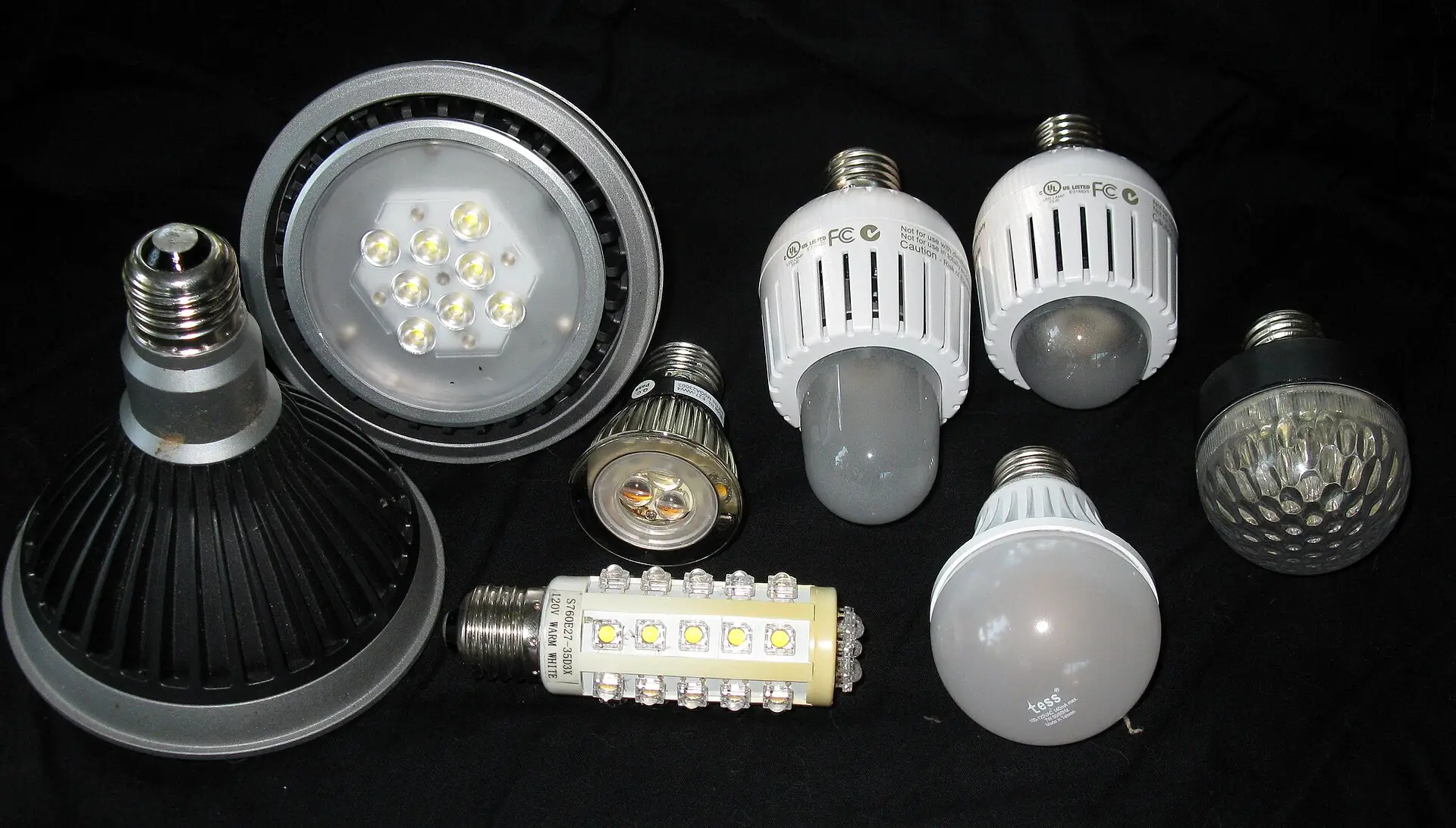
The pattern: mini-string swaps rarely pay back quickly on energy alone unless you run a lot of them all night at a high rate. C9 swaps and inflatable timers pay back fast. LEDs also last longer, run cooler, and let you link more strings per outlet — real benefits, but not bill math.
Circuit, outlet and plug limits
- String max-connect: printed on the tag. Incandescent minis often allow only a few strings end-to-end; LEDs usually allow many more. Don’t exceed it — that’s how plugs and fuses overheat.
- Circuit: a 15 A household circuit is about 1,800 W total. For loads that run 3+ hours, staying under about 80% (≈12 A or ≈1,440 W) is good practice — and count whatever else is on that circuit (garage freezer, porch light, outdoor outlets often share).
- Timer and plug rating: many outdoor plug-in timers are rated around 15 A / 1,875 W, and some smart plugs less per outlet — check the label, and remember a two-outlet timer’s rating is usually the total, not per outlet.
- Cords: use outdoor-rated extension cords sized for the load; long runs of thin cord to heavy incandescent displays get warm.
Troubleshooting
| Symptom | Likely cause | Fix |
|---|---|---|
| Timer clicks on but nothing lights | GFCI outlet tripped (often moisture) | Reset the GFCI; lift connections off the ground, add drip loops, cover plug joints with outdoor-rated covers |
| GFCI trips every time it rains | Water in a connection or a damaged cord | Find it by plugging in sections one at a time; replace damaged strings; never bypass the GFCI |
| Photocell timer flickers on and off at dusk | Porch light, streetlight or headlights hitting the sensor | Aim the sensor away from other lights, or switch to a fixed schedule |
| Lights on during the day after a storm | Mechanical timer lost time in a power outage | Reset the dial; consider a digital or smart timer that keeps time |
| Smart plug offline outside | Wi-Fi doesn’t reach that outlet | Move the router or add an extender, or use a non-Wi-Fi timer there |
| Bill jumped more than your math | Inflatables or strings running 24/7, or someone overriding the timer | Meter one night; check the timer’s actual on/off times; check daily usage in your utility account |
| Half an incandescent mini string is dark | One loose or failed bulb in that section | Reseat or replace bulbs; if it’s old, it may be time for an LED string |
Ten-minute season plan (worksheet)
Copy this into a note before you hang anything:
- List every item and its tag watts (or metered watts). Total them.
- Split into two groups: “lights” (strings, projectors, candles) and “fans and motors” (inflatables, animated figures).
- Pick hours for each group. For example, lights dusk to 10:30 pm, fans dusk to 9 pm.
- Estimate the season: watts ÷ 100 × the cost-per-100-watts number for each group’s schedule, then add them.
- Check the circuit: total watts on each outdoor circuit under ~1,440 W for long runs, and each string within its max-connect.
- Decide on purchases last: a timer if you don’t have one; LED replacements only for the items with the biggest per-string savings in the payback table.
Most households finish this and find the answer is “one or two timers, maybe new C9s” — not a full LED replacement.
When buying makes sense
- You have no timer and run lights 10+ hours a night: an outdoor timer or outdoor smart plug usually pays back in one season on any display bigger than a couple of strings.
- You have inflatables: a timer that ends their night early is the highest-return purchase in this guide (display C).
- You run incandescent C9s or lots of incandescent minis all night: LED replacements usually pay back in one to three seasons depending on hours and rate.
- You’re on a high rate or time-of-use plan: the same swaps pay back roughly twice as fast at $0.30 as at $0.17.
- You already run LED on a schedule: you’re done. Spend the effort on heating and drafts instead, where the dollars are much larger.
Our picks
These listings were checked against Amazon product pages on 2026-10-13. Check current listings, ratings, and outdoor/wet ratings before buying.
Outdoor smart plug (schedules, sunset timing in the app, two separately controllable outlets)
- Kasa Outdoor Smart Plug EP40 (IP64 weather resistance, 2 sockets) Check price on Amazon — use on a GFCI-protected outdoor receptacle; good for splitting strings and inflatables onto separate schedules.
Dusk start with a countdown (follows sunset, shuts off on its own)
- Woods 50122WD Outdoor Dusk to Dawn Lighting Timer, 2 grounded outlets, light sensor with 2–8 hour countdown Check price on Amazon — use the countdown setting; dusk-to-dawn mode runs all night.
Fixed schedules, no Wi-Fi
- BN-LINK Outdoor 24-Hour Mechanical Timer Outlet, 2 grounded outlets, 30-minute intervals, weatherproof cover Check price on Amazon — simplest option; reset after power outages.
- BN-LINK Outdoor 7-Day Programmable Timer Outlet, 2 outlets, 8 on/off programs, 15A/1875W Check price on Amazon — weekend vs weekday schedules.
Measure before you hang
- P3 Kill A Watt P4400 plug-in electricity usage monitor (meter a string or inflatable indoors) Check price on Amazon
Want LED strings? Buy UL- or ETL-listed sets rated for outdoor use and compare the printed watts; we don’t link a specific string here because listings change constantly.
Safety rules
- No indoor plugs, timers, or extension cords outdoors. Use outdoor-rated gear on GFCI outlets.
- Don’t exceed the max-connect number printed on a string, or the plug’s or timer’s watt/amp rating.
- Don’t staple or nail through wires; use plastic clips. Keep connections off the ground and out of snow and puddles.
- Throw out strings with cracked insulation or broken sockets. Don’t run cords through closed doors or windows where they get pinched.
- Keep inflatables staked and tethered; unplug them in high wind.
- Turn displays off when you’re away or asleep if they aren’t on a timer.
What this won’t fix
Holiday lighting is a small, seasonal part of most bills — even the big incandescent example above is under $100 for a season. Wattages above are typical, not universal; your strings’ labels win. Payback numbers assume your rate, hours, and what you pay for replacements.
Bottom line
Read the watts → put it on an outdoor timer with a fixed off time (not dusk-to-dawn) → give inflatables a shorter schedule → replace incandescent C9s and big incandescent runs first → leave working LED alone. Then put real effort into the bigger winter moves on Start Here. Amazon links may earn a commission as an Associate (disclosure).
Some links on this page go to Amazon, and we earn a commission if you buy, at no extra cost to you. Prices and savings vary by home and utility rate. More in our disclosure.