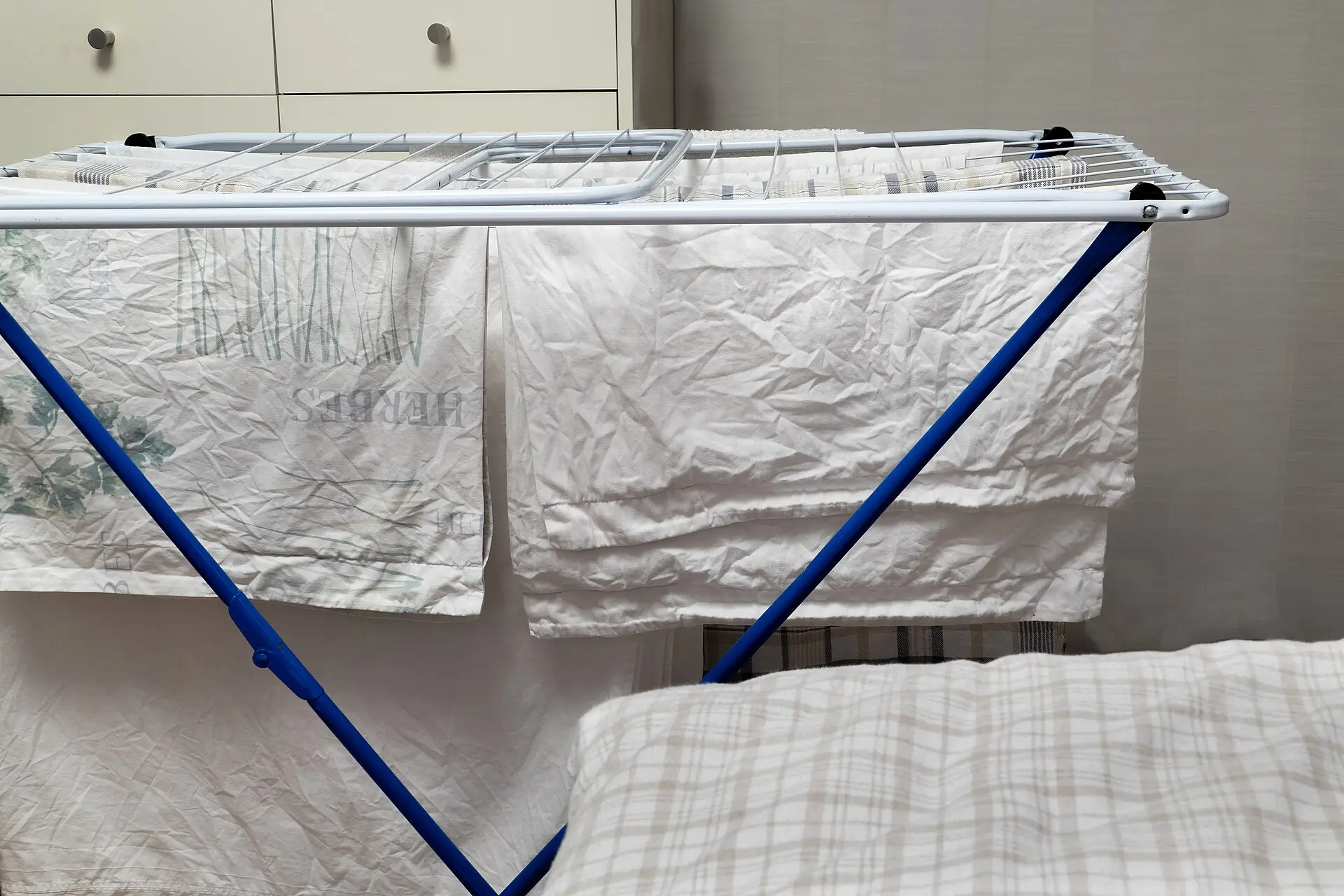
Laundry is one of the easiest places to see real money because you do it every week. The honest question is what one load costs on your bill — and which settings actually change it. We’ll do the per-load math at your rate and show where the energy really goes: hot water and the dryer, not the washer motor. There are also four example households and notes on when buying anything makes sense.
The short version
- Washer motor: pennies per load. Not where the money is.
- Hot water: the real washer cost — and it shows up on your water heater, not the washer.
- Dryer: usually the single biggest laundry line item, especially electric.
- Cheapest wins, in order: wash cold → max spin → clean lint filter and vent → air-dry some loads → shift to off-peak if you’re on time-of-use → only then think about new machines.
Where the energy in a load goes
- Washer motor and controls: small — typically about 0.1–0.3 kWh per load for a modern machine.
- Hot water for the wash: the big washer cost. ENERGY STAR and DOE commonly cite roughly 90% of washer energy going to heating water. A warm or hot load can draw several gallons of hot water from your water heater.
- Dryer: typically the largest single laundry cost. Electric dryers commonly use about 2–5 kWh per load depending on load size, spin, settings and vent condition.
- Optional extras: “steam,” “sanitize” and “allergen” cycles on many front-loaders use an internal heater inside the washer to push water hotter. That’s extra electricity on top of whatever your water heater supplied.
Step 1: Find your rate
Your effective electric rate = total bill ÷ total kWh (include delivery and fees). Gas rate = total gas bill ÷ therms. Use those, not the advertised supply rate. If you’re on a time-of-use plan, write down the peak and off-peak prices separately — laundry is one of the easiest loads to shift.
Step 2: What one gallon of hot water costs
Heating a gallon of water from about 50°F to 120°F takes roughly 8.34 lb × 70°F ≈ 584 BTU, or about 0.17 kWh. Real water heaters lose some of that, so as planning numbers:
| Water heater type | Energy per hot gallon (approx.) | Cost per hot gallon |
|---|---|---|
| Electric tank (resistance) | ~0.18 kWh | ~$0.022 at $0.12 · ~$0.031 at $0.17 · ~$0.054 at $0.30 |
| Gas tank (~60% efficient overall) | ~0.0097 therm | ~$0.010 at $1.00 · ~$0.015 at $1.50 · ~$0.020 at $2.00/therm |
| Heat pump water heater (UEF ~3.5) | ~0.05 kWh | ~$0.006 at $0.12 · ~$0.008 at $0.17 · ~$0.015 at $0.30 |
Colder incoming water in winter (40°F in much of the north) raises these by about 15%. A higher tank setpoint raises them too — which is one reason ~120°F is the usual recommendation.
Step 3: Hot-water cost per load by washer type
Hot gallons per load vary a lot by model, load size and cycle. These are illustrative planning numbers, not ratings:
| Washer type and cycle | Hot gallons (approx.) | Electric WH at $0.17 | Gas WH at $1.50/therm | Heat pump WH at $0.17 |
|---|---|---|---|---|
| Any modern washer, cold | ~0 | ~$0.00 | ~$0.00 | ~$0.00 |
| Front-loader, warm | ~4 | ~$0.12 | ~$0.06 | ~$0.03 |
| Front-loader, hot | ~8 | ~$0.25 | ~$0.12 | ~$0.07 |
| HE top-loader, warm | ~6 | ~$0.19 | ~$0.09 | ~$0.05 |
| HE top-loader, hot | ~12 | ~$0.37 | ~$0.18 | ~$0.10 |
| Older agitator top-loader, warm | ~10 | ~$0.31 | ~$0.15 | ~$0.08 |
| Older agitator top-loader, hot | ~18 | ~$0.56 | ~$0.26 | ~$0.15 |
The takeaway: on an electric water heater with an older top-loader, every hot load can cost more than half a dollar before drying. On gas or a heat pump water heater, cold wash still saves money, just less.
Step 4: Dryer cost per load by type and rate
| Dryer and load | Energy (approx.) | At $0.12/kWh | At $0.17/kWh | At $0.30/kWh |
|---|---|---|---|---|
| Electric, small or well-spun load | ~2 kWh | ~$0.24 | ~$0.34 | ~$0.60 |
| Electric, typical load | ~3.3 kWh | ~$0.40 | ~$0.56 | ~$0.99 |
| Electric, heavy towels / weak spin / restricted vent | ~4.5 kWh | ~$0.54 | ~$0.77 | ~$1.35 |
| Heat pump dryer, typical load | ~1.3 kWh | ~$0.16 | ~$0.22 | ~$0.39 |
Gas dryer: roughly 0.15–0.25 therm of gas plus about 0.3 kWh for the drum motor and controls. At $0.17/kWh that’s about $0.25 at $1.00/therm, $0.35 at $1.50, $0.45 at $2.00 per typical load.
Step 5: Put it together — cost per load
| Combination (typical load, $0.17/kWh, $1.50/therm) | Approx. cost per load |
|---|---|
| Cold wash + air-dry | ~$0.03 |
| Cold wash + gas dryer | ~$0.38 |
| Cold wash + heat pump dryer | ~$0.25 |
| Cold wash + electric dryer | ~$0.59 |
| Warm wash (front-loader, electric WH) + electric dryer | ~$0.71 |
| Hot wash (older top-loader, electric WH) + electric dryer | ~$1.15 |
These are illustrative ranges, not measurements of your machines.
Weekly example (7 loads, $0.17/kWh, older top-loader, electric everything): hot wash + electric dry ≈ 7 × ($0.03 + $0.56 + $0.56) ≈ $8.05/week, ~$420/year. Cold wash + electric dry ≈ $4.10/week. Cold wash + air-dry half the loads ≈ $2.20/week. That’s the real-money spread.
Annual laundry cost by loads per week
Pick your per-load cost from the table above, then find your loads per week:
| Cost per load | 3 loads/wk | 5 loads/wk | 7 loads/wk | 10 loads/wk |
|---|---|---|---|---|
| $0.10 | ~$16/yr | ~$26/yr | ~$36/yr | ~$52/yr |
| $0.40 | ~$62/yr | ~$104/yr | ~$146/yr | ~$208/yr |
| $0.70 | ~$109/yr | ~$182/yr | ~$255/yr | ~$364/yr |
| $1.10 | ~$172/yr | ~$286/yr | ~$400/yr | ~$572/yr |
If you’re in the bottom row with a big family, laundry is worth an evening of attention. If you’re in the top row, your money is better spent on heating, cooling and water heating.
Four worked household examples (illustrative)
All examples assume a typical load, $0.17/kWh and $1.50/therm unless noted, and 52 weeks a year. Swap in your own rates, machines and loads.
1. Couple, 4 loads/week, front-loader, electric water heater, electric dryer, everything on warm.
- Now: 4 × ($0.03 motor + $0.12 warm water + $0.56 dryer) ≈ $2.84/week ≈ $148/year
- Switch to cold: 4 × $0.59 ≈ $2.36/week ≈ $123/year (saves ~$25)
- Cold + air-dry 2 of 4 loads: (4 × $0.03) + (2 × $0.56) ≈ $1.24/week ≈ $64/year
- Savings ≈ $84/year, mostly from the rack (~$58/year of it), so a $27 rack pays back in about 6 months.
2. Family of four, 9 loads/week, older agitator top-loader, electric water heater, electric dryer, 5 hot + 4 warm loads. The weaker spin leaves clothes wetter, so assume ~4 kWh per dryer load ($0.68).
- Now: 5 × ($0.03 + $0.56 + $0.68) + 4 × ($0.03 + $0.31 + $0.68) ≈ $6.35 + $4.08 ≈ $10.43/week ≈ $542/year
- All cold: 9 × ($0.03 + $0.68) ≈ $6.39/week ≈ $332/year (saves ~$210)
- All cold + air-dry 3 loads/week: (6 × $0.71) + (3 × $0.03) ≈ $4.35/week ≈ $226/year
- Savings ≈ $316/year with no new machines. This is the household where a high-spin front-loader is worth pricing when the old washer dies.
3. Gas house, 7 loads/week, HE top-loader on warm, gas water heater, gas dryer.
- Now: 7 × ($0.03 + $0.09 warm water + $0.35 gas dry) ≈ $3.29/week ≈ $171/year
- Cold: 7 × $0.38 ≈ $2.66/week ≈ $138/year (saves ~$33)
- Cold + air-dry 2 loads/week: (5 × $0.38) + (2 × $0.03) ≈ $1.96/week ≈ $102/year
- Savings ≈ $69/year. Smaller, because gas is cheap per unit of heat — don’t expect electric-house numbers here.
4. High-rate all-electric home ($0.30/kWh), 6 loads/week, front-loader, 2 hot + 4 warm, electric dryer at 3.3 kWh.
- Per load at $0.30: motor ~$0.06, hot water ~$0.43 (hot) or ~$0.22 (warm), dryer ~$0.99
- Now: 2 × ($0.06 + $0.43 + $0.99) + 4 × ($0.06 + $0.22 + $0.99) ≈ $2.96 + $5.08 ≈ $8.04/week ≈ $418/year
- Cold + air-dry 3 loads/week: (6 × $0.06) + (3 × $0.99) ≈ $3.33/week ≈ $173/year
- Savings ≈ $245/year. If the dryer is due anyway, a heat pump dryer (~$0.39/load here) would save about $0.60 per remaining dryer load — about $94/year at 3 loads/week.
Spin speed: the cheap dryer cut
Dryer energy roughly tracks how much water is left in the clothes. An 8 lb load spun to about 65% remaining moisture (common for older top-loaders) holds ~5.2 lb of water; spun to about 45% (common for high-spin front-loaders) it holds ~3.6 lb — roughly 30% less water to evaporate. That often shows up as noticeably shorter dry times.
- Use the highest spin the fabric allows (towels and jeans can take max spin).
- Add an extra spin on heavy loads if your machine offers it — it costs a fraction of a cent in motor energy versus several cents of dryer time.
- Don’t overload: a packed drum spins and tumbles less effectively.
Vent and lint: the hidden dryer tax
A restricted vent makes the dryer run longer for the same load, and it’s a fire risk. Illustrative math: if a clogged vent pushes a 3.3 kWh load to ~4.3 kWh, that’s about $0.17 more per load at $0.17/kWh — about $62/year at 7 loads a week.
- Clean the lint filter every load; wash it with soap and water every few months if fabric softener film builds up (hold it under the tap — if water pools instead of passing through, it’s coated).
- Brush the full vent run at least yearly with a vent cleaning kit; more often for long runs or big families.
- Check the outdoor flap opens freely while the dryer runs.
- Replace white vinyl or crinkly foil transition ducts with semi-rigid or rigid metal, as short and straight as practical.
Time-of-use: when you dry matters
On a flat rate, time doesn’t matter. On a time-of-use plan, a 3.3 kWh electric dryer load costs ~$1.32 at a $0.40 peak rate versus ~$0.40 at a $0.12 off-peak rate. At 5 dryer loads a week, shifting all of them off-peak is worth about $240/year in that example. Hot washes on an electric water heater shift too, though the tank may reheat later anyway — a water heater timer helps there.
Practical rules: start loads when you’re home and awake, use the delay-start feature on the washer rather than leaving a dryer running unattended, and confirm your plan’s exact windows on your bill.
Step 6: Measure what you can
- Washer (120V): plug it into a Kill A Watt P4400 (check the washer’s amp rating is within the meter’s 15A limit — washers with internal heaters may not be), run a normal cold load, read kWh. This is motor + controls only — the hot water shows up on your water heater, not here.
- Electric dryer (240V): you can’t plug it into a Kill A Watt. Use your utility’s hourly usage graph — run two or three loads in a quiet evening hour and compare to a normal hour — or a whole-home monitor with a circuit sensor on the dryer breaker. Nameplate watts × run time gives an upper bound.
- Hot water: if you have an electric water heater, compare a day of hot-wash laundry with a cold-wash day in hourly data. The difference is the water-heating cost.
- Dry time: the cheapest meter is a kitchen timer. Write down minutes per load for a week, then again after cleaning the vent or adding max spin.
Simple before/after test
| Week | What you change | What you record |
|---|---|---|
| 1 | Nothing — your normal routine | Loads, cycle temps, dryer minutes per load |
| 2 | Cold wash on everyday loads, max spin | Same |
| 3 | Clean lint filter + vent; air-dry 2–3 loads | Same |
| 4 | Compare hourly kWh (and gas therms) on laundry days | Weekly cost vs week 1 |
The free moves (do these first)
- Wash in cold for everyday loads. Modern detergents are formulated for it.
- Run full loads — a half load uses much of the same energy.
- Use the highest safe spin — less water in the clothes means less dryer time.
- Clean the lint filter every load and check the vent for restriction (vent cleaning guide); a clogged vent lengthens cycles and is a fire risk.
- Use auto/moisture-sensor dry, not long timed cycles, and dry similar fabrics together.
- Dry loads back-to-back so the drum is already warm.
- Air-dry what you can on a drying rack — the dryer is the biggest line item.
- Skip steam/sanitize extras unless you need them.
- Water heater at ~120°F so the hot loads you do run don’t overheat water.
Payback: what’s actually worth buying
| Purchase (approx. price) | What it saves (illustrative, $0.17/kWh) | Rough payback |
|---|---|---|
| Foldable drying rack (~$27) | Replaces 2 electric dryer loads/week ≈ $58/yr | ~5–6 months |
| Heavy-duty gullwing rack (~$58) | Same 2 loads/week ≈ $58/yr; holds a full load | ~1 year |
| Wool dryer balls (~$20) | If they trim 10% of a 3.3 kWh load, 7 loads/week ≈ $20/yr | ~1 year — or never if your loads don’t change |
| Dryer vent cleaning kit (~$23) | Only if the vent is restricted: ~$40–60/yr plus fire safety | Months — if restricted; otherwise safety only |
| Kill A Watt (~$16) | Nothing directly; tells you the real washer number | Measurement tool |
| Whole-home monitor (~$150) | Nothing directly; shows the 240V dryer and every other load | Not justified by laundry alone |
| Heat pump dryer (premium over a standard dryer, often several hundred dollars) | ~$0.34/load at $0.17 → ~$106/yr at 6 loads/week | Several years; best when your dryer is due |
Prices change; check the product page. Savings depend on your rate and how many loads you actually change.
Troubleshooting: when laundry costs more than it should
| Symptom | Likely cause | Cheapest fix |
|---|---|---|
| Clothes need two dryer cycles | Restricted vent, coated lint filter, overloaded drum, weak spin | Clean filter and vent; check the outdoor flap; extra spin; smaller loads |
| Dryer tumbles but barely heats (electric) | One leg of the 240V breaker tripped or a failed heating element | Reset the breaker; if it persists, have the element or thermal fuse checked |
| Auto-dry stops with damp clothes, or never stops | Moisture sensor bars coated with softener residue | Wipe the metal sensor bars inside the drum with rubbing alcohol |
| Laundry-day spikes in hourly data | Hot or sanitize cycles, washer internal heater, long timed dry | Default to cold, skip extras, use sensor dry |
| Clothes not clean on cold | Overloading, under-dosing detergent, very cold winter tap water | Smaller loads, dose to the label, pre-treat stains, use warm for heavily soiled loads |
| Front-loader smells musty | Detergent and moisture left in gasket and drum | Leave the door ajar, wipe the gasket, run the manufacturer’s monthly clean cycle |
| Hot water runs out after laundry | Hot washes plus showers back-to-back | Wash cold; don’t raise the tank setpoint to compensate |
| Kill A Watt shows odd or zero readings | Washer heater exceeds 15A, or meter on an extension cord | Plug directly into the outlet; skip metering heater cycles |
Which one should you buy?
- Never measured anything? A Kill A Watt for the washer and your utility’s hourly data for the dryer — find your real per-load number first.
- Running the dryer for every load? A drying rack is the cheapest big cut.
- Long dryer cycles? Clean the vent and try wool dryer balls; time a few loads before and after.
- Lots of hot washes on an electric water heater? Switch to cold first; then look at water heater timers or a heat pump water heater if it’s due.
- Want to see the 240V dryer and the rest of the house? A whole-home monitor — a bigger purchase, worth it only if you’ll act on the data across the whole house.
- Machine failing anyway? Then compare ENERGY STAR front-loaders and heat pump dryers — don’t replace a working one just for energy.
Our picks
We re-checked these listings on Amazon on 2026-10-13; specs and prices change, so confirm on the product page.
Measure first
- P3 Kill A Watt P4400 (meter a 120V washer per load) Check price on Amazon
- Emporia Vue 3 Home Energy Monitor (circuit-level view of the 240V dryer and water heater; requires panel installation — hire an electrician if you’re not comfortable) Check price on Amazon
Skip the dryer for some loads
- Honey-Can-Do Heavy-Duty Gullwing Clothes Drying Rack (air-dry loads instead of running the dryer) Check price on Amazon
- Honey-Can-Do Oversized Collapsible Clothes Drying Rack, 35″ (bigger loads, folds flat) Check price on Amazon
- Amazon Basics Foldable Portable Metal Clothes Drying Rack (small-space option) Check price on Amazon
- TempPro TP50 Hygrometer (watch indoor humidity if you air-dry inside) Check price on Amazon
Shorter dryer cycles
- Smart Sheep Wool Dryer Balls, 6-pack XL (may trim dry time — test it) Check price on Amazon
- Holikme 30 ft Dryer Vent Cleaner Kit (brush out a restricted vent run) Check price on Amazon
Amazon links may earn us a commission as an Amazon Associate at no extra cost to you (disclosure).
What this won’t fix
- Per-load figures are typical ranges, not your machines; load size, spin, fabric and vent condition swing them a lot.
- Hot gallons per load vary by model and cycle; check your washer’s manual or ENERGY STAR listing if you want a better number.
- Hot water cost depends on your water heater (electric, gas, heat pump), its setpoint and your incoming water temperature.
- A Kill A Watt can’t meter a 240V dryer.
- Air-drying indoors adds moisture — fine in dry winter air, but watch humidity in a damp basement.
Quick checklist
- Compute your real electric and gas rates from the bill
- Find your water heater type and setpoint
- Meter one cold washer load; check dryer usage in hourly data
- Switch everyday loads to cold
- Max spin, full loads, clean lint filter + vent, sensor dry
- Air-dry a few loads a week
- Shift dryer loads off-peak if you’re on time-of-use
- Only replace machines when they’re due
Bottom line
The washer motor costs pennies; hot water and the dryer are where the money is. Wash cold, spin hard, keep the vent clean, air-dry what you can — that can roughly halve a typical household’s laundry cost, and in a big electric household it can be worth $200–$300 a year. Then go after the bigger moves on Start Here. Amazon links may earn a commission as an Associate (disclosure).
Some links on this page go to Amazon, and we earn a commission if you buy, at no extra cost to you. Prices and savings vary by home and utility rate. More in our disclosure.