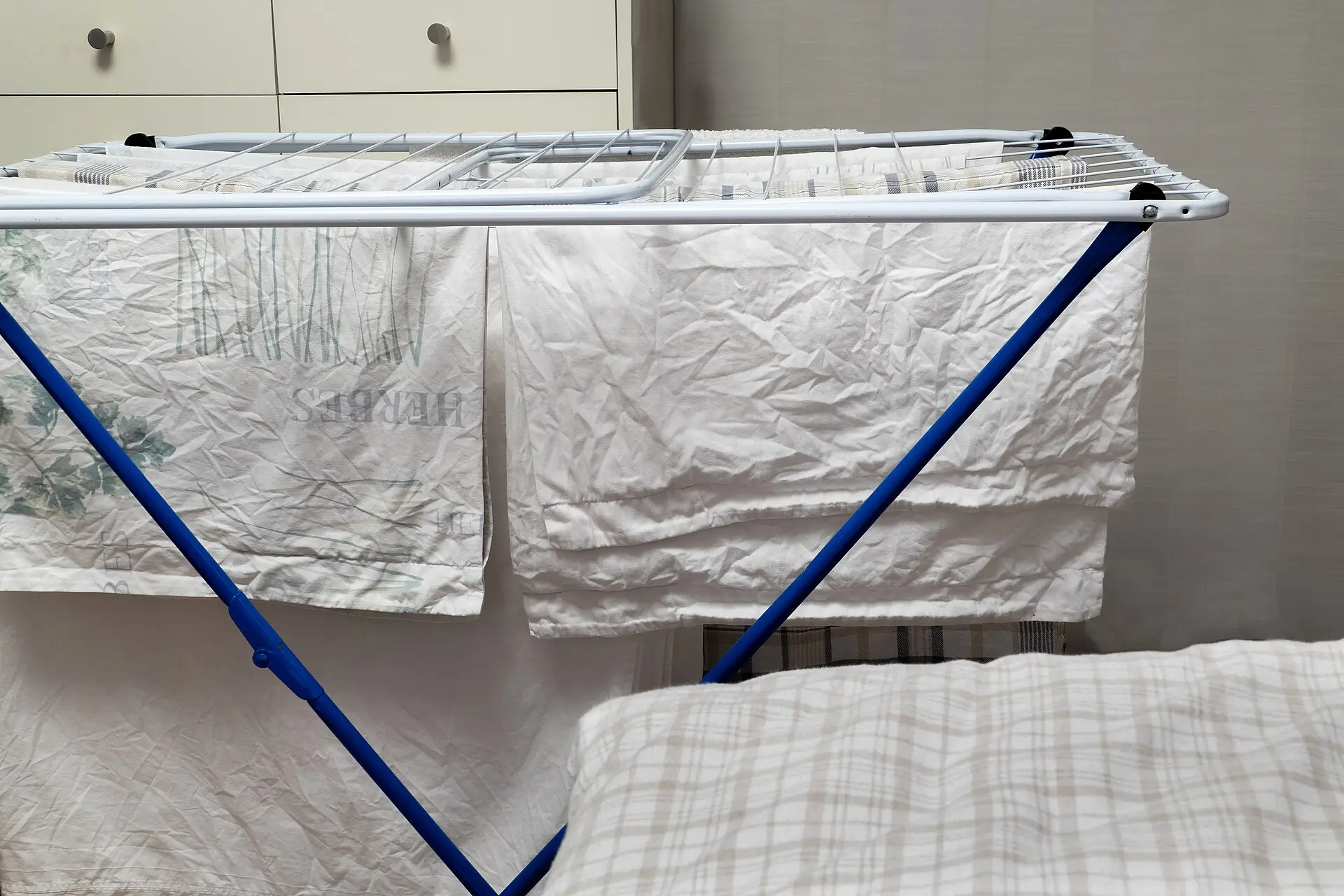
A clothes dryer is one of the bigger single loads in many US homes, and an indoor drying rack is one of the few fixes that costs less than a tank of gas and needs no tools. The catch: indoor air-drying is a habit change, it adds moisture to your house, and it only saves money on loads you genuinely move off the dryer. Estimate what your dryer actually costs before you buy. Then pick a rack that fits your loads and floor space, and track humidity with a hygrometer instead of guessing.
You save on skipped loads, not on owning a rack
A rack in the closet saves nothing. What saves money is the number of electric dryer loads you replace each month, multiplied by what each of those loads costs. Three things decide whether this is worth your effort:
- Dryer type. A standard electric resistance dryer is where air-drying pays best. A gas dryer still uses some electricity for the drum and controls, but most of its drying energy is gas — the dollar case is smaller. A heat pump dryer is already efficient, so skipped loads save less.
- How many loads move. Households that move towels and jeans (the long, hot cycles) to a rack see more effect than those that move a few shirts. Be honest about what you’ll actually hang.
- What you add back. Running a dehumidifier, a space heater, or a dryer “touch-up” cycle on every rack load claws back part of the savings. A fan is cheap; a heater is not.
There are side benefits we will mention but not monetize: less shrinkage and fading on clothes you care about, fewer lint-trap cleanings, and less wear on elastic. Those are real; they are not on your utility bill.
Check your home before you buy
Do this before you buy. It takes one laundry day.
- Check the dryer type and nameplate. Look inside the door or on the back for the rating label. Electric dryers list volts (usually 240 V) and watts or amps. Note it. Gas dryers list BTU input and a small electric rating.
- Find your rate. Read your bill for the all-in price per kWh (energy plus delivery). If you’re on time-of-use, note peak vs off-peak — drying at night may already be cheaper.
- Measure if you can. A plug-in watt meter like a Kill-A-Watt only fits 120 V plugs, so it won’t read a standard electric dryer. A circuit-level monitor such as Emporia Vue or Sense can show the dryer circuit’s kWh per load. No monitor? Many utilities show hourly or 15-minute usage online; run the dryer alone during a quiet hour and read the bump.
- Estimate if you can’t measure. Nameplate watts ÷ 1,000 × cycle hours × rate gives a ceiling. The heater cycles on and off and the auto-dry sensor ends early, so the real number is usually lower. Treat the estimate as an upper bound.
- Count your loads. Tally a normal week: how many dryer loads, and which ones (towels, jeans, mixed, delicates). Long heavy loads are the ones worth moving.
- Do the math honestly. Monthly opportunity ≈ cost per load × loads per week you’ll realistically hang × ~4.3. Subtract anything you’ll add back (fan is negligible; dehumidifier or space heater is not). If the result is a few dollars a month, a cheap compact rack is right-sized. If it’s meaningful, a full-size gullwing plus clip hangers pays back faster.
Example math only (not a promise): if your measured dryer use were 3 kWh per load at $0.17/kWh, that’s about $0.51 per load. Moving 4 loads a week would be roughly $0.51 × 4 × 4.3 ≈ $8.80 a month. Your numbers will differ — plug in your own.
Already machine-drying long cycles? A clogged vent stretches every load. Clean it per our dryer vent guide so the loads you keep in the dryer cost less too.
Product types at a glance
| Type | Best for | Watch-outs |
|---|---|---|
| Gullwing / wing rack | Full mixed loads, towels, families | Big open footprint (roughly a loveseat’s width when open); needs a spot you can leave it overnight |
| Tripod / rotating-arm rack | Shirts and dresses on hangers, small apartments | Holds fewer heavy items; tips if loaded one-sided |
| Compact accordion rack | A few items, starter test, dorms | Lower capacity; long items touch the floor |
| Clip hanger (octopus) | Socks, underwear, baby clothes, washcloths | Light items only; hang from a rod or shower bar |
| Flat mesh sweater rack | Wool and knit sweaters that stretch on hangers | Slower; one or two items per tier |
| Retractable clothesline | Laundry room, garage, or bathroom with two walls to anchor | Needs wall anchors into studs; sag under heavy loads |
What to do first
Do these first
- Electric resistance dryer + several loads a week — this is the core case. Move the long hot loads first (towels, jeans, sweatshirts) if you have the space and patience, or start with mixed lights that dry fast.
- Dry heated house in winter — indoor drying adds humidity that many homes lack in January. Check with a hygrometer; if you’re under ~35% RH, rack drying can be a comfort bonus. See our humidifier guide for safe indoor RH ranges.
- Clothes you already avoid machine-drying — delicates, activewear, and knits. A rack makes the habit easier even when the bill effect is small.
- Time-of-use rates with peak evenings — hang the loads you’d otherwise dry at peak.
These can wait
- Gas dryer with cheap gas — the dollar case is smaller; buy a rack for fabric care, not bill math.
- Heat pump dryer — already efficient; savings per skipped load are modest.
- Damp basement or humid climate already above ~55–60% RH — you’ll fight musty laundry and may need a dehumidifier that cancels the savings. Dry outdoors in season or keep machine-drying.
- No space to leave a rack open overnight — a rack you won’t set up becomes clutter. A tripod or clip hanger over the tub may be your ceiling.
What not to do
- Do not dry clothes on, over, or close to a space heater, electric baseboard heater, wood stove, or furnace burner. Fabric near heating elements is a fire hazard. Keep the manufacturer’s clearances; use a fan, not a heater, to speed drying.
- Do not block furnace or water heater combustion air, return grilles, or closet louvers with a rack or a wall of damp laundry.
- Do not dry big loads in a small closed bedroom overnight — humidity climbs fast and condensation on cold windows can follow.
- Do not ignore musty smells or sweating windows. That’s your signal the room is too humid, not that you need fabric spray.
- Do not anchor a retractable line into drywall alone for heavy loads — use studs or proper anchors rated for the pull.
- Do not buy a rack sized for your fantasy laundry habit. Start with one rack; add a second only after a month of using the first.
Which one should you buy?
- Do you have an electric resistance dryer?
- No (gas or heat pump) → a rack is mostly for fabric care. Buy a compact rack or clip hanger, not a big setup. Skip to step 5 if delicates are your main goal.
- Yes → continue.
- How many loads a week will you realistically hang?
- 0–1 → compact accordion rack or a clip hanger is enough to test the habit.
- 2–4 → one full-size gullwing rack, or a tripod if most items go on hangers.
- 5+ → gullwing plus a tripod or clip hangers; consider a retractable line in the laundry room.
- How much floor space can stay open overnight?
- Small (a corner) → tripod/rotating-arm rack.
- A clear spot about the size of a loveseat → gullwing.
- Neither → clip hangers on the shower rod and a few shirts on hangers on a door rod.
- What’s your drying room’s humidity? Put a hygrometer in it for a few days.
- Winter dry (under ~40% RH) → go ahead; expect faster drying.
- Mid (40–55%) → fine with a fan and sensible spacing.
- Humid (55%+) → dry fewer items, move to a bigger room, open doors, run the bath fan — or skip indoor drying for heavy loads.
- Do you hand-wash sweaters or knits? Add a flat mesh rack; hanging stretches them.
- Still unsure? Start with the compact rack and a hygrometer, track loads moved for a month, then size up.
Size / capacity notes (verify before checkout)
| Item | What to check | Why it matters |
|---|---|---|
| Open footprint | Length × depth with wings open | Gullwings can be roughly 4–5 feet wide open; measure the spot |
| Capacity rating | Listed weight limit (often ~30–50 lb) | Wet towels are heavy; overloaded racks sag or fold |
| Hanging length | Height of the top rail and wing ends | Long pants and sheets drag on short racks |
| Folded thickness | How flat it stores | Decides whether it fits beside the washer |
| Material | Powder-coated or stainless steel vs plain steel | Rust spots transfer to clothes |
| Feet | Non-slip caps | Hard floors and laundry rooms get wet |
| Hygrometer | Reads RH ±a few percent | You need trend, not lab accuracy |
Our picks
We earn a commission if you buy through these Amazon links, at no extra cost to you. Check size and fit on the listing before you order.
Best full-load rackHoney-Can-Do Heavy-Duty Gullwing (50 lb)
The gullwing style holds the most flat-hung laundry for its footprint, folds flat between loads, and this model is a long-running, heavily reviewed 50 lb–rated pick. It’s the rack to buy if you’re moving real towel and jean loads off an electric dryer.
- Honey-Can-Do Heavy-Duty Gullwing Clothes Drying Rack, 50 lb, white Check price on Amazon
Best budget starterAmazon Basics Foldable Drying Rack
A simple, inexpensive collapsible rack (about 29.5″ wide) with a very large review base. Good for testing the habit with a few loads a week before you commit floor space to a gullwing.
- Amazon Basics Foldable Portable Metal Clothes Drying Rack Check price on Amazon
Best oversized collapsibleHoney-Can-Do Oversized Collapsible Rack (35″, 50 lb)
A wider accordion-style rack with a 50 lb rating — more rail length than a compact rack without the gullwing’s open wingspan. A middle ground for apartments that still dry full loads.
- Honey-Can-Do Oversized Collapsible Clothes Drying Rack, 35″, 50 lb, grey Check price on Amazon
Best for hangers / small floorsHoney-Can-Do 64″ Tripod Rack
Three rotating arms hold shirts and dresses on hangers — they dry with fewer wrinkles and go straight into the closet. Small floor footprint for apartments.
- Honey-Can-Do 64-Inch Steel Tripod Clothes Drying Rack with 3 rotatable arms Check price on Amazon
Alternate tripod: SONGMICS 61.6″ rack with three rotatable arms — a lower-cost take on the same idea Check price on Amazon
Best for socks and small itemsToplife clip hangers (set of 4)
Socks and underwear eat rack space. Clip hangers hang from a shower rod, closet rod, or the top rail of a tripod and keep small items off the main rack.
- Toplife Clothes Hanger with 10 Clips, set of 4 Check price on Amazon
Best for sweatersSTORAGE MANIAC stackable mesh drying rack
Knits stretch on hangers and rails. A flat mesh rack lets sweaters dry in shape; stackable tiers save floor space.
- STORAGE MANIAC Sweater Drying Rack, stackable mesh lay-flat dryer Check price on Amazon
Must-have helperTempPro TP50 hygrometer
The difference between “free humidity in a dry winter house” and “musty laundry and sweating windows” is a number you can read. A cheap hygrometer in the drying room tells you when to open the door or dry fewer items.
- TempPro TP50 Digital Hygrometer Indoor Thermometer Check price on Amazon
Optional, for loads you still machine-drySmart Sheep wool dryer balls
Wool dryer balls separate items in the drum and can help airflow on bulky loads. Manufacturers claim shorter drying times; we haven’t measured that and don’t promise it. Their honest job here is replacing single-use dryer sheets on the loads you still run. Pair with a clean vent and the dryer’s auto-dry (moisture sensor) setting instead of timed cycles.
- Smart Sheep Wool Dryer Balls, 6-pack XL Check price on Amazon
Optional for laundry rooms with two solid walls: a retractable line (anchor into studs) adds rail length without floor space Check price on Amazon
What we left out
- Heated / electric drying racks — they use electricity to do what room air does for free; a fan is cheaper to run. They can make sense for very small spaces, but they’re not a bill-cut buy.
- Space-heater-plus-rack hacks — fire risk; see the “What not to do” list.
- Dehumidifier as a default add-on — only buy one if your hygrometer proves the room stays humid, and remember it uses power.
- Invented ASINs or “save $X per year” claims.
Troubleshooting
| Symptom | Likely cause | Fix |
|---|---|---|
| Laundry smells musty | Room too humid, items packed tight, or drying took too long | Check RH; space items out; add a fan; open the door or run the bath fan; dry fewer heavy items at once |
| Towels feel stiff | No tumbling, hard water, or too much detergent | Use less detergent; shake towels hard before hanging; a 5–10 minute no-heat or air-fluff tumble after rack drying softens them |
| Takes all day to dry | Low spin, cool room, still air | Use the washer’s highest safe spin; move rack to a warmer room (not next to a heater); add a fan |
| Windows fog in the drying room | Humidity climbing, cold glass | Move rack to a larger room; crack the door; run exhaust fan; see window insulation kits for cold-glass condensation |
| Rack sags or folds | Over the weight limit with wet towels | Split the load; hang heavy items on the lower, center rails |
| Rust marks on clothes | Chipped coating on rails | Replace the rack or wrap the damaged rail; choose powder-coated or stainless |
| Rack tips over | Tripod loaded on one side | Balance arms; put heavier items low and opposite |
| Shirts wrinkle badly | Folded over rails | Hang on hangers from a tripod or door rod; shake and smooth while wet |
What this won’t fix
- It won’t help on loads you still machine-dry. For those, clean the dryer vent, clean the lint screen every load, and use auto-dry instead of timed cycles.
- It won’t beat a humid climate. If your house already runs damp, indoor drying can make comfort and mold risk worse.
- It adds time and space. That’s the trade. If a rack goes unused, the savings are zero.
- Gas and heat pump dryers cut the dollar case. Still useful for fabric care.
- No universal number. Rates, dryer age, load habits, and climate vary too much for honest “you’ll save $X” claims.
After you set it up
- Dryer type and nameplate noted; rate per kWh written down
- Cost per load measured (monitor or utility interval data) or estimated as a ceiling
- One rack chosen for real weekly loads and open floor space
- Hygrometer in the drying room; RH checked during the first few loads
- Rack placed away from space heaters, baseboards, and combustion air openings
- Clip hangers for socks and small items so the main rack holds big ones
- Dryer vent cleaned for the loads that still go in the machine
Habits that help
- Spin harder. Use your washer’s highest safe spin; less water in means faster drying out.
- Hang right away. Wet laundry sitting in the drum gets musty and wrinkly.
- Space it out. Air needs to move between items; a fan beats a crowded rack.
- Split loads. Rack-dry the quick stuff, machine-dry only what you must, ideally off-peak.
- Watch the hygrometer. Treat the number, not your nose, as the signal to change rooms.
FAQ
Does air-drying clothes on a rack actually lower my electric bill?
It can, if you have an electric resistance dryer and you replace real dryer loads with rack loads. A standard electric dryer heats with a large 240 V element (nameplates commonly list several thousand watts), so every load you skip avoids that runtime. We do not guarantee a dollar figure: the impact depends on how many loads you move to the rack, your dryer type (electric vs gas vs heat pump), how long your cycles run, your rate per kWh, and whether you end up running a dehumidifier or space heater to compensate. Estimate your own number with the math in this guide before buying anything.
How do I find out how much my dryer costs per load?
Most electric dryers are 240 V, so a standard plug-in watt meter like a Kill-A-Watt will not fit. Use a circuit-level home energy monitor (Emporia Vue or Sense class) if you have one, read your utility’s hourly/interval data on a day you run only the dryer, or estimate: nameplate watts × hours the heater actually runs × your rate. Heaters cycle, so nameplate × full cycle time overstates cost; treat it as a ceiling, not a measurement.
Will drying clothes indoors cause mold or condensation?
It adds moisture to the room — a wet load releases a lot of water as it dries. In a dry heated house in winter that can be a comfort plus. In a small closed room, a damp basement, or a tight house that already runs humid, it can push relative humidity high enough to fog windows and feed mold. Put a cheap hygrometer in the drying room; if it climbs and stays above roughly 60% RH or windows sweat, open the door, run the bath fan, move the rack to a larger space, or dry fewer items at once.
Gullwing vs tripod vs compact accordion rack — which drying rack should I buy?
Gullwing (wing-style) racks hold the most flat-hung laundry for their footprint and fold flat — best for families moving full loads off the dryer. Tripod/rotating-arm racks put shirts on hangers and take little floor space — best for work shirts, dresses, and apartments. Compact accordion racks are cheap and good for a few items or a starter test. Flat mesh sweater racks are for knits that stretch when hung. Many households end up with one main rack plus clip hangers for socks and underwear.
Is it safe to put a drying rack next to a space heater, baseboard heater, or radiator?
Do not drape clothes on or near a space heater or electric baseboard heater — fabric too close to heating elements is a fire risk, and manufacturers specify clearances. Keep racks well back from heaters, furnace closets, and anything with a flame. Warm air nearby helps drying, but contact or blocked airflow is not worth it. A box or ceiling fan pointed at the rack is the safer way to speed things up.
How long does laundry take to dry on an indoor rack?
It varies with fabric, spin speed, room temperature, humidity, and airflow. Thin synthetics and cotton tees can be dry in several hours in a warm dry room; heavy towels, jeans, and hoodies may need overnight or most of a day, longer in a cool humid basement. Use the washer’s highest safe spin, leave space between items, flip thick pieces halfway, and add a fan. If loads routinely smell musty, the room is too humid or the items are packed too tightly.
Related reading
- Dryer vent cleaning kits — shorter cycles and lower fire risk for loads you still machine-dry
- Emporia Vue vs Sense — measure the 240 V dryer circuit instead of guessing
- Kill-A-Watt plug-in meter — measure 120 V laundry-room loads (not the dryer itself)
- Furnace humidifier water panels — safe winter indoor humidity ranges
- Oil-filled space heaters — zone heating, with clearance rules that apply to laundry too
- Heat pump water heaters vs standard — the other big laundry-adjacent load
- Smart plugs for vampire power — small always-on loads around the house
- Lower your electric bill: priority checklist — this-month order of operations
- Start Here — full suggested reading order
Bottom line
If you have an electric resistance dryer, an indoor drying rack is one of the cheapest bill-cut buys available — but only for loads you actually move off the machine. Measure or estimate cost per load → count loads you’ll realistically hang → pick gullwing, tripod, or compact by load size and floor space → put a hygrometer in the drying room → keep racks away from heaters. Gas and heat pump dryer owners should buy for fabric care, not bill math. Keep the loads you still machine-dry efficient with a clean vent. Amazon links may earn a commission as an Associate (disclosure). Return to Start Here or the priority checklist for order of operations.
Some links on this page go to Amazon, and we earn a commission if you buy, at no extra cost to you. Prices and savings vary by home and utility rate. More in our disclosure.