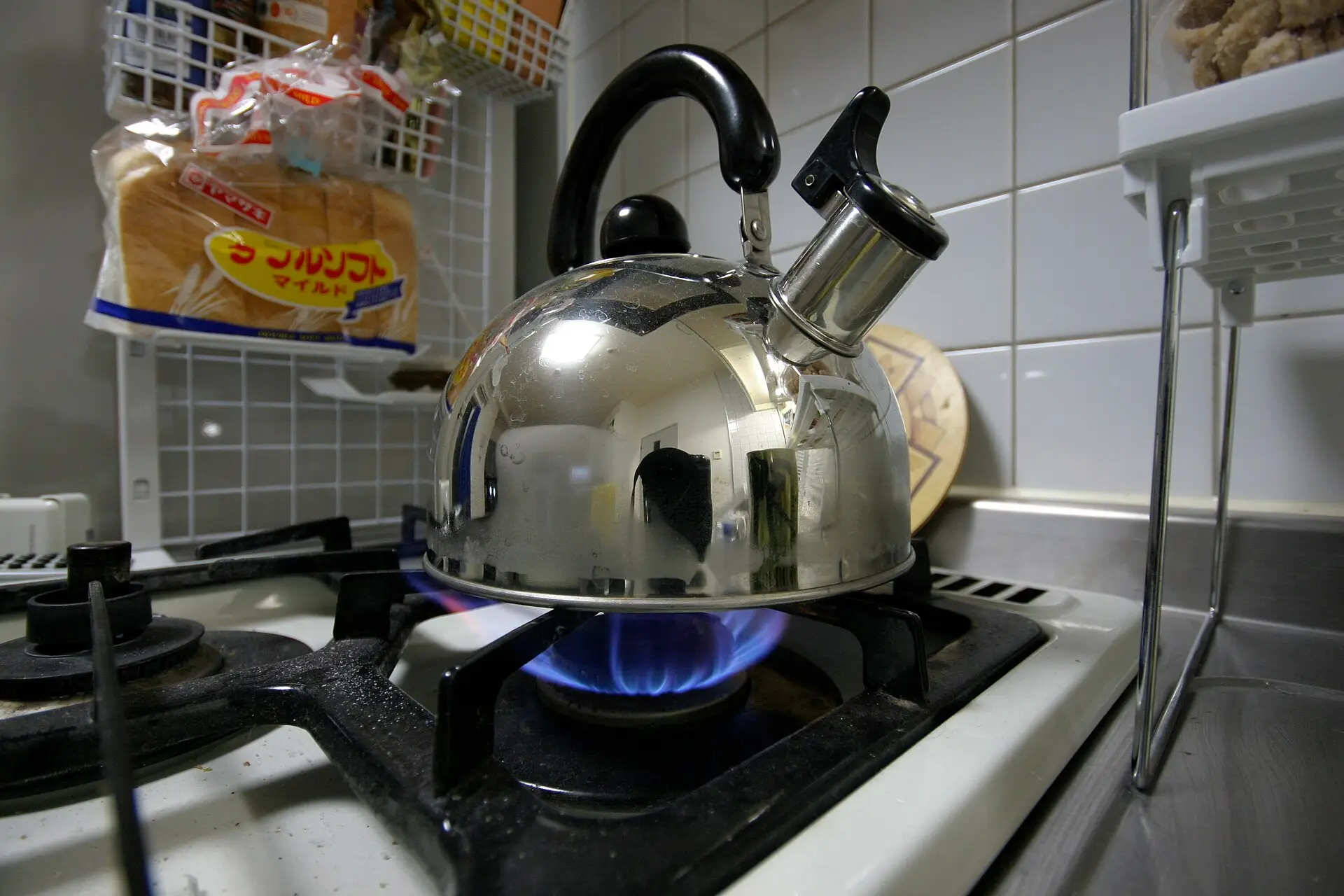
Boiling water is one of the most repeated energy jobs in a kitchen: morning coffee, a few cups of tea, oatmeal, instant noodles, a head start on pasta. Each boil costs pennies, so it’s easy to ignore, and it’s also easy to get wrong in the same way every day. The device you use matters less than people think. The biggest difference usually comes from how much water you heat versus how much you pour. Below is what water actually needs, what each method costs at three common electric rates, four example households, and when a new kettle is worth the counter space.
The short version
- A corded electric kettle is usually the cheapest electric way to boil water, about 2 cents a liter at $0.17/kWh.
- Induction is close behind. Coil and smooth-top burners and microwaves trail by a fraction of a cent to about a cent and a half per liter.
- A gas burner wastes more heat but is often a bit cheaper per liter anyway, because gas costs less per unit of heat.
- Overfilling costs more than device choice. Boiling a full kettle for one mug uses three to four times the energy you needed.
- Most households spend roughly $8–30 a year boiling water. A shared office kettle can run closer to $100.
- A new kettle rarely pays for itself on energy alone. Buy one for speed and auto shut-off, not for the bill.
How much energy water actually needs
Heating water takes a fixed amount of energy no matter what device you use: about 1 BTU per pound per °F, or roughly 0.00116 kWh per liter per °C.
- Tap water around 60°F (15.5°C) to a boil at 212°F (100°C) is about an 85°C rise.
- One 12 oz mug (~0.35 L) needs about 0.035 kWh in theory.
- One liter needs about 0.1 kWh.
- A full 1.7 L kettle needs about 0.17 kWh.
No device beats that floor. Everything above it is loss: heat escaping around the pot, heating the burner or kettle body itself, the microwave’s power conversion, and water you boiled but didn’t use. Water straight from the fridge or a cold winter tap takes a little more; water left in the kettle from an hour ago takes a little less.
What a mug, a liter, and a full kettle cost
Example math for a typical 1,500 W corded kettle running about 75–85% efficient. Your kettle can land outside these ranges; a plug-in meter tells you for sure.
| How much you boil | ~kWh in a kettle | At $0.12/kWh | At $0.17/kWh | At $0.30/kWh | ~Time at 1,500 W |
|---|---|---|---|---|---|
| One 12 oz mug (kettle with a low minimum fill) | ~0.04–0.05 | ~0.5¢ | ~0.8¢ | ~1.4¢ | ~1.5–2 min |
| Typical minimum fill (~0.5 L) | ~0.06 | ~0.7¢ | ~1¢ | ~1.8¢ | ~2.5 min |
| 1 liter (a French press or two big mugs) | ~0.12–0.13 | ~1.5¢ | ~2¢ | ~3.8¢ | ~4–5 min |
| Full 1.7 L kettle | ~0.2–0.21 | ~2.5¢ | ~3.5¢ | ~6¢ | ~7–9 min |
To find your real rate, divide your electric bill total by the kWh you used, including delivery charges and fees. The advertised supply rate is usually lower than what you actually pay.
Kettle, induction, coil, microwave, or gas
Efficiencies below are rough, commonly cited ranges for boiling water. Pot shape, a lid, and wattage move them, so treat this as a way to rank options rather than a promise.
| Method | Rough efficiency boiling water | ~kWh per liter | At $0.12/kWh | At $0.17/kWh | At $0.30/kWh |
|---|---|---|---|---|---|
| Corded electric kettle | ~75–85% | ~0.12–0.13 | ~1.5¢ | ~2¢ | ~3.6–3.9¢ |
| Induction cooktop (lid on, matched pot) | ~75–85% | ~0.12–0.13 | ~1.5¢ | ~2¢ | ~3.6–3.9¢ |
| Electric coil or radiant smooth-top (lid on) | ~60–75% | ~0.13–0.17 | ~1.6–2¢ | ~2.2–2.9¢ | ~3.9–5.1¢ |
| Microwave (mug or bowl) | ~50–65% | ~0.15–0.2 | ~1.8–2.4¢ | ~2.6–3.4¢ | ~4.5–6¢ |
Gas, per liter, for comparison:
| Gas method | Rough efficiency | Gas used per liter | At $1.00/therm | At $1.50/therm | At $2.00/therm |
|---|---|---|---|---|---|
| Pot or stovetop kettle on a gas burner, lid on | ~30–40% | ~0.008–0.011 therm (~840–1,120 BTU) | ~0.8–1.1¢ | ~1.3–1.7¢ | ~1.7–2.2¢ |
Read these honestly: the spread between the best and worst electric method is about a cent per liter. If you boil 2 liters a day, switching from a coil burner to a kettle saves roughly $2–4 a year at $0.17/kWh. Gas looks wasteful on paper, but at typical prices it’s competitive or slightly cheaper. Use your own price per kWh and per therm before you decide anything.
Keep-warm, reboils, and overfilling
These three habits cost more than the choice of appliance.
Overfilling. A full 1.7 L kettle uses about 0.2 kWh. One mug’s worth uses about 0.05. If you fill to the top three times a day for three mugs, that’s about 0.6 kWh a day, or roughly $37 a year at $0.17/kWh. Filling to what you’ll pour (respecting the minimum line) brings it to about 0.15–0.18 kWh a day, around $10–11 a year. That one change is worth more than any kettle upgrade.
Reboiling. A kettle that has cooled to around 140°F still needs about half the energy of a fresh boil to come back up, roughly 0.1 kWh for a full kettle. Boil, walk away, forget, reboil: that habit quietly doubles what some people spend.
Keep-warm. Many kettles with a hold feature cycle the element to keep water near your chosen temperature, very roughly 30–80 W on average depending on the model and how full it is. An hour a day is about 0.03–0.08 kWh, or $2–5 a year at $0.17/kWh. Not a lot, but it’s money spent on water you often pour down the sink. A vacuum flask holds hot water for hours with no electricity at all.
Four example households (illustrative)
All four use the per-liter ranges above and 365 days a year unless noted. Swap in your own rate and habits.
1. The tea drinker
One person, four cups of tea a day, $0.17/kWh. Right now the kettle gets filled about halfway (~0.85 L) for each cup.
- Now: ~0.11 kWh × 4 = ~0.44 kWh a day, ~160 kWh a year, about $27 a year.
- Fill to the minimum line for each cup: ~0.06 kWh × 4 = ~0.24 kWh a day, about $15 a year.
- Boil 1 liter once in the morning and keep it in a flask for the later cups: ~0.125 kWh a day, about $8 a year.
- Saves roughly $12–19 a year at $0.17/kWh, or about $22–35 at $0.30/kWh, with nothing to buy.
2. The pasta-water starter
Family of four, electric coil range, $0.17/kWh. A liter for the French press every morning, plus 4 liters of pasta water three nights a week.
- All on the coil burner: coffee ~0.15 kWh × 365 = ~55 kWh, pasta ~0.6 kWh × 156 = ~94 kWh. About 150 kWh a year, roughly $25.
- Coffee water in a kettle, plus a full kettle poured into the pasta pot while the rest heats on the burner: about 133 kWh a year, roughly $23.
- Saves about $2–3 a year. The real gain is time: dinner water boils several minutes sooner. That’s a fine reason to own a kettle, just not a money reason.
3. The office kettle
Ten people sharing one kettle, about 15 boils a workday, 250 workdays a year, $0.17/kWh. People tend to top it up to around 1.2 L for one mug, and it often gets reboiled after sitting.
- Now: ~0.15 kWh × 15 = ~2.25 kWh a day, ~560 kWh a year, about $95 a year.
- Fill to need (about 0.6 L on average) and boil a fresh, smaller amount instead of reboiling a full one: ~1.1 kWh a day, ~280 kWh a year, about $48 a year.
- Saves roughly $45–50 a year with a sticky note and a measuring mark on the kettle. A thermal carafe filled once in the morning helps too.
4. The gas-stove home
Gas range at $1.50/therm, electricity at $0.17/kWh. About 2 liters a day for coffee, tea, and the odd pack of noodles.
- In a stovetop kettle on gas: ~0.02 therm a day, ~7 therms a year, about $11 a year.
- In an electric kettle: ~0.25 kWh a day, ~91 kWh a year, about $15 a year.
- Gas is slightly cheaper here. At $2.00/therm it’s roughly a tie, and with cheap electricity around $0.12/kWh the kettle comes out a few dollars ahead of $2.00 gas. An electric kettle is still a reasonable buy for speed, auto shut-off, and less combustion exhaust in the kitchen, but not to save money.
Across these four, yearly boiling costs run from about $8 to $95, and the savings worth chasing come almost entirely from filling less and reboiling less. For comparison, sealing drafts or fixing a thermostat schedule is often worth far more. See the priority checklist.
Time-of-use plans and the morning coffee
Many time-of-use plans put their highest rate in the late afternoon and evening, often around 4 to 9 p.m. Some, especially winter schedules, also have a morning peak, often somewhere between 6 and 10 a.m. Check the windows on your own bill.
- At a $0.40 peak rate, a liter in a kettle is about 5 cents. Four minimum-fill cups at peak are about 10 cents a day, roughly $35 a year.
- You can’t really move your morning coffee, but you can boil once and pour the rest into a flask instead of reboiling through the peak.
- Evening noodles or pasta water at peak: the kettle is still the cheapest electric option, and filling to need matters more than timing.
- Boiling water isn’t a big enough load to justify planning your day around a rate schedule. Shift the dryer, dishwasher, or EV charging first.
What to do first
- Find your real rate. Electric bill total ÷ kWh used, and gas bill total ÷ therms if you cook with gas.
- Meter the kettle. Plug the kettle base into a Kill A Watt, reset it, boil exactly 1 liter from a measuring cup, and read the kWh. Then try one mug and a full kettle.
- Meter the microwave the same way: one mug, the time you normally use.
- Estimate the stovetop. Most ranges are 240 V or hardwired, so a plug meter won’t fit. Use your utility’s hourly smart-meter data at a quiet hour, or a circuit monitor like Emporia or Sense. Or just compare times: a burner that takes twice as long as a kettle at similar wattage is losing more heat.
- Count your boils for a week. Note how much you boil versus how much you actually pour. That ratio is usually the biggest number on this page.
Easy habits that beat buying anything
- Boil only what you’ll pour. Use the kettle’s fill marks or pour your mug into it first. Respect the minimum line, but don’t fill to max for one cup.
- Put the lid on. On the stove, a lid cuts boil time noticeably. A kettle’s lid needs to be closed or it may not shut off on its own.
- Match the pot to the burner. A small pot on a big coil wastes heat around the edges; a big pot on a small burner takes forever.
- Turn off keep-warm unless you’ll pour again soon. Use a flask for later.
- Descale in hard-water areas. Scale insulates the element and slows boils.
- Give pasta a head start: boil part of the water in the kettle while the pot heats on the burner.
- Start with cold tap water. Water from the hot tap already cost energy at your water heater, and you waste more running the pipe until it’s hot.
What not to do
- Don’t fill the kettle to the top for one mug out of habit.
- Don’t reboil a full kettle because it cooled down while you got distracted. Boil a fresh small amount instead.
- Don’t buy a new kettle to save a few dollars a year if the one you have works.
- Don’t buy a temperature-control kettle expecting a lower bill. Buy it for the tea.
- Don’t microwave water in a sealed container, and don’t take a very hot mug of plain water straight out without letting it rest.
- Don’t plug a kettle into an extension cord or power strip, and don’t run it at the same time as a toaster or air fryer on the same circuit.
- Don’t leave a gas burner on unattended.
Descaling, hard water, and temperature control
Hard water leaves calcium and magnesium scale on the element and the bottom of the kettle. A thin film barely changes anything. A thick, crusty layer slows boils, makes the kettle louder, and sheds flakes into your cup.
- Descale every month or two in hard-water areas, or whenever you see a white crust. Many manuals suggest filling with equal parts white vinegar and water, or water with citric acid, bringing it to a boil, letting it sit, then rinsing. Follow your kettle’s manual.
- Boil and pour out one batch of fresh water afterward to clear any vinegar taste.
- Filtered water slows scale buildup. Distilled water stops it, but it’s rarely worth buying just for a kettle.
- Glass kettles show scale clearly, which makes it easier to stay on top of. Stainless hides it.
On temperature control: heating water to 175°F for green tea instead of 212°F skips about a quarter of the heating, around half a cent per liter at $0.17/kWh. A 195–205°F setting for pour-over coffee saves even less. Variable temperature is a taste feature. It’s a good one if you drink a lot of tea, but it won’t show up on your bill, and a kettle that holds that temperature for an hour can use more than it saves.
Outlets, cords, and circuits
- Most US electric kettles are about 1,500 W, which is roughly 12.5 amps at 120 V. That’s a big load for a few minutes.
- Plug the base directly into a wall outlet, not an extension cord or power strip. Manufacturers’ manuals say the same.
- Newer US kitchens usually have at least two 20-amp countertop circuits; older kitchens may have a single 15-amp circuit. A kettle plus a 1,200–1,500 W toaster, air fryer, or microwave on one circuit is 22–25 amps, enough to trip the breaker.
- Use GFCI-protected countertop outlets, and keep the base dry. Water on the base is a common reason a GFCI trips.
- If a plug or outlet feels warm or looks discolored, stop using it and have it checked.
- Keep the cord away from the counter edge, where a child or pet can pull a full kettle down.
When it isn’t working right
| Problem | Likely cause | What to try |
|---|---|---|
| Kettle won’t shut off, or boils on and on | Lid not fully closed, steam path blocked, kettle overfilled, worn thermostat switch | Close the lid firmly, keep the water under the max line, and check that the steam vent isn’t covered. If it still won’t switch off, stop using it and replace it. |
| Boils much more slowly than it used to | Heavy scale, very cold water, a long or thin extension cord, or a shared circuit sagging under another load | Descale, plug straight into the wall, and run it on its own. Compare against the times in the table above. |
| White flakes or a crust inside | Hard-water scale | Descale per the manual; use filtered water if it builds up fast |
| Kill A Watt shows an odd number | Reading watts instead of kWh, not reset before the boil, or the meter is on a power strip | Plug the meter straight into the wall, reset it, and switch to the kWh display. You should see about 1,400–1,500 W while it heats and close to 0 W when it clicks off. |
| Breaker or GFCI trips when the kettle starts | Another big appliance on the same circuit, water on the base, or a failing kettle | Run the kettle alone, dry the base, and try another countertop circuit. If it keeps tripping on its own, retire the kettle. |
| Clicking on and off after it boils | Keep-warm or temperature hold is on | Turn off keep-warm if you don’t need it, or pour extra water into a flask |
| Plastic or metallic taste | New kettle, or water sitting in it for days | Boil and discard a few batches when new; empty it instead of leaving water in it overnight |
Does a new kettle pay for itself?
Approximate prices from current listings; they change often. Savings are illustrative at $0.17/kWh, for about 2 liters a day.
| Purchase (approx. price) | What it replaces | Saves per year | Rough payback |
|---|---|---|---|
| Basic 1,500 W glass or stainless kettle (~$20–35) | A microwave for all your hot water | ~3–10 years | |
| Basic 1,500 W kettle (~$20–35) | An electric coil or smooth-top burner | ~$1–5 | ~5–25 years, often longer than the kettle lasts |
| Basic 1,500 W kettle (~$20–35) | An induction cooktop | About $0 | Never, on energy |
| Basic 1,500 W kettle (~$20–35) | A gas burner | Usually costs a little more | Never, on energy |
| Temperature-control kettle (~$50) | A basic kettle | Pennies, and keep-warm can erase them | Never, on energy |
| A vacuum flask you already own | Reboiling and keep-warm | ~$2–8 | Immediate |
| Kill A Watt P4400 (~$16–25) | Nothing directly | Shows your real number | Measurement tool |
At a high rate like $0.30/kWh, roughly halve these payback times. Either way, the cheapest upgrade is filling to need, which costs nothing.
Which one should you buy?
- You boil water most days and use a microwave or coil burner now: a basic 1,500 W kettle with clear fill marks and auto shut-off is the sensible pick. Get it for the speed.
- You want to see the water level and scale: a glass kettle. Glass and stainless are about equally efficient.
- You have kids, pets, or a busy counter: a stainless kettle is tougher, and auto shut-off plus boil-dry protection is a must either way.
- You drink green, white, or oolong tea, or make pour-over coffee: a temperature-control kettle is worth it for taste. Leave keep-warm off unless you’ll use it.
- You already have a working kettle, cook on induction, or rarely boil water: you don’t need anything new.
- You’re not sure what your kettle uses: start with a plug-in meter.
What actually saves energy in a kettle is easy-to-read fill marks, including small amounts, and a lid that closes properly so it switches off on time. Wattage, “rapid boil” claims, and LED lights don’t change the efficiency much.
Our picks
We re-checked these Amazon listings on 2026-10-14. Prices and availability change, so confirm on the product page. We picked widely reviewed, plain kettles with auto shut-off and boil-dry protection rather than the cheapest or the fanciest.
Glass kettles (easy to see fill level and scale):
- COSORI Electric Kettle 1.7L, borosilicate glass, 1500 W (wide opening for cleaning, no plastic touching the water) Check price on Amazon
- Mueller 1.8L Electric Kettle, borosilicate glass, 1500 W (auto shut-off, 0.5 L minimum fill) Check price on Amazon
- Amazon Basics Electric Kettle with Glass Carafe, 1.7L, 1500 W (a low-cost basic with a water-level window) Check price on Amazon
Stainless kettle (tougher on a busy counter):
- Hamilton Beach 1.7 Liter Electric Kettle 40880G, stainless steel, 1500 W (cordless base, auto shut-off) Check price on Amazon
Temperature control (for tea and pour-over coffee):
- Hamilton Beach Smart Electric Kettle 41036, 1.7L stainless, 1500 W (many temperature settings, keep warm, works with Alexa; turn keep-warm off if you don’t need it) Check price on Amazon
Measure it yourself:
- P3 Kill A Watt P4400 Electricity Usage Monitor (meter a mug, a liter, and a full kettle) Check price on Amazon
Amazon links may earn us a commission as an Amazon Associate at no extra cost to you (disclosure).
Safety rules
- Don’t microwave water in a sealed container, and be careful with plain water in a very smooth mug. Superheated water can erupt when disturbed. Let it rest or put a wooden stir stick in it first.
- Don’t run a kettle empty or fill it above the max line.
- Don’t plug a kettle into an extension cord or power strip.
- Keep cords away from counter edges where kids or pets can pull a full kettle down.
- Don’t leave a gas burner on unattended, and use the range hood.
Other kitchen costs worth a look
If you cook big batches, the slow cooker vs. Instant Pot vs. oven guide runs the same kind of math for chili and pot roast. For small meals, our air fryer and toaster oven comparison looks at the oven-preheat problem. The fridge runs all day, so the refrigerator and freezer cost guide is worth a look too. And for a number on any 120 V appliance, the Kill A Watt guide walks through measuring it.
What this won’t fix
- Boiling water is a small part of most bills. Space heating, cooling, and your water heater are usually far bigger.
- The efficiency figures are rough ranges. Pot shape, lid, starting water temperature, and wattage all move them. Your meter reading wins.
- Gas vs. electric depends on your rates. We don’t declare a winner without your bill.
Quick checklist
- Find your price per kWh (and per therm)
- Meter a liter in your kettle and a mug in your microwave
- Track boiled vs. poured water for a week
- Fill to need, lid on, keep-warm off, flask for later
- Stop reboiling full kettles
- Descale if you have hard water
- Plug the kettle straight into the wall, on its own circuit when it’s running
- Buy a kettle only if you boil water most days without one
Bottom line
An electric kettle is usually the cheapest electric way to boil water, induction is close, coil burners and microwaves trail by about a cent a liter, and gas depends on your rates. For most homes the whole job costs $8–30 a year, and filling to need saves more than any new appliance. Meter one boil, stop overfilling and reboiling, and buy a kettle with clear fill marks if you boil water daily without one. Then put your real effort into the bigger moves on Start Here. Amazon links may earn a commission as an Associate (disclosure).
Some links on this page go to Amazon, and we earn a commission if you buy, at no extra cost to you. Prices and savings vary by home and utility rate. More in our disclosure.